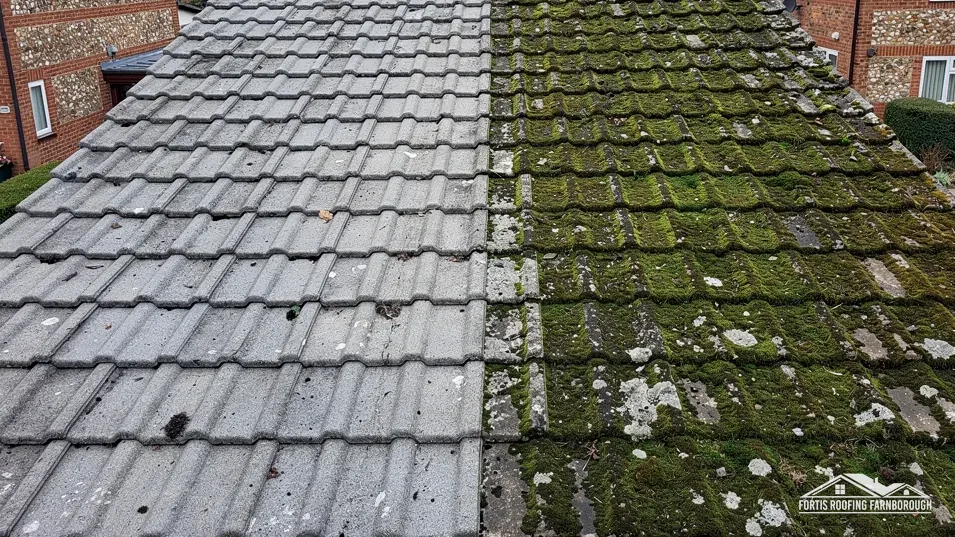
Concrete tiles
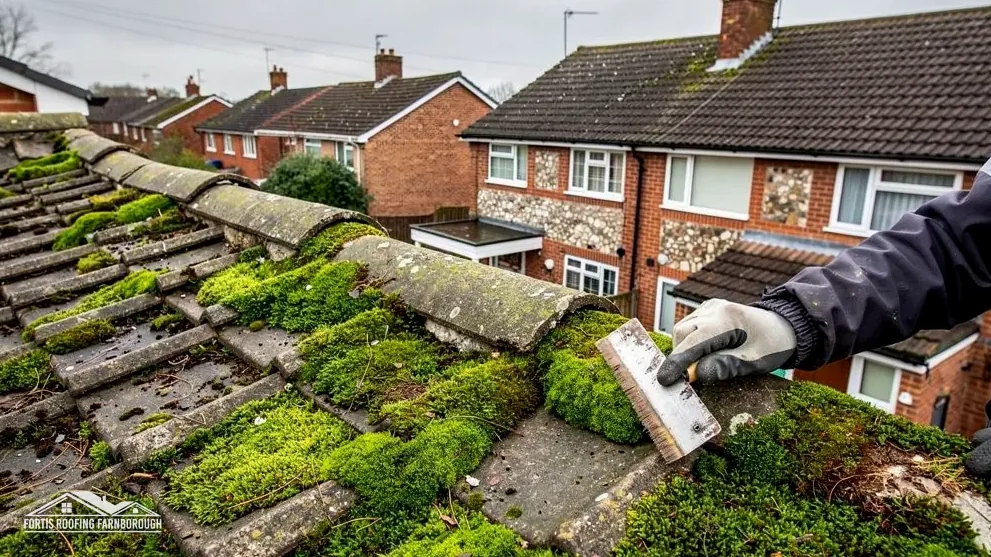
Scraped and brushed by hand so the face is not worn back.
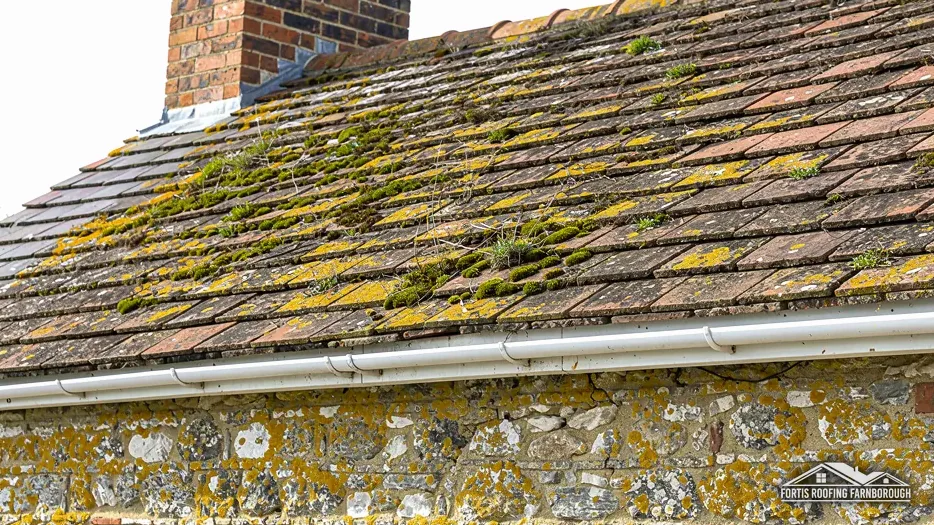
Moss lifted by hand, then the roof beneath checked
We clear the moss without blasting the tiles, empty the gutters and downpipes, and photograph anything the moss was hiding before we price a repair.

Scraped and brushed by hand so the face is not worn back.
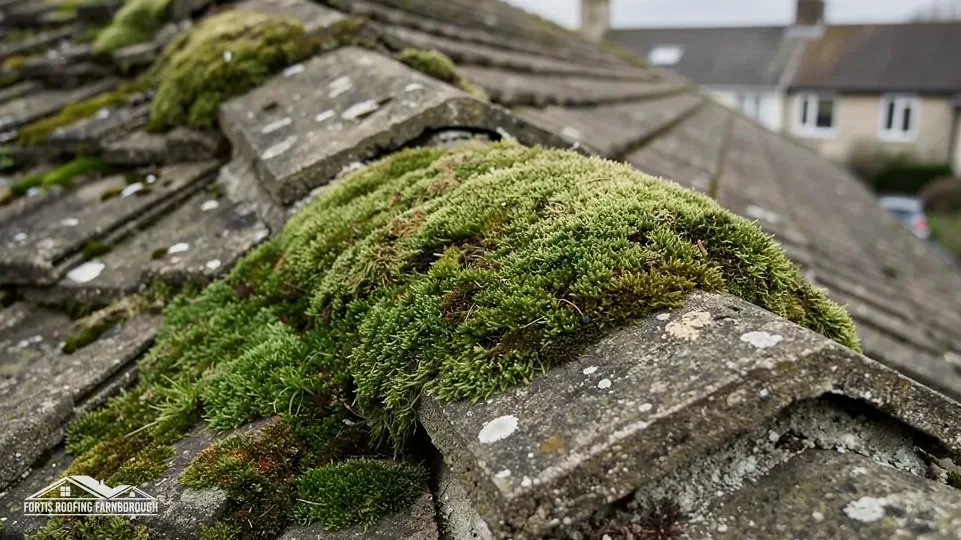
Fired clay, given 60-80 years by HomeBuilding, cleaned gently.

Moss eased from the laps without levering slates loose.
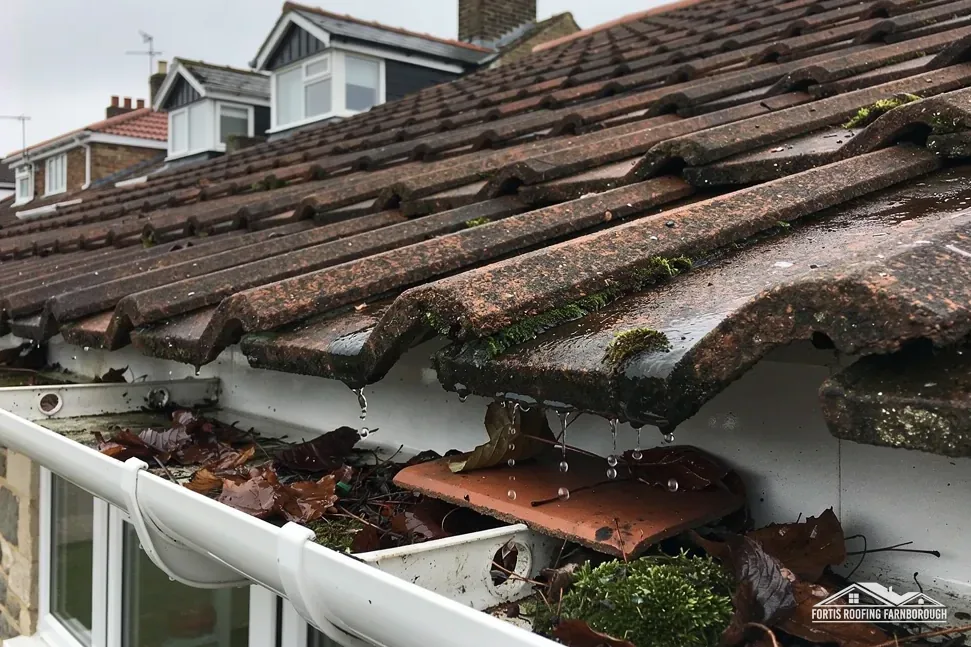 Hand moss removal
 Biocide treatment
 Gutters and downpipes cleared
 Valleys cleared
 Ridge and tile checks
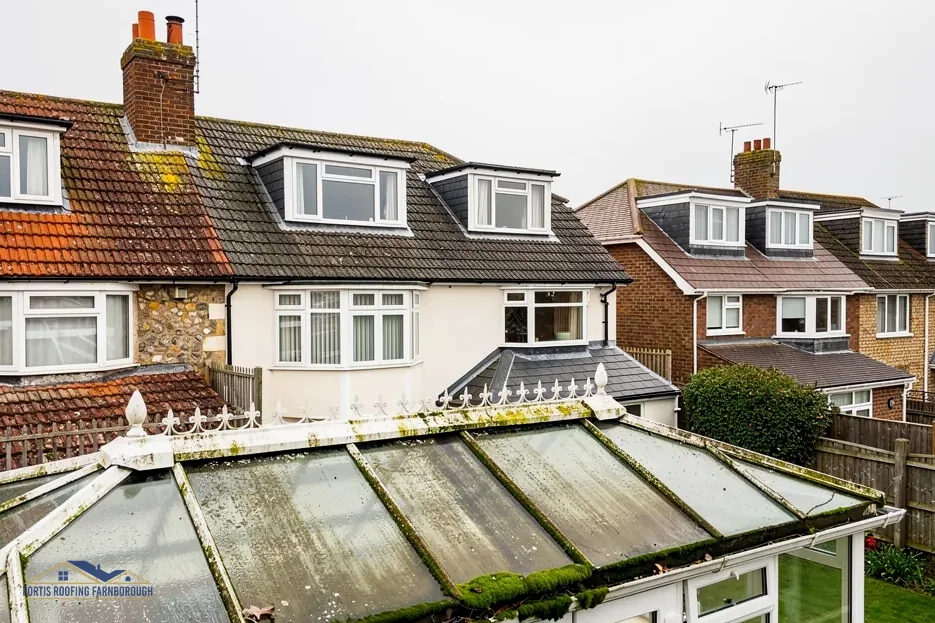 Flat roof cleaning
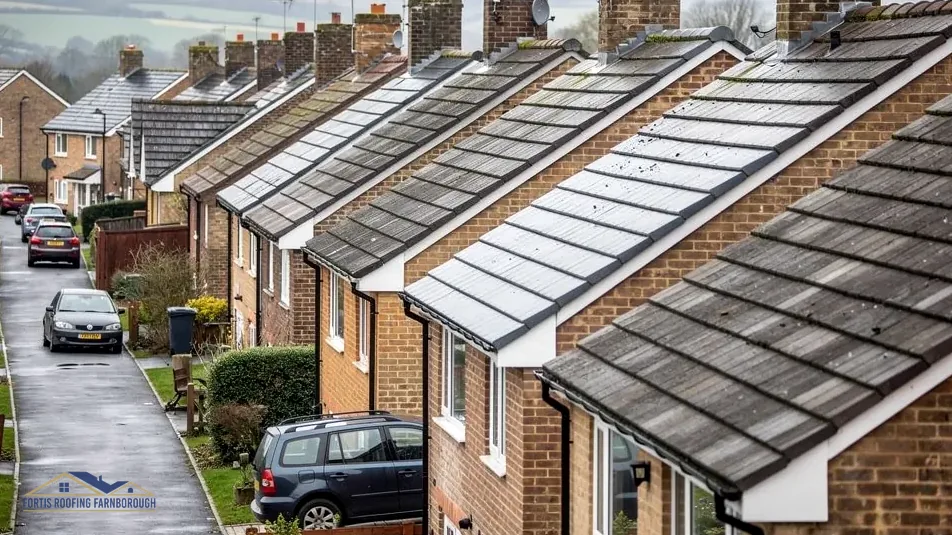
Moss sits on tiles that are still hard, whole and firmly fixed.
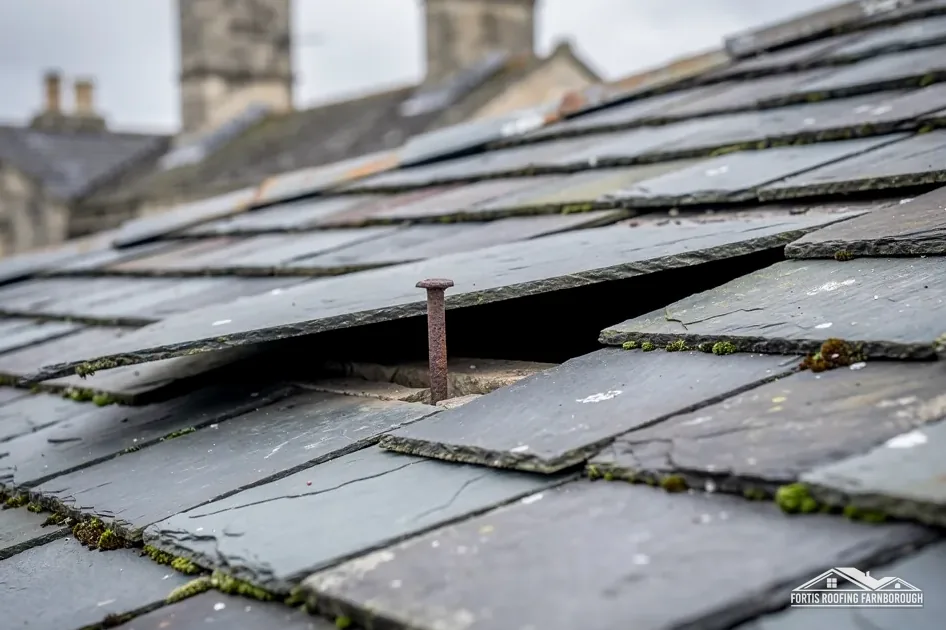
The moss was hiding slipped tiles, perished ridge mortar or a blocked valley.
The tiles underneath are soft, flaking or near the end of their life.
Roof cleaning, the figures
Local rainfall and frost, cleaning methods, tile lifespans, the biocide rules, gutter falls and the asbestos checks, each from a named source, and what they mean before anyone climbs onto your roof.
| No. | Chapter | The figure it turns on |
|---|---|---|
| 01 | Why moss settles on Farnborough roofs | 118 wet days a year |
| 02 | Hand, brush, soft wash or high pressure | Jet washing: not recommended |
| 03 | What a clean roof is protecting | Clay tile: 60-80 years |
| 04 | Biocides, the law and what runs off | BPR article 17(5) |
| 05 | Gutters, valleys and the run-off route | 1mm fall for every 600mm |
| 06 | Cement sheet roofs and what moss hides | Built before 2000: assume asbestos |
Chapter 01 of 06
The climate a roof in the Farnborough area grows moss in
Moss needs three things: a surface to hold on to, regular moisture and some shade. A roof in north-east Hampshire supplies all three. Averages for 1991 to 2020 from the Met Office climate station at South Farnborough put rainfall at about 715 mm a year, with a millimetre or more falling on around 118 days and around 53 air-frost days. Those figures do not mark the area out as unusually wet. They do mean a tiled roof stays damp for long stretches of the year, and the slopes that see least sun stay damp longest.
Moss forms soft green cushions, rooted in the grit and dust that collects along the bottom edge of each tile and in the gaps between them. It holds water like a sponge. Lichen is the flat, crusty growth in grey, yellow or orange patches, fixed tight to the tile face. Algae shows as dark streaks or a green film, often running down from the ridge or below a chimney. Each looks different from the street, and each needs a different response: moss is lifted off, lichen is usually treated and left to weaken, and algae streaks are mainly a matter of appearance.

A cushion of moss along the tail of a tile keeps the tile wet long after a shower has passed. When the temperature drops below freezing, that trapped water expands, and on an older or softer tile the surface can start to flake. Thick moss can also lift the bottom edge of a tile or slate, opening a path for wind-driven rain to reach the underlay, the sheet beneath the tiles whose job is to stop stray rain getting into the loft.
The bigger damage often happens lower down. Rain washes loose moss off the slopes and into the valleys, the inside corners where two slopes meet, and then into the gutters and downpipes. A blocked valley pushes water sideways under the tiles. A blocked gutter spills over, soaks the fascia board it is fixed to and can run back under the bottom course of tiles. The methods for clearing it are compared in the next chapter.
Trees make a difference too. A roof under overhanging branches gets more shade, more leaf litter and more debris in its gutters, and moss tends to come back there sooner after a clean. Cutting back trees is outside our trade, but we point out where overhanging growth is feeding the problem so you can decide what to do about it.
None of this means every patch of moss needs urgent work. A light green bloom on a sound roof is a cosmetic matter. What we look at is depth, where it is sitting and whether it is reaching the gutters, valleys and the laps between tiles.
Chapter 02 of 06
| Method | What it involves | Published position |
|---|---|---|
| Hand scraping and brushing | Moss lifted off with hand tools, tile by tile | No pressure on the tile surface |
| Biocide treatment | A product applied to kill remaining growth | Use within its authorisation (BPR article 17(5)) |
| High-powered jet washing (not advised) | Water at high pressure across the slope | Not recommended by Marley |
| Professional-only biocides at home | A trade product used by a homeowner | The public should never use them (HSE) |
There are four broad ways to get moss off a roof, and they do very different things to the tiles underneath. The table sets them out with the published position on each. The gentlest is the oldest: scraping the moss off by hand and brushing the loose material down the slope, a few tiles at a time, with the debris caught before it reaches the gutters.
Debris control is part of the method. Moss scraped from the slopes is bagged on the roof or swept onto sheets, not pushed over the edge onto paths, cars and flower beds. Paths and drives below are swept at the end of each day, and anything that has dropped into a downpipe is cleared before we leave.
Marley, one of the large UK tile makers, is direct about high-pressure cleaning: "The use of high powered jet washes is not recommended as it can damage the surface of the slate or tile, thus reducing its expected life considerably." A concrete tile has a surface layer that sheds water. Blast that away and the tile absorbs more water, grows moss faster and weathers sooner. Clay tiles and slate can suffer too, and pressure aimed up the slope can drive water under the laps and into the loft. We avoid it for all of those reasons.
Soft washing sits between the two: a low-pressure spray of a cleaning or biocidal product that is left to work. Its results depend almost entirely on which product is used and whether the label is followed. Our guide to soft washing and pressure washing a roof sets out why we do not use the second on tiles.
No cleaning method repairs a tile. If the moss has been holding a cracked tile together, or sitting on a ridge whose mortar has crumbled, clearing it reveals the fault rather than causing it. That is the main reason we would rather a roofer cleaned a roof than a general exterior cleaner: the person on the slope can see a slipped tile, a lifted flashing or a loose ridge and say so, with a photo, before the scaffold or ladders come down.
Access matters as much as method. A bungalow can often be cleaned from roof ladders; a two-storey house or a steep roof usually needs scaffold or a tower, and a large job may need both. Walking on a tiled roof breaks tiles if it is done carelessly, so we use crawling boards and ladders that spread the load across the slope. All of this is part of what sets the price of a clean, alongside the roof area and how deep the moss is.
Chapter 04 of 06
The rules that govern products used to kill moss and algae
A moss killer is a biocide: a product made to kill living organisms. That puts it inside a legal regime. Article 17(5) of the Biocidal Products Regulation says "Biocidal products shall be used in compliance with the terms and conditions of the authorisation". In plain terms, the label is not advice. It sets out where the product may be used, by whom, how strong and how often.
The HSE adds a line for homeowners: "Members of the general public should never use biocidal products that are only intended for professional users". Under the older pesticide controls the HSE also says "It's an offence to advertise, sell, supply, store or use a non-approved product." So a drum of trade-strength roof treatment bought online is not a shortcut for a householder, and a product sold for patios is not automatically approved for a roof.
After the moss has been lifted by hand, a biocide applied to the label can kill the spores and root fragments left on the tiles, and loosen lichen so it weakens over time instead of being scraped off. It is applied at low pressure and left to work. Rain then washes the dead growth off gradually, which is why a treated roof can look better weeks after the visit than on the day. Our guide to roof biocide treatment explains the process step by step.
A treatment is not a substitute for removal on heavy growth. Biocide on thick moss kills it where it sits, but the dead cushions still hold water and still end up in the gutters, so the bulk is lifted by hand first and the product used on what remains. On a light bloom, a treatment on its own can be enough, and the survey tells us which you have.
Whatever goes on the roof comes off it through the gutters and downpipes. Before a treatment we look at where those downpipes discharge: into a drain, a soakaway, a water butt, a flower bed or close to a garden pond. A water butt is disconnected for the day, plants below the eaves can be covered, and the product is chosen and applied within its label conditions for that setting. If you keep fish or have pets that use the garden, tell us at the survey.

Birds matter here too. Under section 1 of the Wildlife and Countryside Act 1981, the law protects a wild bird's nest while birds are building it or using it, and intentionally taking, damaging or destroying it in that period is an offence. Gutters, eaves and the gaps under ridge tiles are common nest spots, so we check before cleaning and leave an active nest alone until it is empty.
Chapter 05 of 06
| Drainage part | Published figure | Source |
|---|---|---|
| Eaves gutter run | 1mm of fall for every 600mm | Brett Martin |
| Roof drainage layout | BS EN 12056-3:2000, current | BSI Knowledge |
| Flat roof, finished | Minimum 1:80 fall | BS 6229:2025 |
| Flat roof, as designed | Designed for a 1:40 fall | IKO |
Moss removal is as much about drainage as about tiles. Everything that comes off a slope, by hand or by rain, travels the same route: down the tiles, along the valleys, into the eaves gutters and through the downpipes to the drain. The table gives the published figures for that route. Brett Martin's installation guidance gives a gutter a fall of 1mm for every 600mm, so a run only drains properly if it is clear along its length and still sitting at its fall.
A clump of moss at an outlet is enough to hold water in a gutter. In heavy rain the water spills over the front, down the wall and onto the path, or backs up over the rear edge and soaks the fascia, the board along the eaves that the gutter brackets are screwed to. Over time a wet fascia rots, the brackets loosen and the gutter drops out of its fall, which makes the next blockage worse. Inside, a damp patch near the top of an outside wall can be blamed on the roof when the cause is the gutter in front of it.
Downpipes block in the same way, usually at the bend near the top or at the shoe at the bottom. A downpipe that has been blocked for a while can overflow at its joints and stain the wall. Our guide to moss in gutters traces that damage route in detail, and our gutters, soffits and fascias service covers a gutter that needs refixing or replacing rather than clearing.
Valleys collect moss faster than any other part of a pitched roof, because two slopes drain into them. A lead or tile valley packed with moss diverts water sideways under the tiles on either side, which is a common cause of a stain spreading from an inside corner of a ceiling.
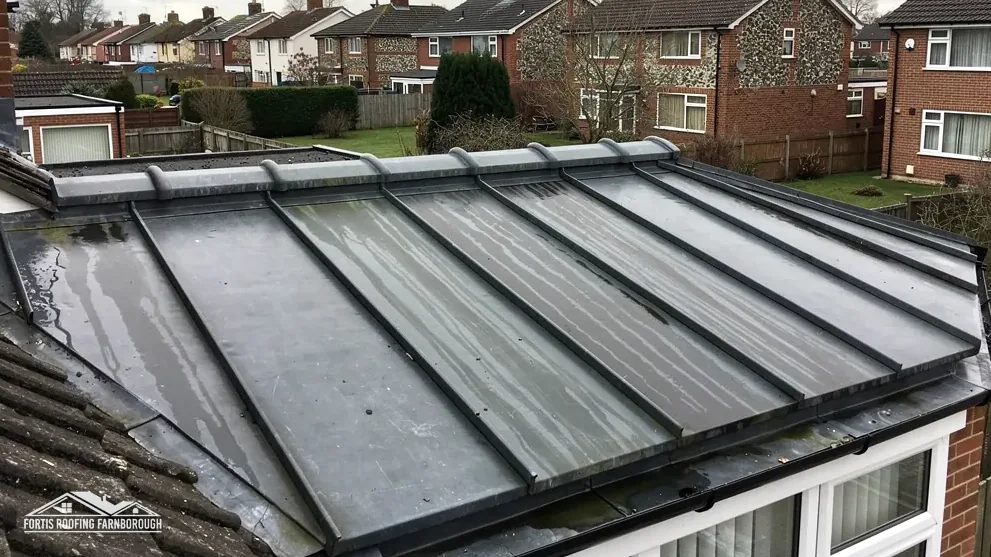
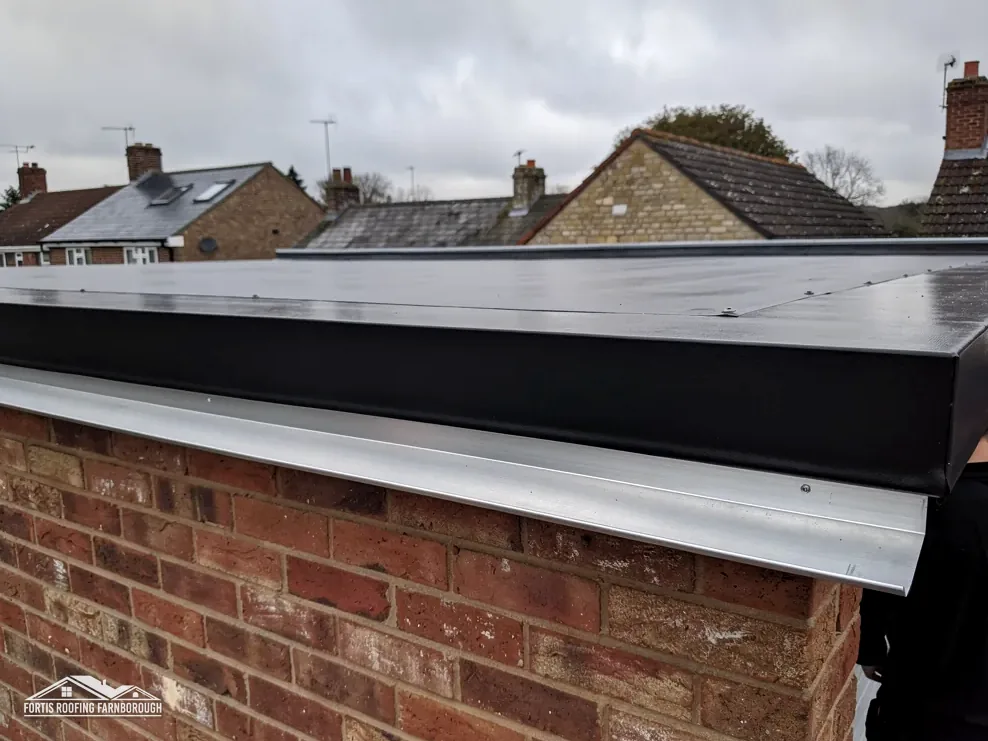
Flat roofs hold on to moss and silt where water ponds. BS 6229:2025 keeps a minimum finished fall of 1:80 for flat roofs with membrane coverings, and IKO's design figure for a single-ply roof is a 1:40 fall. A flat roof that ponds is cleaned carefully, with no sharp tools on the membrane, and the outlet is cleared so the water can leave.
Every roof clean we carry out ends with the gutters and downpipes emptied and the debris bagged and taken away, so nothing is left to wash back in with the next rain. Where access allows, we run water along a cleared gutter to see it reach the outlet. If a gutter still overflows once it is clear, the cause is its fall or its size rather than moss, and we tell you which.
Chapter 06 of 06
The checks that come before a cleaning method is chosen
Some roofs should not be cleaned the usual way at all. The commonest are corrugated cement sheets on older garages, sheds and outbuildings, and older cement slates on houses. The HSE's rule of thumb is that where a building dates from before 2000, or was refurbished before then, you assume asbestos, and its guidance A14 calls asbestos cement roofs "always fragile". A fragile roof cannot be walked on, and a sheet scrubbed, scraped hard or blasted risks being broken up, which changes how the work has to be done and who can do it.
HSE guidance treats work on asbestos cement as non-licensed when the material is carefully handled without breaking it up, including cement that is weathered but not otherwise badly damaged. Work that substantially damages or breaks it up becomes notifiable non-licensed work. So on a cement garage roof, the first question is not how to clean it but whether it should be cleaned at all, or left, or replaced. Asbestos waste never goes in a general skip: it is double-wrapped, labelled and carried on a consignment note. Our guide to cleaning an asbestos roof sets out the options. Plastic roof lights in a garage or extension roof can look solid under a coat of moss, so we treat them as fragile as well and never rest boards, ladders or our own weight on them.
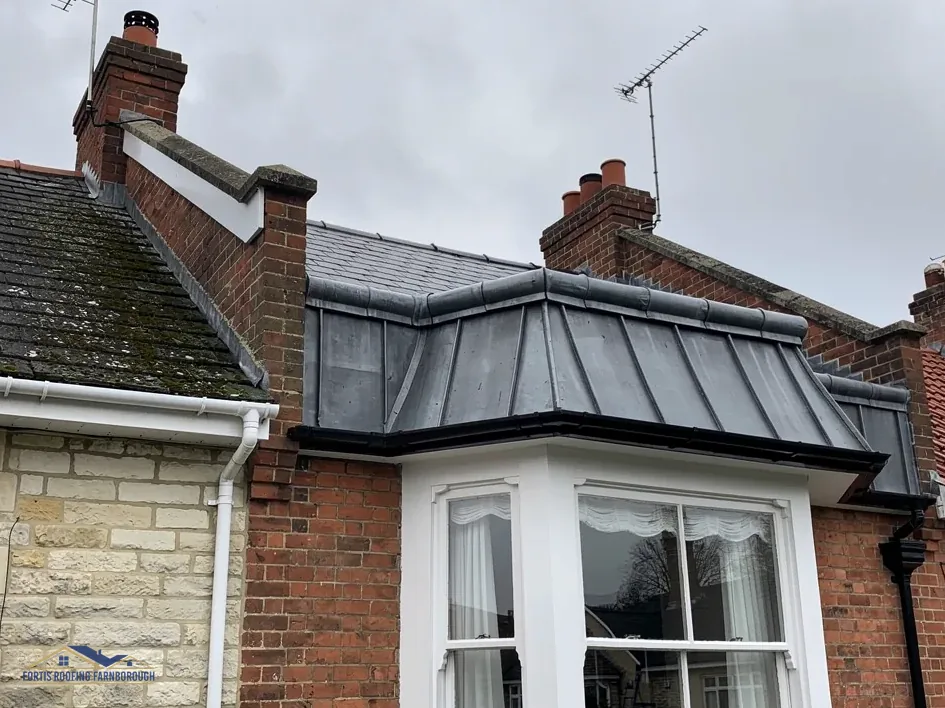
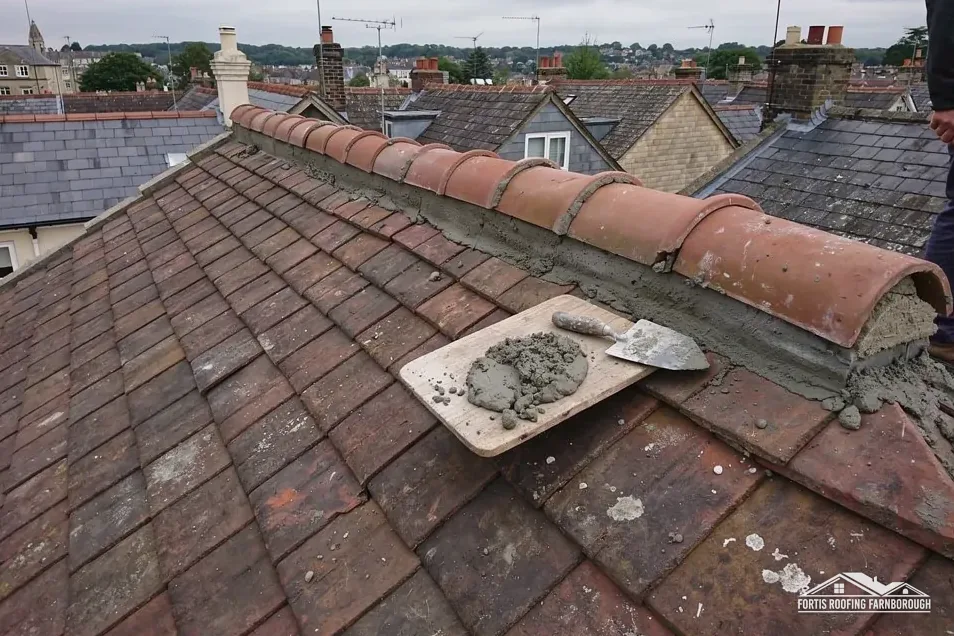
On a tiled or slated house roof, removing moss is often the first time anyone has seen the roof surface properly in years. The faults that tend to appear are cracked or slipped tiles that the moss was holding in place, ridge mortar that has crumbled to sand, lead flashings lifted at a chimney and eaves felt that has rotted behind the gutter. Since the 2014 revision of BS 5534, as Marley explains, mortar alone is not relied on to keep ridge and hip tiles in place, which means a perished ridge is re-bedded with a mechanical fixing on every unit or replaced with a dry ridge system.
Cement roofs
We photograph each of these and send you the pictures with a note of what each means. A small repair, such as refixing a few slipped tiles, can often be done on the same visit with your agreement. Anything bigger we survey and price in writing, so you can decide on it with the evidence in front of you. Our guide to roof repairs found after moss removal lists the usual findings, and for domestic and commercial roofs alike the cleaning visit doubles as a check of the whole roof.
Book a roof cleaning survey: we check the tiles, gutters and run-off route, and send photos before any work starts.
| Job | Typical UK range |
|---|---|
| Gutters cleared at the front and back of the house (Which?, ex VAT) | £75 to £350 |
| Between one and six broken tiles replaced (Which?, ex VAT) | £75 to £400 |
| Roof survey, national average (MyJobQuote) | around £300 |
Source: Which? cost guide (November 2025, prices ex VAT); MyJobQuote roof survey cost guide (October 2026)
National figures, not ours. The price of a clean depends on roof area, height and access, how deep the moss is and the covering; you get one written total after we survey.
Methods, biocides, lichen, gutters, cement roofs and the repairs moss can hide, written for homeowners weighing up a roof clean.
Guide · 9 min read
A fair price for roof cleaning depends on the roof, not on a rate per house. Size, pitch,…
Guide · 9 min read
Cleaning is worth paying for when growth is holding water against the roof or blocking its drainage. It…
Guide · 9 min read
Soft washing lets an approved product do the cleaning at low pressure, while a jet relies on force…
The roof area, its height and access, the covering, how thick the moss is and whether a biocide treatment and gutter clearing are included. A bungalow reached from ladders costs less to clean than a steep two-storey roof that needs scaffold. We survey first, then give you one written total covering all of it.
It is when moss is thick, reaching the gutters or valleys, or lifting tiles, because those are the routes to damp and blockages. A light bloom on a sound roof is mainly cosmetic. If the tiles under the moss are soft and near the end of their life, a repair or re-roof may be the better spend.
There is no fixed cycle. A shaded slope under trees can need attention every few years, while an open, sunny roof may stay clear for much longer. Gutters are the better yardstick: if they fill with moss each year, the roof above them is shedding it and is worth a look.
A dry spell is best, since moss lifts more cleanly and a treatment is not washed off straight away; we avoid frosty days, when wet tiles are slippery and brittle. Birds also matter: it is an offence to intentionally damage a nest in use, so active nests are left until they are empty.
Working at height on a sloping roof is where the risk lies, and walking on tiles can crack them. If you treat moss yourself, use only a product sold for amateur use on roofs and follow its label: the HSE says the public should never use professional-only biocides. Never use a jet washer on the tiles.
In time, yes, on a damp or shaded slope, because the conditions that grew it are still there. A biocide treatment after hand removal slows the return, and clearing gutters and overhanging growth helps. We would rather tell you that plainly than promise a roof that stays clean for a set number of years.
Get your free roof quote
Send us a photo of the moss and your gutters, and we will survey the roof and drainage.
10-year workmanship guarantee, in writing.