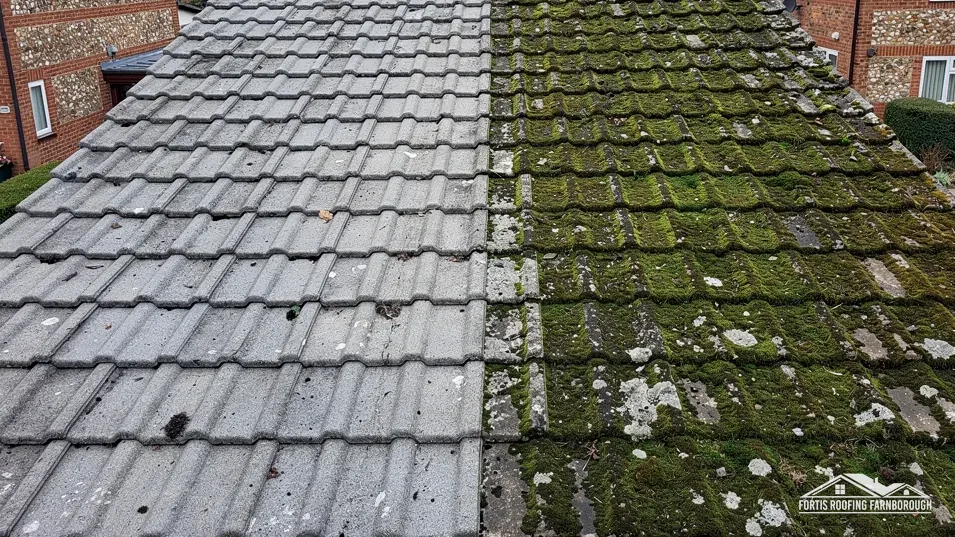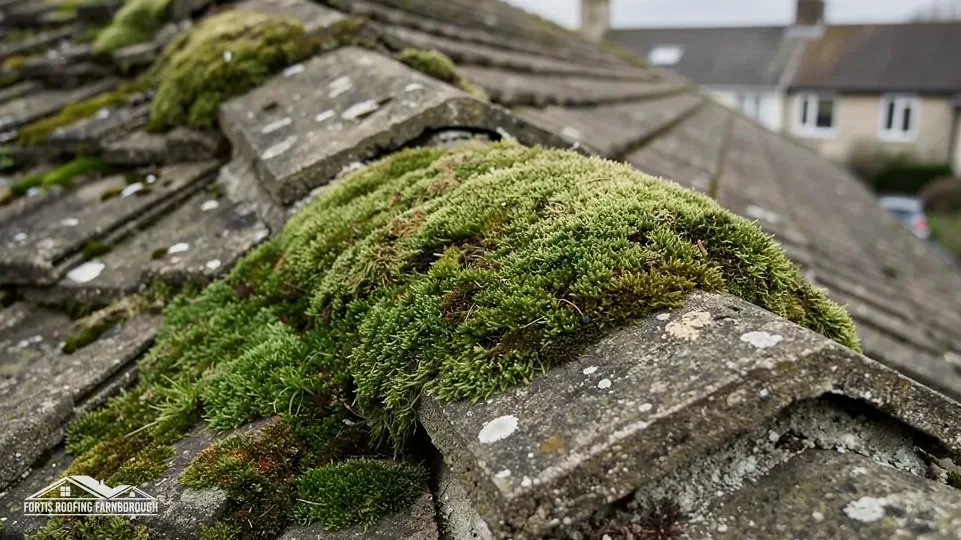
Moss on a roof looks like a surface problem, a green fur on tiles that spoils the look of the house. In practice it holds water against the covering, loosens the grip of the tiles on each other and can end up blocking gutters when clumps are washed down. Owners want it gone, and the first question is usually when to do it.
The honest answer is that timing matters less than method. A well-judged treatment can be carried out in most months, and a poorly judged one can do harm at any time. What the season changes is the weather risk, the safety of working on a wet or icy roof, and how quickly a treatment has a visible effect.
This post looks at the local climate as the Met Office records it, then goes through the seasons, the methods and the rules on chemicals. It also covers what we check on a roof before any moss comes off, because sometimes the real job is a repair underneath. Cleaning is priced after the survey, since the roof's size, pitch, access and covering set the work, and the figures published by cost guides disagree too much to be a guide.
What the climate record tells you
Moss grows where there is moisture, shade and a surface to hold on to. Whether your roof offers those depends on the slope, the trees nearby and the covering, but the background climate sets how often the conditions are right, so it is worth knowing what the local record shows.
Met Office averages
The Met Office keeps a climate station at South Farnborough, and its averages cover 1991 to 2020. Annual rainfall is about 715 mm, falling on around 118 days of the year with at least 1 mm. There are about 53 days of air frost a year, and sunshine totals about 1,589 hours. January is the wettest month among the rows we read, with about 73 mm.
What these figures do and do not say
They describe a station in South Farnborough, not every street in north-east Hampshire, and they are averages across thirty years, so any given year can differ. They are context. We would never call Farnborough windy or exposed on the strength of them, because rain and frost averages say nothing about wind.
Why frost matters
Frost means water in a porous tile or in the gaps between laps freezes and thaws repeatedly. Moss that keeps a tile damp keeps it in that cycle longer, which is one reason it is worth removing. A roof that is damp for much of the winter is also slower to dry in spring.
Shade and aspect
A north-facing slope or one under trees stays damp longer and grows moss sooner. A slope that never sees the sun is where moss starts first and where it is slowest to leave.
Season by season
No month is banned, but each season has a different risk for the roof and for the people on it. This is a guide to the trade-offs and not a calendar.
Spring
Moss is growing and the weather is settling, so spring is a sensible time to treat. Check for nesting birds before work begins, and wait if a nest is in use. Under the Wildlife and Countryside Act 1981 s1, nests in use are protected, and the offence is aimed at anyone who intentionally harms or removes one.
Summer
Long dry spells help any treatment dry and do its work, and dry tiles are safer underfoot. Very hot days are hard on the people working on a roof, and some treatments are best applied out of direct sun, following the product label.
Autumn
Leaves and debris land on the roof and in the gutters, so clearing the roof and gutters together is efficient. The days are shorter and the roof stays damp for longer, so a clear dry spell is worth waiting for.
Winter
Frost and wet surfaces make a roof slippery, and a roofer will not work on an icy slope. Treatment may still be possible on a mild dry day, but results are slower in cold weather. Our answer on roof cleaning in winter goes into the practicalities.
Putting it together
Choose a dry spell, avoid frost and strong wind and give the roof time to dry. The method matters more than the month, and a survey tells you if the roof can take cleaning at all.
Why a jet wash does the roof harm
A pressure washer is the first tool many householders think of, and it is the method with the most downside for a roof, so avoid it.
What the manufacturer says
Marley, a tile maker, does not recommend powerful jet washes on its tiles and slates, because they can mark the surface and shorten the life the covering would otherwise have. A roof tile's surface is its first protection against water, and once that is roughened the tile holds moisture and grows moss again faster.
What else goes wrong
A jet can force water up under the laps of the tiles, past the underlay and into the loft. It can dislodge tiles and chip edges, and it blasts mortar from ridges and verges that may already be tired. Dislodged moss and grit end up in the gutters and downpipes.
Standing on the roof
Applying a jet means working on a wet, steep surface. That is a safety risk for the operator, and it is a reason why we do not recommend householders attempt it.
Gentler methods
Lifting moss by hand with a soft brush and treating the surface with a suitable product, applied as the label directs, avoids most of that damage. Our guide on soft wash against pressure wash explains the harm a pressure wash can do and what to use in its place.
Whichever method is used, the quote should say what it is, because "roof clean" can mean very different things.
Biocides and the rules on using them
Biocides are products made to kill living things, here moss, algae and lichen. Roof treatments are biocides, so the rules for biocidal products apply to them, and they are stricter than you might expect for something sold in a bottle.
The legal position
Article 17(5) of the Biocidal Products Regulation requires a product to be applied as its authorisation allows. In practice that is the label: the dilution, the way it is applied, the precautions and the surfaces it is approved for. HSE's guidance for the public is blunt: keep away from any product made for professionals only. Its guidance on biocides also treats the advertising, sale, supply, storage or use of an unapproved product as an offence under the control rules.
What this means for a householder
If you buy a roof treatment from a shop, read the label and use it as directed. Do not buy or use a professional-only product, and do not mix products or add your own strength. If a company offers to apply a mystery product, ask for its name and check the label.
Run-off
What is applied to a roof ends up in the gutters and drains, and on plants and pets in the garden. The label says what precautions apply. Our guide to roof biocide treatment sets out the questions to ask, and the run-off point matters for ponds and pets in particular.
Not a cure by itself
A biocide stops growth, but it does not repair tiles. If the roof is worn, the treatment buys time and does not replace the repair.
What we look at before any moss comes off
Taking moss off a roof can reveal problems that the moss was hiding, and sometimes the moss is a symptom of one. A survey before cleaning avoids a nasty surprise.
The covering
We check whether the tiles are sound or whether they are crumbling, flaking or porous. Old, soft tiles can break when moss is lifted, and a roof in that state may need repair first. The survey shows whether cleaning is worth it or the money is better spent on repair.
Ridge and verge mortar
Mortar on ridges and verges perishes with age, and moss often grows along a failed joint. Brushing or washing over it can finish it off, so the survey notes the state of every joint.
Gutters
Clumps of moss fall into the gutters. Clearing them is part of the job, and a gutter full of moss that blocks an outlet is a fault in itself.
Access
The way onto the roof, the height and the position of the moss decide how it is reached, from a ladder to a full scaffold, and each step up in access takes more time on site. The way the roof is reached adds to the cost. If scaffold has to stand on the highway, a licence is needed under the Highways Act 1980 s169, so ask who applies for it.
Pricing
Cost guides for roof cleaning contradict one another, so a published range would mislead. The size of the roof, its pitch, the access and the covering set the work, and one written price follows the survey.
Keeping moss from coming back
Removal is a reset, not a cure. Moss returns where the conditions that grew it remain, so a few steps afterwards keep the roof clean for longer.
Reduce the shade
Trees that overhang a roof drop leaves, hold moisture and shade the slope. Cutting back branches lets the roof dry. If the trees are protected, check with your council before cutting. in a conservation area, notice is needed for trees above a certain size. Rushmoor gives six weeks' notice for trees with a stem of 75 millimetres or more at 1.5 metres in its conservation areas.
Keep gutters clear
Water that backs up from a blocked gutter keeps the lowest courses of tiles wet. Empty the gutters regularly, and look at them after storms.
Treat as the label directs
Some treatments leave a residue that slows regrowth. Follow the directions on the label for any repeat application, and never exceed them.
Look after the details
Fix slipped tiles, failed ridge mortar and loose verges before moss finds a foothold. Moss prefers a roof that holds water.
Keep an eye on it
A glance at the roof from the garden once or twice a year, with binoculars, shows where moss is building up. Our roof cleaning and moss removal service covers the treatment and the survey that comes first.