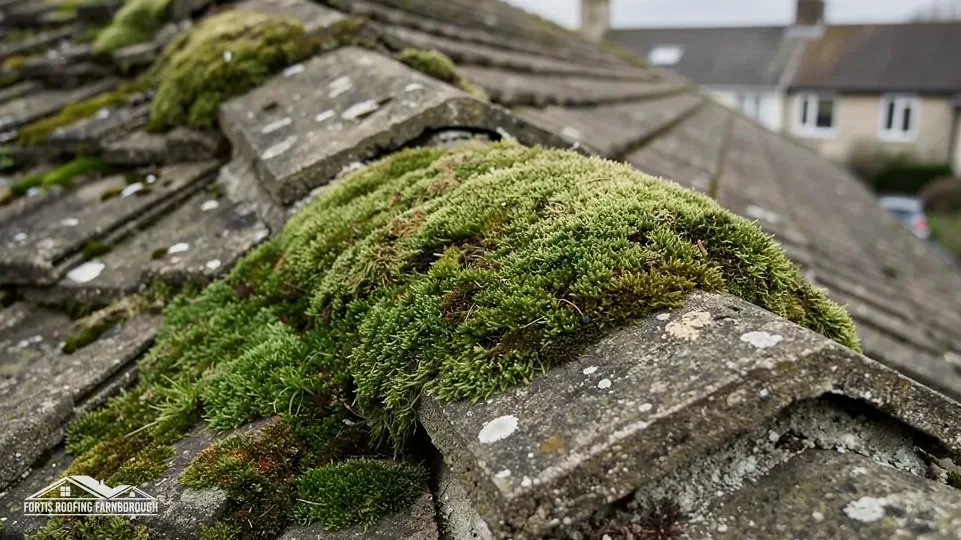
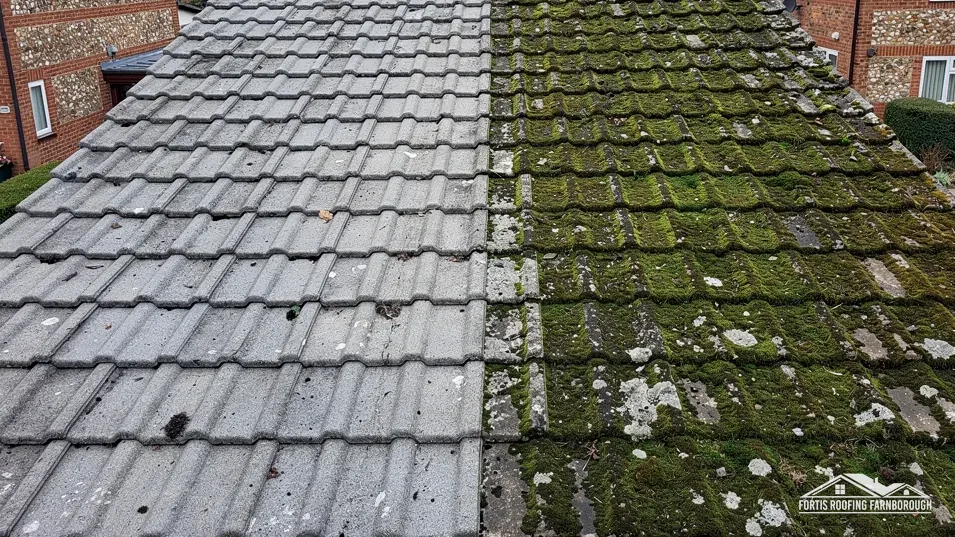
The two terms are often used as if they were close cousins. They are not. A jet cleans by blasting the surface with water at high speed, which is not gentle on anything beneath the dirt. A soft wash cleans by applying a treatment that kills the growth, then rinsing it away at gentle pressure. The difference sounds small on paper and is large on a roof.
Roof coverings are not made to be blasted. Concrete tiles have a surface coating, clay tiles a fired skin, slate a thin natural face. A jet that strips or scars any of these leaves the tile rougher, more porous and quicker to regrow moss. Water forced upwards under the laps can reach the underlay and the loft.
This guide sets out what the tile maker says, how soft washing, hand work and brushing compare, what each does to different coverings, what happens to the water and what to ask any cleaner before they start, for roofs in Farnborough and the villages around it.
Two methods with different ideas
The first thing to understand is what is actually doing the cleaning in each case. The answer decides what the roof has to put up with.
Soft washing
In a soft wash, a liquid treatment is applied to the roof, sprayed on gently and left for the contact time its label states. The growth dies and loosens. A gentle rinse, a soft brush or just the rain then clears it, and the roofer catches what falls. The treatment does the work, and the water is mostly a carrier.
Jetting
A jet uses the speed of the water to dislodge growth. The surface of the roof takes the full force of that, and so does anything underneath it. It is fast on a hard, flat surface such as a patio. A roof is not one of those.
Hand and brush methods
Lifting moss by hand and sweeping with a soft brush rely on a person's touch, and they put very little force on the tile. They take longer and, on thick moss, are often the first step.
Why the difference matters on a roof
Roof layers overlap so that water runs downhill, and nothing in that design expects a jet. Water driven upward, against that direction, finds its way under the laps. Force that strips a surface coat does lasting damage, since a roof covering cannot be recoated in the way a patio can be resealed.
Soft washing uses a product and gentle water. Jetting uses force and risks the tile. The label on the product and the pressure at the nozzle tell you which one you are being offered.
What Marley says about jetting
Marley is one of the main makers of roof tiles in the UK, and its support pages cover cleaning. Its position is clear: high-powered jetting is not recommended, since it can mark the face of slate or tile and so cut the covering's expected life considerably.
What that means
The maker of the tile is telling you that a method many cleaners offer shortens the life of the product. Tile life is what the roof is bought for, and it is reckoned in decades. HomeBuilding (Sep 2025) gives typical lives of 40 to 50 years for concrete tiles and 60 to 80 years for clay, as ranges, not promises. Taking years off that for the sake of a fast clean is a poor trade.
How the damage happens
- A jet strips the surface coating from concrete tiles, so they soak up more water.
- It can scar the fired face of clay and flake old slate.
- It pushes water and grit beneath the laps and towards the loft.
- It shifts loose tiles and breaks brittle ones.
- It scatters debris and runoff into gutters, paths and neighbouring gardens.
A roof that looks clean
After a jet, a roof can look new for a season. The tiles are paler and cleaner. The damage shows later, as the roughened surface grows moss faster than before. That is why a roof that has been jetted can look worse within a couple of years than one that was cleaned gently.
Our guide to roof moss removal methods sets every option in one table.
Coatings and tile surfaces
Different coverings have different surfaces, and each has a different way of being harmed.
Concrete tiles
Most concrete tiles carry a coloured surface layer that gives their finish and some protection. A strong jet can wear it away, leaving a rougher, more absorbent surface. The tile body is still there, and it is slowly losing its protection. Moss finds a rough surface easier to hold on to.
Clay tiles
Clay tiles are fired, and the surface skin formed in the kiln is what resists water. Scouring removes it. Old hand-made clay is especially vulnerable, and frost then spalls the damaged face. Our guide to cleaning clay roof tiles covers the gentle methods.
Natural slate
Slate is thin and layered. A jet can lift or flake the surface and force water behind the slate. Slates are also held by nails or hooks that rust with age, and vibration or force can loosen them.
Fibre cement and asbestos cement
Fibre cement slates and sheets age differently, and asbestos cement must never be blasted or scrubbed. If a roof might contain asbestos, it is identified first. HSE's guidance treats asbestos cement roofs as always fragile.
Coatings
Some roofs have been coated or painted. A jet strips the coating unevenly, leaving a patchy finish and bare tile beneath. A soft wash with the wrong product can also affect a coating, so the data sheet is checked.
Whatever the covering, the first question is what is already there, which is why a survey comes first.
The methods compared
This table sets out the main methods in terms of what each puts on the roof.
| Method | Force on the tile | Water | Chemicals | Speed |
|---|---|---|---|---|
| Hand lifting | Very low | None | None | Slow |
| Soft brushing | Low | None or a little | None | Moderate |
| Soft wash with treatment | Low | Low pressure | Approved biocide | Quick to apply, slow to take effect |
| High-pressure jet | High | High pressure | Often none | Fast, and not recommended |
The trade-off
Methods that put less force on the roof take longer to give a result. A soft wash is quick to apply, though the moss dies back over days or weeks. A jet gives an instant effect and takes some of the roof with it. The sensible choice is to accept the slower result.
Time and cost
Force and speed are what make a jet cheap to run. A cleaner can clear a large roof in a short visit and move on. Gentler methods take longer on the roof, which is where much of the cost sits. The fair comparison is not the price of the visit but the cost of the roof afterwards, including any tiles that need replacing because of the way it was cleaned.
Combinations
Jobs often combine methods. Thick moss is lifted by hand, the roof is treated, and a soft brush finishes a few weeks later. Each step uses the lightest tool that does the job.
Rules for treatments
Soft wash products are biocides. Each product has to carry an approval that covers the job, and HSE tells householders to leave products meant for trained users alone. Our guide to roof biocide treatment sets out the rules in more detail.
Water, runoff and neighbours
Every method puts something into the gutters and the garden. The question is how much and what it carries.
Water in the roof
High pressure forces water into places it never meets in rain. A perished underlay, a poorly lapped tile or a gap at a flashing lets it through to the loft, where it wets insulation and timber. A low-pressure method asks much less of a roof's weatherproofing. Even so, a roof with a failed underlay should be repaired before it is washed at all.
Debris
Jets scatter moss, grit and tile fragments widely, and dried debris can be blown around later. Gentle methods let the roofer catch and bag material as it comes off, so it does not end up in a neighbour's garden or a drain.
Treatment runoff
A soft wash sends a diluted treatment down the roof. The label may call for protection of plants, ponds and water butts, and for gutters to be cleared afterwards. The runoff is planned for, not left to chance.
Noise and mess
A jet is loud and splashy. Soft washing and hand work are quieter and cleaner, which neighbours notice, and which makes the whole visit easier to live next to.
Frost and timing
Water on a roof just before a freeze can leave ice in the laps. Roof work is planned for dry weather with no frost forecast, and the product's stated contact time is kept to.
Gutters get a final clear whichever method is used, because debris and dead growth land there. Our roof cleaning and moss removal service plans for that from the outset.
Questions to ask before anyone starts
Many cleaners advertise on the strength of a result that looks impressive on the day. A few questions tell you how it will look in two years.
Method
Ask what method will be used and at what pressure. If the answer is a jet, ask why, given that the tile maker does not recommend it. If it is a soft wash, ask what product, what dilution and how long it stays on the roof.
Product and rules
Ask for the product name and its data sheet, and for confirmation that it is approved for the job and the user. Ask where the runoff goes and how plants and ponds are protected.
Roof condition
Ask whether the roof will be checked before cleaning for cracked tiles, slipped tiles and failed underlay, and whether repairs would be done first. Ask for photographs of any defects.
Access
Ask how the roofer will reach and move over the roof without breaking tiles, and what access equipment is in the price.
Price
Ask for a written quote that names the method, the access and VAT. Our quote is one total, set after a survey, and it takes in the access and tidying that the survey shows the job needs. Where two quotes differ widely, the gap is often explained by method and access. Citizens Advice suggests getting at least 3 written quotes.
Wildlife and timing
Ask whether the roof has been checked for nesting birds or bats before work starts. Birds nesting in a roof are protected, and every bat species and its roost is fully protected, so the work waits or is planned with advice if either is present.
Aftercare
Ask whether a follow-up visit is included, since soft washing and treatment take effect over weeks. A cleaner who has chosen the method with care can answer every one of these.