North Camp's older streets
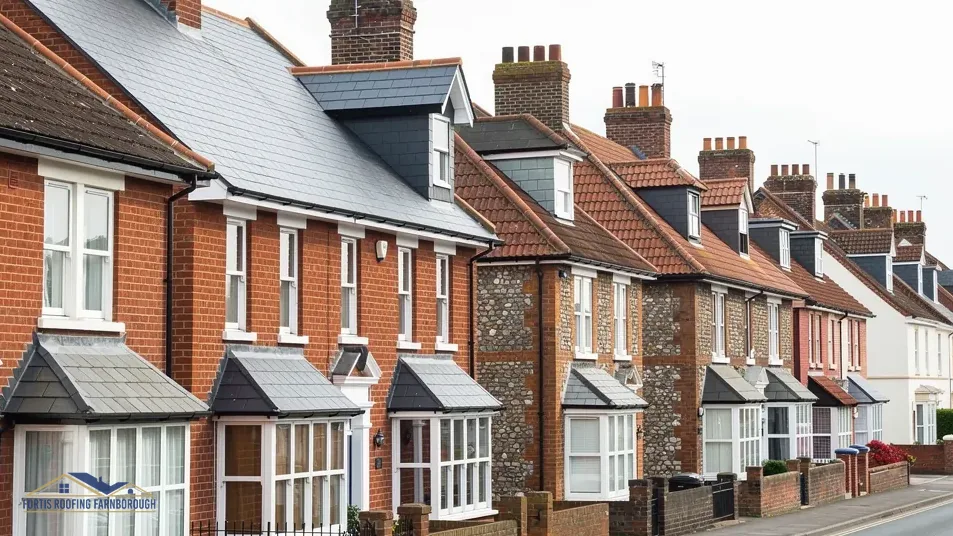
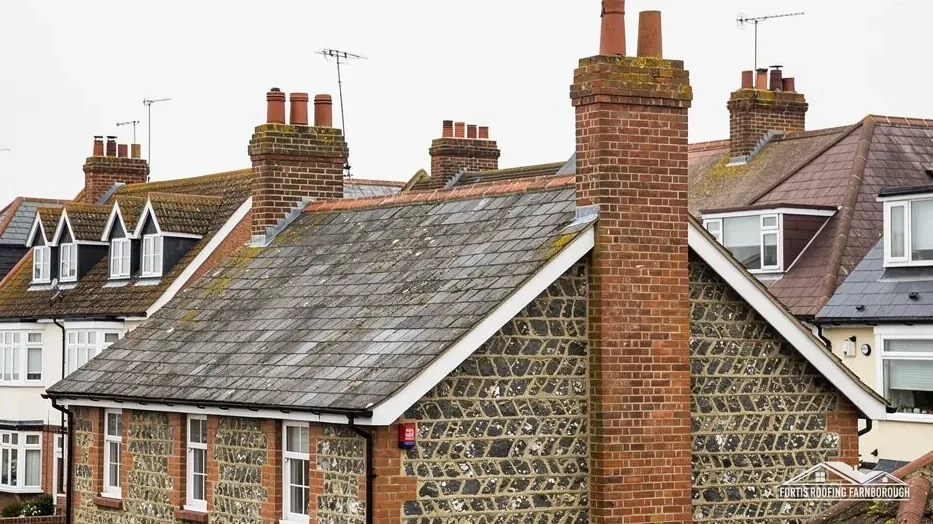
Laid out from the 1860s, with the principal roads in place by 1874.
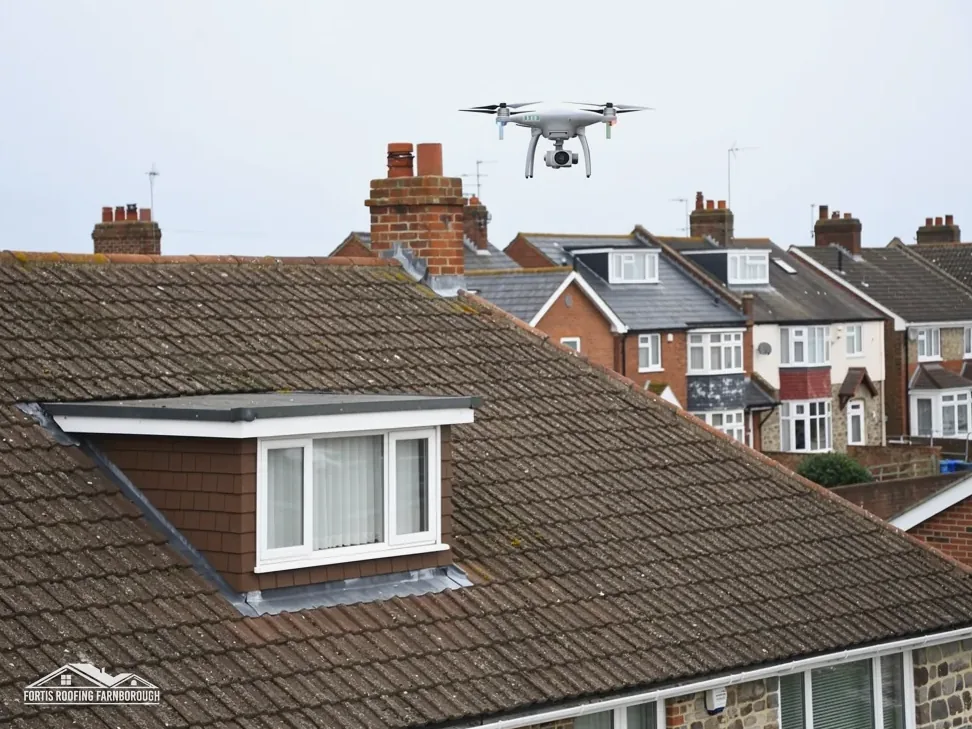
We measure and photograph before we price.
A roofing company that surveys your roof, photographs what we find and gives you one written price for the work.
Laid out from the 1860s, with the principal roads in place by 1874.
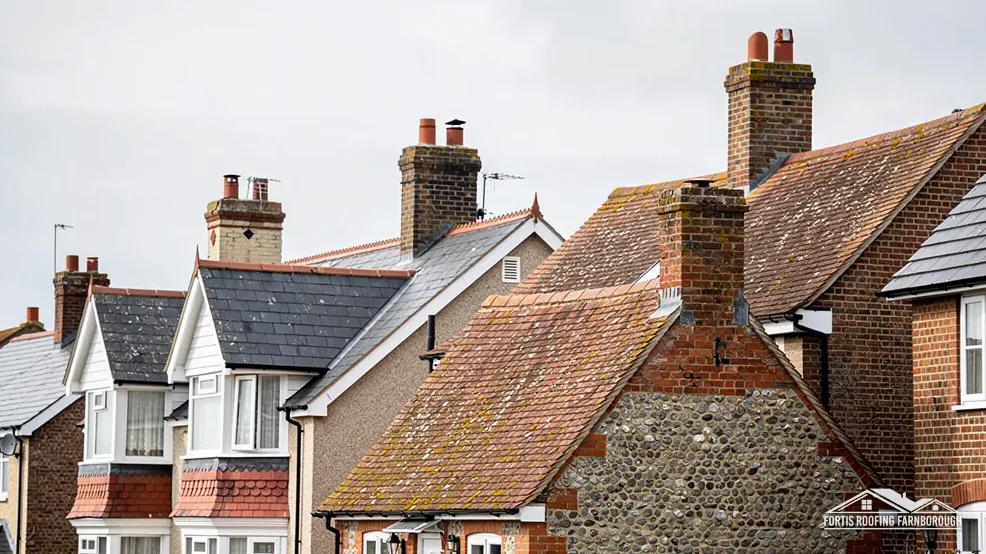
Rushmoor dates new housing at Cove to the 1950s and 1960s.
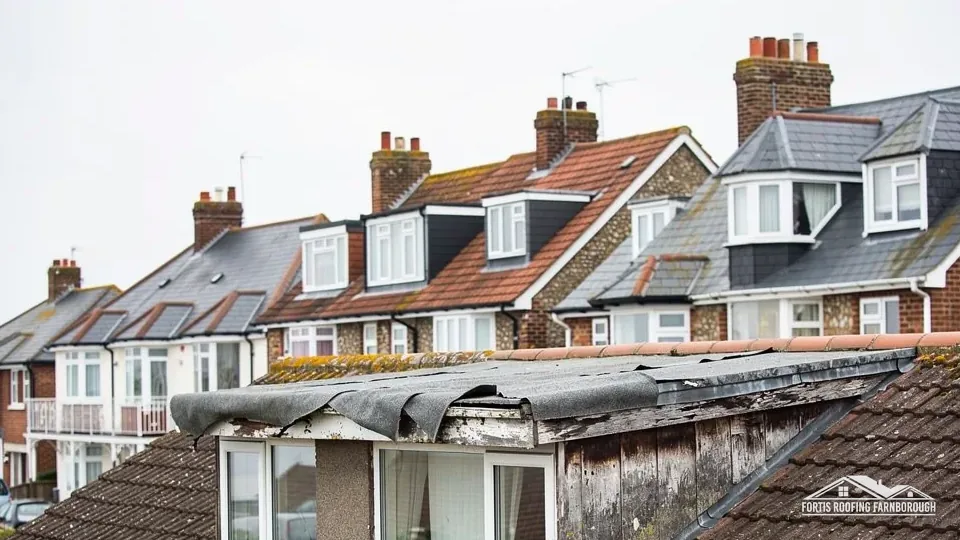
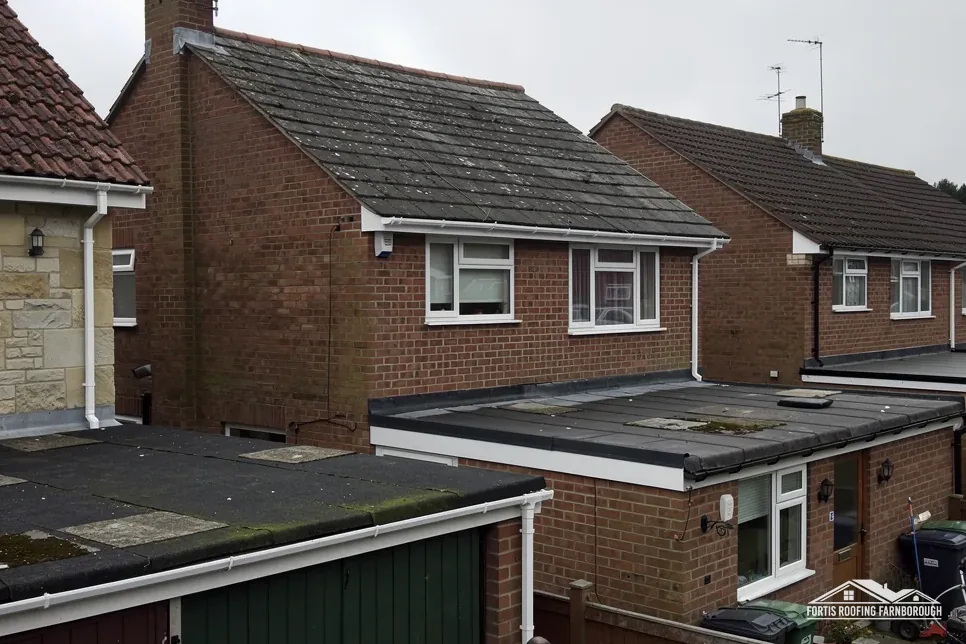
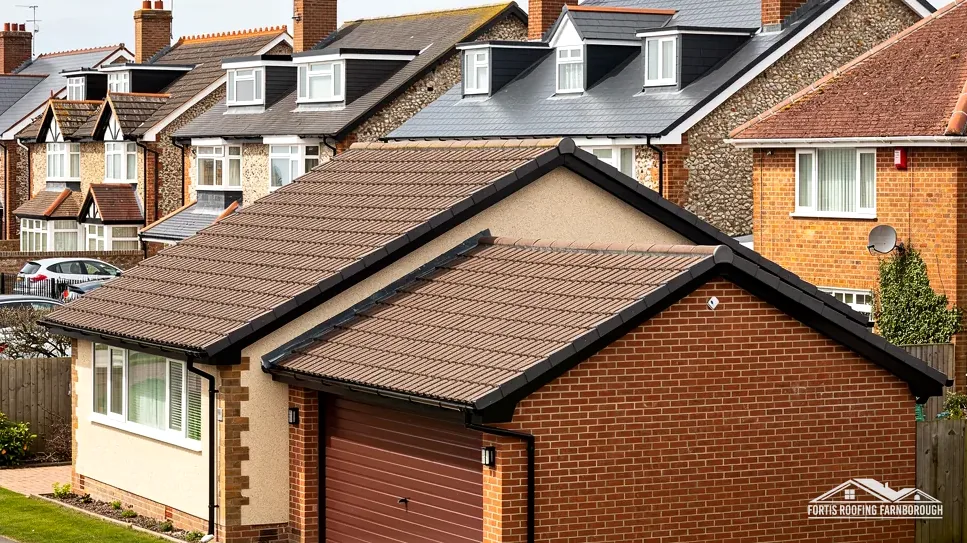
Garages, extensions and dormers where felt, EPDM or GRP needs a close look.
Map of the area we cover: a ring of about 25 miles around Farnborough, with Fleet, Farnham, Woking, Guildford, Bracknell, Wokingham, Basingstoke, Reading marked.
Roofers in Farnborough for Cove and North Camp out to Guildford, Woking and Bracknell; each town page carries its own council and planning details. Map data © OpenStreetMap contributors. Loads only when you ask for it.
Farnborough roofs, the figures
Housing dates from Rushmoor, rainfall and frost from the Met Office, lifespans, consent rules and consumer law from their published sources, and what each one means when we survey your roof.
| No. | Chapter | The figure it turns on |
|---|---|---|
| 01 | Farnborough's streets, era by era | From the 1860s to the 1980s |
| 02 | What Farnborough's weather does to a roof | 118 wet days in an average year |
| 03 | Flat roofs and other coverings, by lifespan | Lead flat roof: 60-100 years |
| 04 | When building control or planning applies | Under 25 per cent of the envelope |
| 05 | What the published prices assume | A 65 m² three-bed semi roof |
| 06 | Checking a roofer, and storm claims | Written quotes from at least 3 traders |
Chapter 01 of 06
| Place | When | What the council records |
|---|---|---|
| Farnborough Street | The oldest part | The oldest part of Farnborough can be traced here |
| North Camp and South Farnborough | From the 1860s | Principal roads in place by 1874 |
| Farnborough Street crossroads | Early 20th century | Suburban commuter housing spreading outwards |
| St Michael's Abbey | Completed in 1887 | Held in trust as a Benedictine monastery |
| Cove | 1950s and 1960s | New housing developments |
| Southwood | 1980s | New housing developments |
Farnborough sits in Rushmoor, in the north-east of Hampshire close to the Surrey border. The borough was formed in 1974, bringing Aldershot and Farnborough together, and the council's Conservation Areas Overview of June 2025 is the clearest public record of how the town's streets were built. The panel above takes its dates from that document and nothing else.
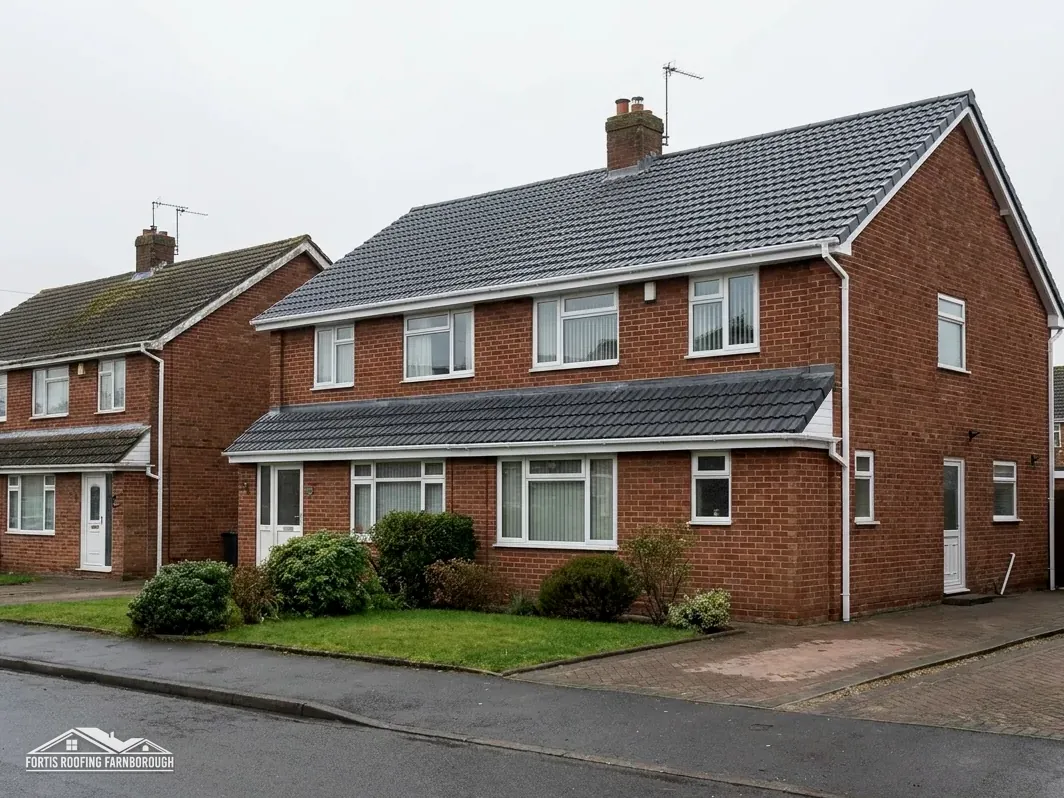
The oldest part of Farnborough grew around Farnborough Street, where parts of St Peter's Church date from the twelfth and thirteenth centuries. The railway arrived in 1838, and a second station followed in the village centre in 1849. After the army came to Aldershot in 1854, North Camp took shape at the southern end of the town, and the Farnborough Cottage Company, set up in 1863, laid out much of North Camp and South Farnborough. The council records that the principal roads there were in place by 1874. Early in the twentieth century, suburban commuter housing spread out from the Farnborough Street crossroads. Cove gained new housing in the 1950s and 1960s, and Southwood followed in the 1980s.
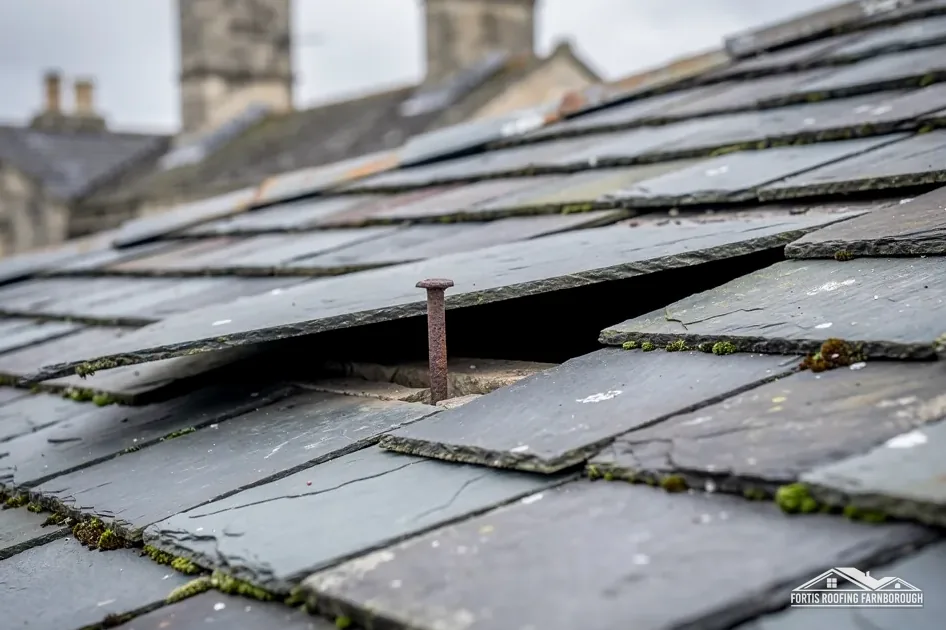
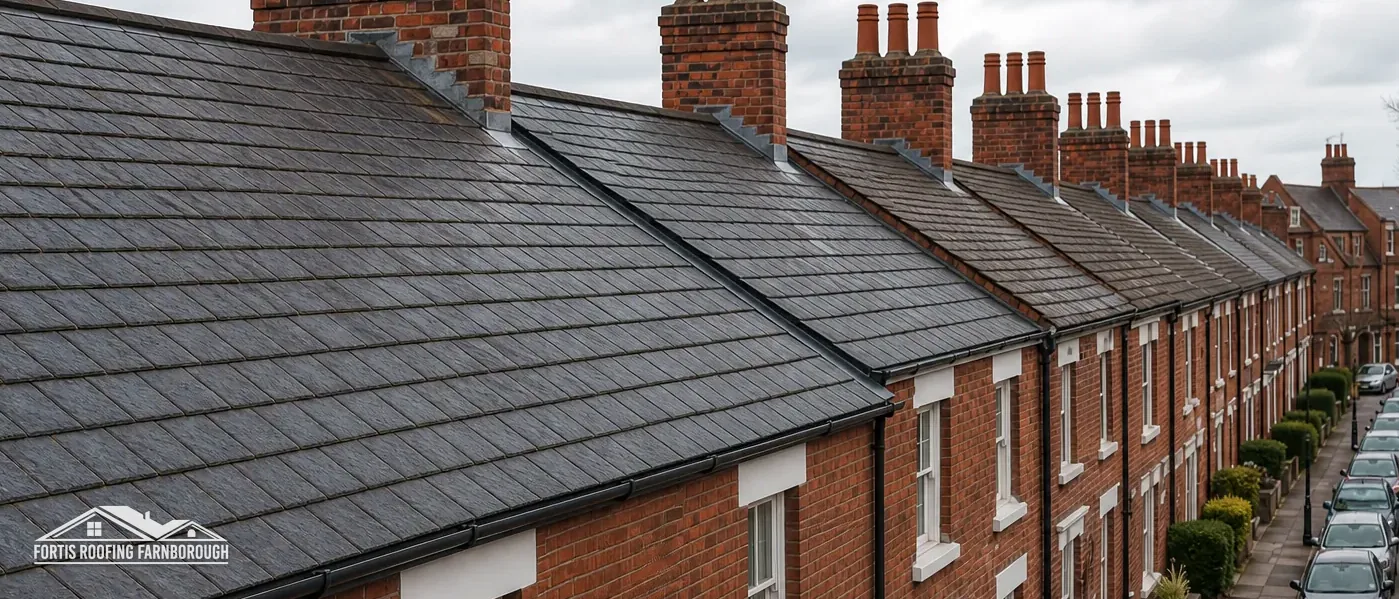
The year a house was built does not tell you what is on its roof today. A house from the 1870s may be on its second or third covering, and a 1980s roof may already have had its ridge re-bedded or its garage re-covered. So we never price a roof from the street name. We go up, look at the covering, the battens (the timber strips the tiles hang on) and the underlay, and photograph what we find.
Age still matters, because published lifespans show where a roof sits in its working life. HomeBuilding gives Welsh slate 100+ years and clay tiles 60-80 years. For concrete tiles the sources differ: HomeBuilding gives plain concrete 40-50 years, while Marley says its roof tiles are expected to last around 60 years and adds that this is not a guarantee. A 1950s Cove house that still carries its first concrete tiles would be past one of those ranges and close to the other. That is a reason to look closely, not a reason to re-roof.
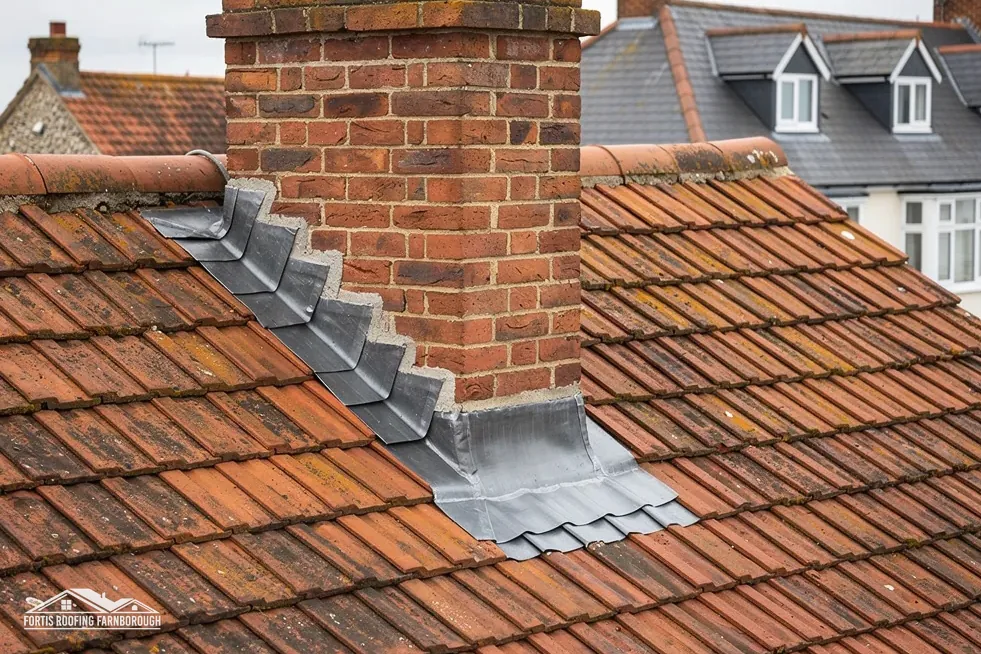
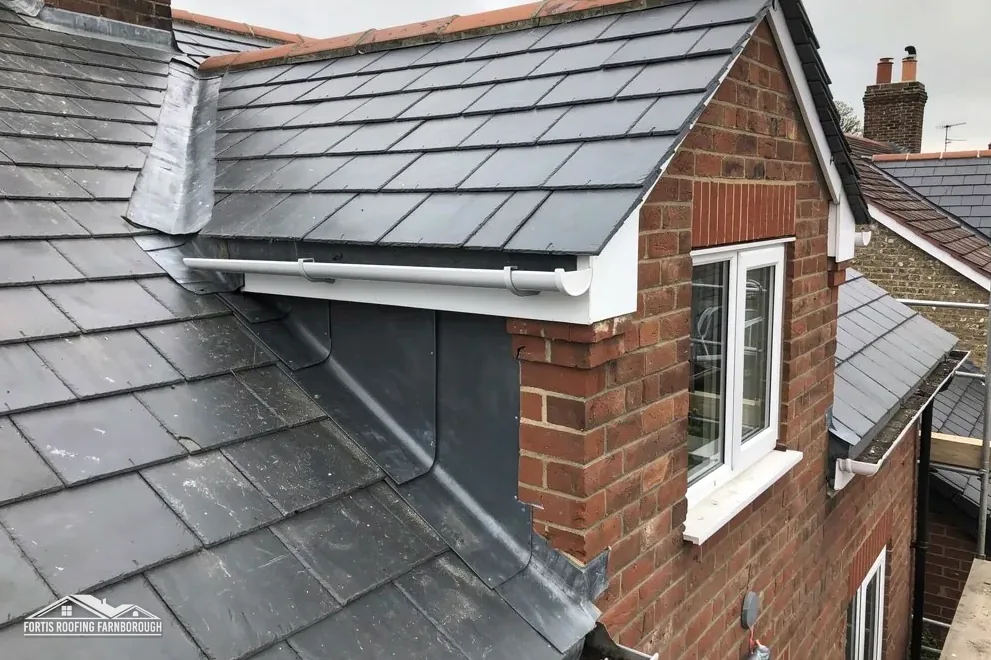
On older streets we pay close attention to the details as well as the slates and tiles: lead valleys, chimney flashings, and the battens and nails underneath. Our pitched roofing work covers those repairs, and our guide on whether roof battens need replacing explains what we look for in the timber. Rushmoor has nine designated conservation areas, including South Farnborough, Farnborough Street, Farnborough Hill and St Michael's Abbey, so on those streets we check the consent route before any change of material.
Chapter 02 of 06
Met Office long-term averages for South Farnborough
The Met Office climate station at South Farnborough gives the averages in the panel, measured over 1991 to 2020. They work out at about 715 mm a year, falling on around 118 wet days, with roughly 53 air-frost days. What the figures show is that a roof here spends a good part of the year wet, and a fair number of nights below freezing.
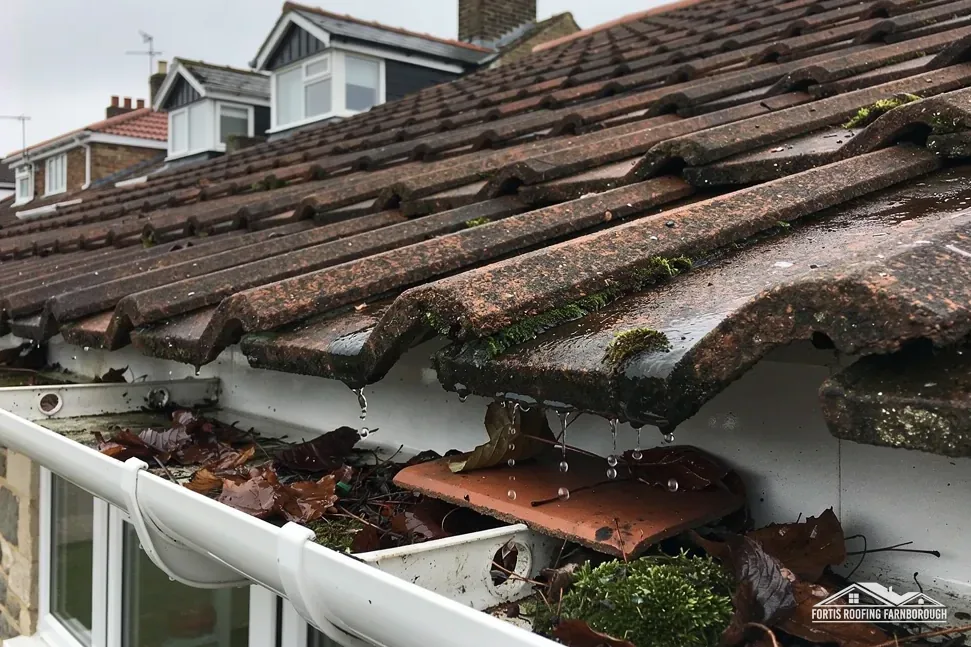
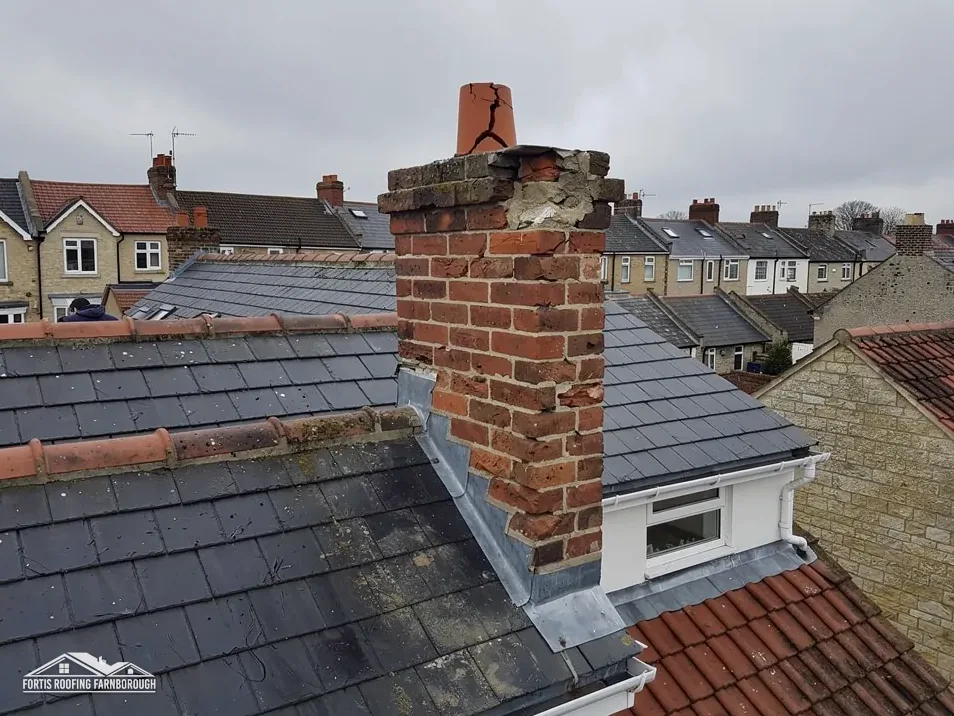
Water finds the weak points. A cracked or slipped tile lets rain onto the underlay. A gutter blocked with moss or leaves overflows at the eaves and soaks the fascia behind it (the board the gutter is fixed to) and the soffit beneath (the board that closes the underside of the eaves). Mortar flaunching around the chimney pots and the lead flashing where the stack meets the slope both shed water that would otherwise run into the brickwork. When one of these fails, the first sign can be a damp patch on a bedroom ceiling some way from the real fault, because water runs along battens and rafters before it drips.
That is why a roof leak is traced, not guessed. We follow the stain back into the loft where we can, then check the covering, valleys and flashings above it, and photograph the cause before we suggest a fix. If the roof is leaking now, our emergency and general roof repairs service makes it safe first and prices the permanent repair once the weather allows. Guttering and the boards behind it have their own page under gutters, soffits and fascias.
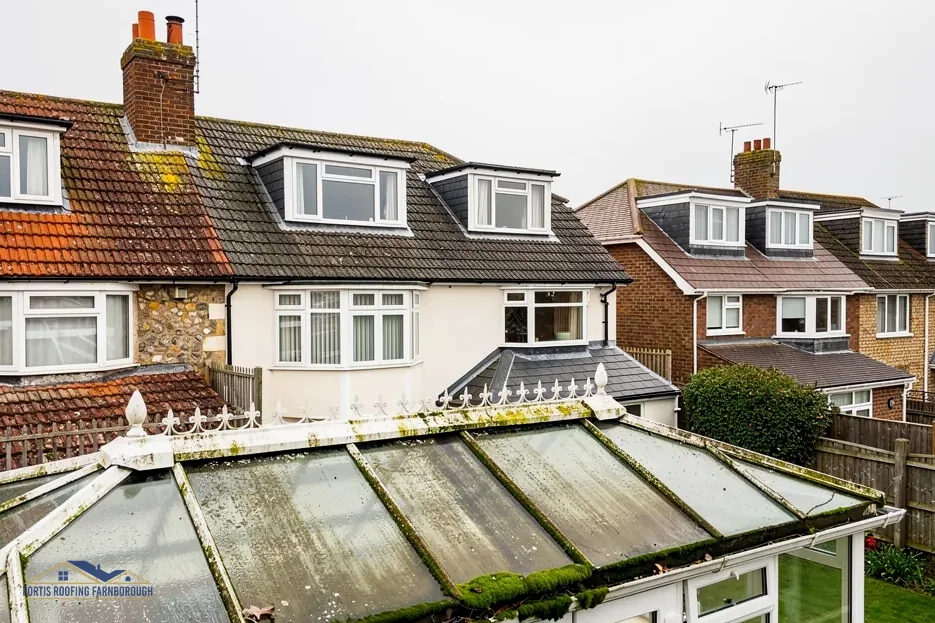
Air frost on around 53 days in an average year means water that has soaked into a porous tile, a weathered ridge joint or a crack in a chimney's mortar can freeze and expand. Over many winters that can flake the face of a tile or open up a joint. Moss and lichen hold water against the surface for longer, and they wash into gutters and outlets when they come loose. Clearing them is a careful job done with hand tools, not a pressure washer, and any treatment has to be used to the product's own conditions.
Sunshine plays a part too, if a smaller one. South Farnborough averages close to 1,589 hours of sun a year, and summer heat is hard on old felt and on sealants around flashings and roof windows. A flat roof that has cracked or blistered over the summer is worth a look before the autumn rain arrives. Clearing gutters before winter is one of the simplest ways to protect the fascia boards and the walls beneath them.
Chapter 04 of 06
| Situation | Rule | What it says |
|---|---|---|
| Part of a roof re-covered | Planning Portal test | No application normally if under 25 per cent of the envelope and under 50 per cent of the roof is affected |
| A heavier covering | Planning Portal | Approval needed if the new covering adds 15 per cent or more to the weight |
| A new covering on a house | GPDO Class C | Normally permitted development |
| A window on a side roof slope | Class C.2 | Obscure-glazed in every case |
| A listed house | Listed Buildings Act s7 | Listed building consent as well as Class B and C rights |
| Rushmoor and Hart addresses | Hart and Rushmoor Building Control Partnership | One team, based in Rushmoor's Farnborough offices |
The national test comes from the Planning Portal. A re-roof does not normally need a building control application if less than 25 per cent of the total building envelope (walls, floor, roof, windows and doors) is affected and less than 50 per cent of the roof is affected. Approval is needed if the new covering is significantly different in fire performance, or heavier by the margin the card with this chapter explains. That matters if you are thinking of swapping concrete tiles for slate or clay.
The building control page that serves both Rushmoor and Hart points people to the Planning Portal guides and sets no threshold of its own. The Hart and Rushmoor Building Control Partnership works from Rushmoor's offices in Farnborough, on 01252 398715. Elsewhere the councils word it differently. Bracknell Forest Council lists replacing roof coverings on pitched and flat roofs among work that may need approval, Basingstoke and Deane Borough Council uses similar wording, and the Royal Borough of Windsor and Maidenhead lists re-tiling or re-felting a roof. So for addresses in those boroughs we check with the council before a re-roof. Owners can also use a registered building control approver instead of the council.
Planning is a separate question. Class C of the permitted development rules covers other alterations to the roof of a house, which includes re-roofing, so a new covering on a house rarely needs planning permission. Listed homes keep their Class B and C rights but need listed building consent for work that affects their character. A new roof window on a side slope must be obscure-glazed in every case, and can only open if the opening parts are more than 1.7 metres above the floor of the room. Roof windows and skylights have their own page under roof windows and skylights.
Conservation areas and Article 4 directions add another layer. In Rushmoor, the Cargate direction in Aldershot covers putting up, altering or removing a chimney or flue where it can be seen from a highway or open space, and the Wellesley direction covers antennas on a roof slope facing a highway. Hart's 1998 directions cover frontage roof slopes and chimneys across most of its conservation areas, and Guildford says you cannot remove or alter a chimney without permission where a direction applies. On article 2(3) land, such as a conservation area or a National Landscape, a dormer is not permitted development. Elsewhere, check whether an Article 4 direction applies with your council before you change a chimney or the look of a roof.
Chapter 05 of 06
The jobs behind the national price guides
The price guides in the panel above each assume a particular job: a 65 m² roof on a three-bedroom semi for HomeBuilding, a 6m x 3m single garage for the Which? felt flat roof figure, and a handful of broken tiles for the smallest Which? repair. Real roofs rarely match those assumptions exactly. That is why national ranges are wide, and why the typical UK figures further down this page are a starting point rather than a price for your house. On a full roof replacement the guides disagree widely: Which? puts an average three-bedroom house at £7,000 to £21,000 ex VAT, while HomeBuilding puts a 65 m² semi in plain concrete tiles at £10,000 to £15,000.
Four things decide the price. The first is access: how high the roof is, whether a tower or a full scaffold is needed, and whether that scaffold stands on the pavement. Scaffolding on a public highway needs a scaffold licence from the highway authority under the Highways Act 1980, and for Rushmoor and Hart addresses that is Hampshire County Council, which says scaffolding companies must apply on behalf of their customers. Scaffolding on private land needs no licence. The second is area, measured on the survey rather than guessed from the ground. The third is the covering itself, because Welsh slate, clay, concrete and the flat-roof membranes differ in material cost and in labour. The fourth is what the survey finds underneath, such as rotten battens, a failed underlay or a sagging deck.
A good quote describes the work clearly enough that you could hand it to another roofer and get a price for the same job. It should say what will be stripped and replaced, which materials will go on, how the waste leaves the site and about how long the work will take. Check whether the total includes VAT and scaffolding, because a quote that leaves either out is not comparing like with like. Ask, too, what happens if something only shows once the old covering comes off, such as a rotten rafter; a clear quote says how that would be handled and agreed before any extra work goes ahead.
Our own quotes are one written total for the whole job, given after the survey and backed by the photographs. Where a repair will do, we price the repair; where the evidence points to a new roof, we show you why before you decide. The roofing costs page sets out typical UK ranges job by job, with each guide named and dated, so you can see where a figure comes from.
Chapter 06 of 06
| Situation | The rule or guidance | Who says so |
|---|---|---|
| Choosing a roofer | Get written quotes from at least 3 different traders | Citizens Advice |
| Contract signed at home | 14-day cancellation period for an off-premises contract | Consumer Contracts Regulations 2013 |
| You called a trader for urgent repairs | No automatic cooling-off period | Citizens Advice |
| A storm without high winds | Rain, hail or snowfall by itself can be a storm | Financial Ombudsman Service |
| No final response from your insurer | Complain to the ombudsman after eight weeks | Financial Ombudsman Service |
| Free consumer advice | Helpline 0808 223 1133 | Citizens Advice |
Citizens Advice suggests getting written quotes from at least 3 different traders before you choose one, and that advice holds whoever you ask, including us. A genuine roofer will want to see the roof before giving a firm price, will put that price in writing, and will be able to show you what is wrong and why the proposed work fixes it. Be wary of anyone who knocks to say they have spotted a problem from the street, wants a large cash payment up front, or presses you to decide that day. Payment in stages that follow the work, rather than a large sum before anything starts, keeps you in control of the job. Our guide on what to ask a roofer before hiring lists the questions worth putting to anyone, us included.
The law gives you time to think in some cases. If you sign a contract at home, after a survey for example, it is an off-premises contract and you can cancel within the 14-day period without giving a reason. Citizens Advice says the cooling-off period begins the day after you enter the contract and applies to services costing £42 or more. If the trader never gives you the cancellation information, the period can be extended by up to 12 months. The exception is a visit you asked for to carry out urgent repairs: Citizens Advice says there is no automatic cooling-off then. For free advice on a contract or a dispute, its consumer helpline is 0808 223 1133. Under the Consumer Rights Act 2015 a service must be carried out with reasonable care and skill, and the DMCC Act 2024 requires a trader to tell you about any dispute resolution scheme available if you are unhappy with the outcome.
Tell your insurer first, make the roof safe with a temporary repair, and keep photographs and receipts; the Institution of Structural Engineers calls photographs vital evidence for a claim. Whether the damage counts depends on your policy's own storm definition. The Financial Ombudsman Service describes a storm as usually involving violent winds, usually with rain, hail or snow, and it takes the Beaufort Scale into account. When it looks at a refused claim, it asks whether there was a storm, whether the damage is consistent with storm damage, and whether storm conditions were the main cause. If you disagree with your insurer's final response, you have 6 months from that date to go to the ombudsman, whose service is free on 0800 023 4567. We make a leaking roof safe and photograph the damage; the claim itself stays between you and your insurer.
Send us your postcode and what you have noticed, and we will book a survey and show you the photographs.
| Job | Typical UK range |
|---|---|
| Replace one to six broken or missing tiles (Which?, ex VAT) | £75 to £400 |
| Put in a new ridge tile (Which?, ex VAT) | £80 to £300 |
| Clear all gutters, front and back (Which?, ex VAT) | £75 to £350 |
| New felt flat roof on a 6m x 3m garage (Which?, ex VAT) | £1,400 to £3,500 |
| Average roof repair in 2026 (MyJobQuote) | around £650 |
| Roof survey (MyJobQuote) | around £300 |
| Replace the entire roof, average three-bed house (Which?, ex VAT) | £7,000 to £21,000 |
| Three-bed semi, plain concrete tiles (HomeBuilding) | £10,000 to £15,000 |
Source: Which?, November 2025 (ex VAT); MyJobQuote, October 2026; HomeBuilding & Renovating, September 2025
These are typical UK ranges from national guides, not our prices. Your own figure arrives as one written price once we have surveyed the roof.
Plain answers on what to ask a roofer, what a roof survey costs and how Farnborough has grown, for owners weighing up their next step.
Guide · 9 min read
A dodgy roofer sells fear, speed and cash. A sound one shows you the roof, writes one price…
Guide · 9 min read
A roof claim goes best when you tell the insurer early, stop further damage, and keep clear evidence.…
Guide · 9 min read
A roof can cost more to put right than almost any other fault in a house. A few…
Expect a survey before any price, and the price in writing. Citizens Advice suggests written quotes from at least 3 traders. A genuine roofer shows you what is wrong, ideally in photographs, explains the fix, and never rushes you on the doorstep. Check that each quote says whether VAT and scaffolding are included.
There is no national government grant for a new roof. ECO4 runs until 31 December 2026, and the Great British Insulation Scheme ended on 31 March 2026. Warm Homes: Local Grant funds insulation where household income is usually £36,000 or less, and a Disabled Facilities Grant pays for adaptations. Each scheme sets its own eligibility.
Roof work is priced by the job rather than the day, so a day rate says little about the final bill. The cost depends on access and scaffold, the roof area, the covering and what the survey finds under it. Once the roof is surveyed, you get one figure in writing for the whole job.
Yes. We carry out roof repairs of every size, from a slipped tile or a cracked ridge to storm damage across a whole slope. If the roof is leaking, we make it safe first with a temporary repair, photograph the damage for you and your insurer, then price the permanent repair once we can see it properly.
Yes. Chimney repair, lead flashing, valleys, gutters, fascias and soffits are all part of the same roof, and we survey them together. A leak blamed on the tiles can start at a chimney flashing or an overflowing gutter, so we trace it first. Commercial roofs, roof windows and slate roofing have their own service pages.
We work across Farnborough, including Cove, North Camp, South Farnborough, Southwood, West Heath and Hawley, and the towns within about 30 road miles: Aldershot, Fleet, Camberley, Frimley, Farnham, Guildford, Woking, Bracknell, Wokingham and Ascot, plus the Surrey Heath and Hart villages. That takes in north-east Hampshire, west Surrey and east Berkshire.
Get your free roof quote
Tell us about the roof and your postcode, and we will arrange a survey at a time that suits you.
10-year workmanship guarantee, in writing.