
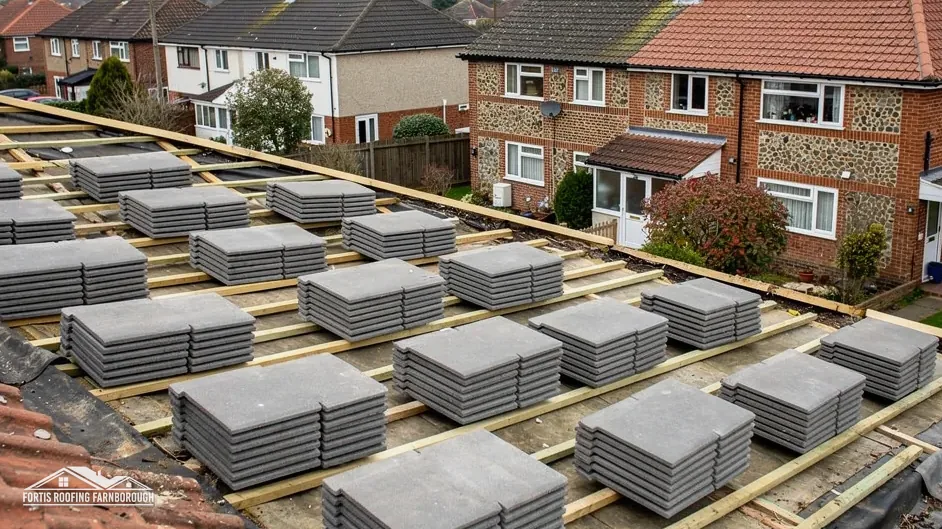
A roofer usually turns up in your life at a bad moment: a stain has appeared on a ceiling, a tile has landed on the path, or a surveyor has written "roof near end of life" in a report. You cannot see your own roof, so you are asked to trust a stranger's description of it. We built Fortis Roofing Farnborough around closing that gap.
Before anything else, somebody climbs up and examines the roof itself. We measure it, photograph what we find, and talk you through the findings in everyday language before a price is mentioned. Only then do you get one price in writing, covering the work, so the decision rests on evidence you have seen with your own eyes.
The name
Why we are called Fortis
Fortis is Latin for strong, which suits a roofer, though a name on a van proves nothing about the work. A strong roof is one where the covering, the fixings and the details around chimneys, valleys and walls have each been checked, and where the work done matches what the roof needs.
We keep the description of our own work modest for the same reason. You should not have to take our word for the state of your roof, so we give you the photographs, the measurements and a written price and let you judge them.
How we work
What every Fortis job involves
The sequence is the same whether the job is one slipped tile or a full re-roof.
- A survey comes first. We look at the covering, the timbers we can safely reach, the gutters, and the flashings, which are the strips of metal or lead that seal a roof where it meets a wall or chimney.
- You get photographs and measurements, so you see the roof as we see it, with the problem areas pointed out.
- When the survey has been completed, the entire job is priced as a single total on paper. We keep our prices good and fair, and what the survey turns up decides the figure.
- Access is set up properly before work begins, waste is taken away, and you hear what the day ahead holds.
A leaking roof gets made safe first. The longer discussion about repair or replacement comes once the water has stopped coming in.
On site
What a tidy, safe job looks like
Roof work puts people and materials above a house, so access comes first. Before the covering is touched we plan the route up to the roof and the route down for waste, and we keep the areas people walk through clear. At some addresses that means scaffolding on the road side, which brings in a licence from the highway authority. We sort that out together with the scaffolder, and it is one reason the written price follows the survey instead of a phone call.
Through the job you hear from us about the day ahead. Old tiles, felt and timber leave with us, the gutters are emptied of debris, and the garden and drive are usable again when we leave. Sheeting or boards that could contain asbestos are a separate case: work on that part pauses until the material has been identified, because HSE guidance is to assume asbestos in buildings from before 2000.
This is routine work for a roofer who surveys first, and it means you can see at the end what the money paid for.
The right fix
A repair, where a repair is enough
A new roof is a large bill for any household, so it should only appear in a quote when the evidence points to it. A handful of slipped tiles, a failed section of ridge or a worn flashing can often be put right while the rest of the roof is left alone. A roof whose battens have rotted, whose underlay has failed or whose covering is breaking up across several slopes is a different matter, and the survey will show that too.
Our cost pages and service guides set out the typical UK price ranges from named, dated sources, so you can judge whether the figure we give you sits where you would expect. Citizens Advice suggests asking at least 3 different traders for written quotes before you commit to one, and that holds for any sizeable job, ours included.
Older properties get extra care. A listed house or a home in a conservation area calls for suitable materials and the proper consent route, and that conversation belongs at the start of the job, not halfway through it.
What we look at
Where roofs tend to let water in
A roof seldom fails evenly across its whole surface. Trouble starts at the junctions. A valley is the inside corner at which two slopes drain together, a ridge is the line across the top and a hip is the sloping outward corner between two slopes. The verge is the finished edge along a gable end. Each of these is a joint between separate parts of the roof, and joints are where rain usually gets in first.
Underneath the covering sit the battens, which are the thin timber laths the tiles hang from, and the underlay, the membrane that catches whatever the tiles let through. Where access is safe, we lift a few tiles and photograph the layers below. A tile can look sound from the ground while the batten under it has gone soft.
On chimneys we check the flashing and the flaunching, the bed of mortar in which the pots sit. Flat roofs get a check of the covering, the falls and the outlets. Every roof gets its gutters examined too, since poor drainage damages a roof from the edge inward.
Where we work
Farnborough and the towns around it
Farnborough lies in Rushmoor, the borough created in 1974 when Aldershot and Farnborough were joined. Rushmoor places the borough in Hampshire's north-east corner, near Surrey. The town calls itself the birthplace of aviation, after the 1905 balloon factory and Samuel Cody's powered flight of 1908.
The roofs here are of different ages. Rushmoor records North Camp and South Farnborough being laid out from the 1860s, new housing at Cove in the 1950s and 1960s, and new housing at Southwood in the 1980s. Houses of different eras need different repairs, and a survey is how we find out which applies to your roof.
We start with Farnborough's own districts, from Cove and Southwood to Hawley, then go out to the towns and villages within about 30 road miles, among them Aldershot, Fleet, Camberley, Farnham, Guildford, Woking and Wokingham. The areas we serve page lists each place with its own council, building control body and planning detail.
There is no public office to visit. We come to you, and the first step is a short enquiry by phone, through the form or on WhatsApp.
Who we work for
Homes, landlords and commercial buildings
Enquiries come from owner-occupiers with a leak, a loose ridge, a tired flat roof or a roof that is simply coming to the end of its life. We also work for landlords and managing agents who need a dependable record of the findings and the work carried out, for owners of shops, industrial units and small blocks, and for buyers and sellers whose survey has flagged the roof.
Whoever the customer is, the aim stays the same: tell the owner what is wrong, what putting it right involves and what that will cost. Our services run from pitched roofing and flat roofing to leadwork, gutters, soffits and fascias and commercial roofing.
Checking us out
How to decide whether we are the right roofer
You can find us on Google, and the Google profile is linked on this page. Beyond that, the most useful checks are ones you can make yourself. Ask any roofer, us included, to put the price in writing, to show you photographs of the problem and to explain what happens if the work uncovers something unexpected. A roofer who is happy to do all three is usually comfortable with the roof they are about to work on.
Our guide on how to spot a dodgy roofer goes through the warning signs in more detail, and the same questions apply to us.
Next step
Tell us about your roof
The quickest way to start is to describe the problem. Use the form on the free quote page, call 01252 596302, or send a message on WhatsApp. We will arrange the survey, and you will have the photographs and the written price to think over at your own pace.