

Brickwork
Fired bricks bedded in mortar, repointed when the joints wash out.
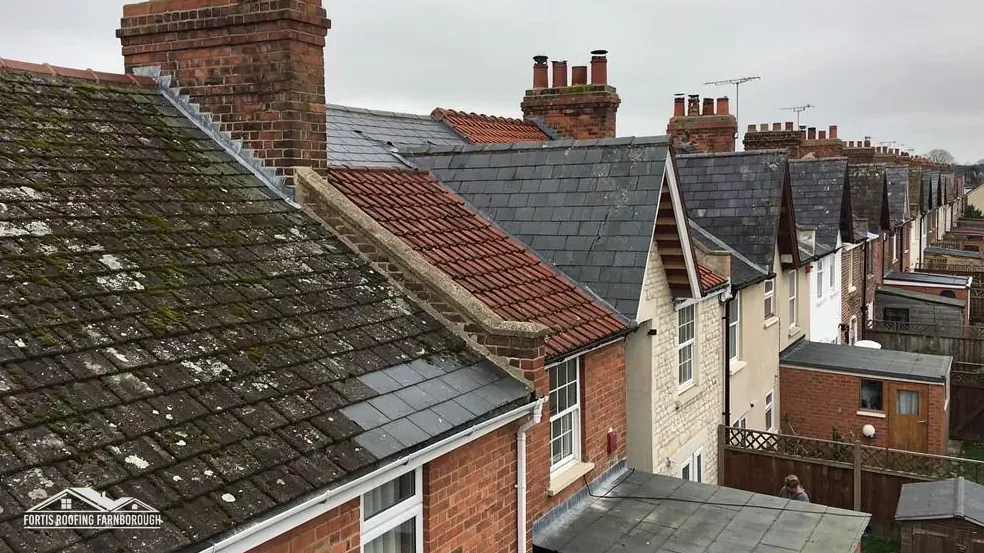
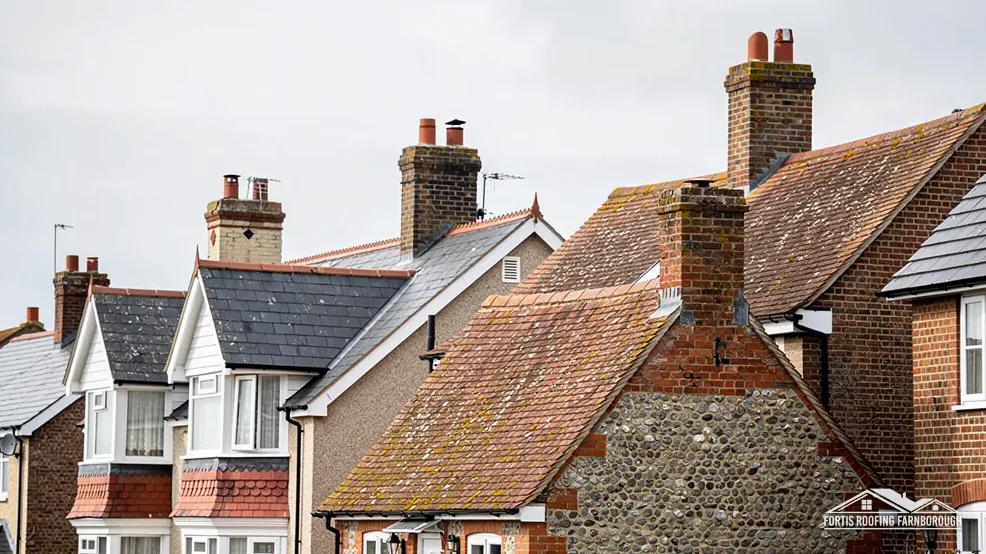
Stacks, flaunching and flashings checked close up, never guessed
We look at the stack from safe access, photograph the pointing, flaunching and lead, and explain what has failed before we price the repair.

Fired bricks bedded in mortar, repointed when the joints wash out.
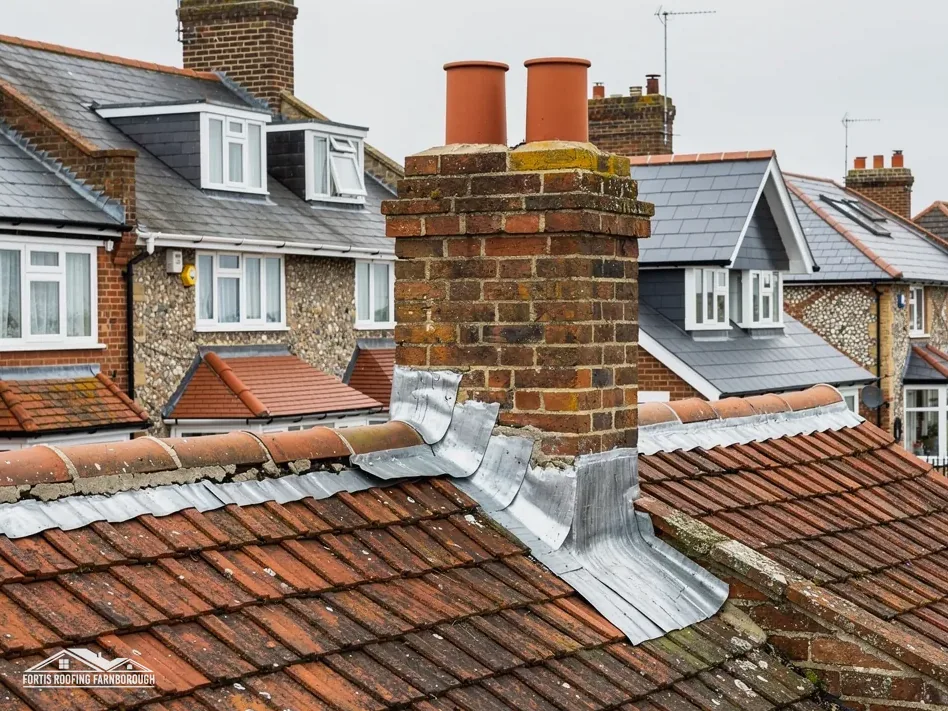
The sloped mortar cap round the pots that sheds rain.

Sheet lead dressed where the stack meets the roof slope.
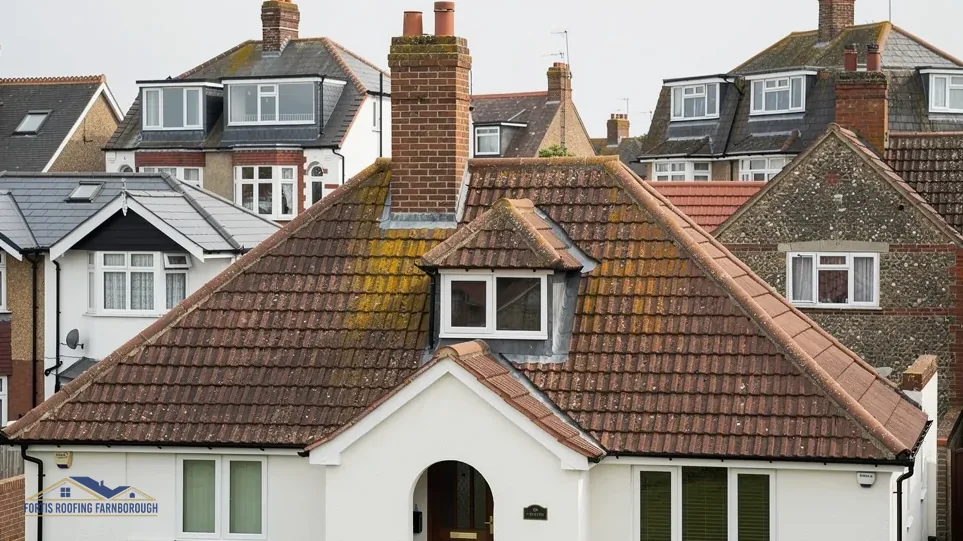 Repointing and brickwork
 Flaunching and pots
 Cowls and capping
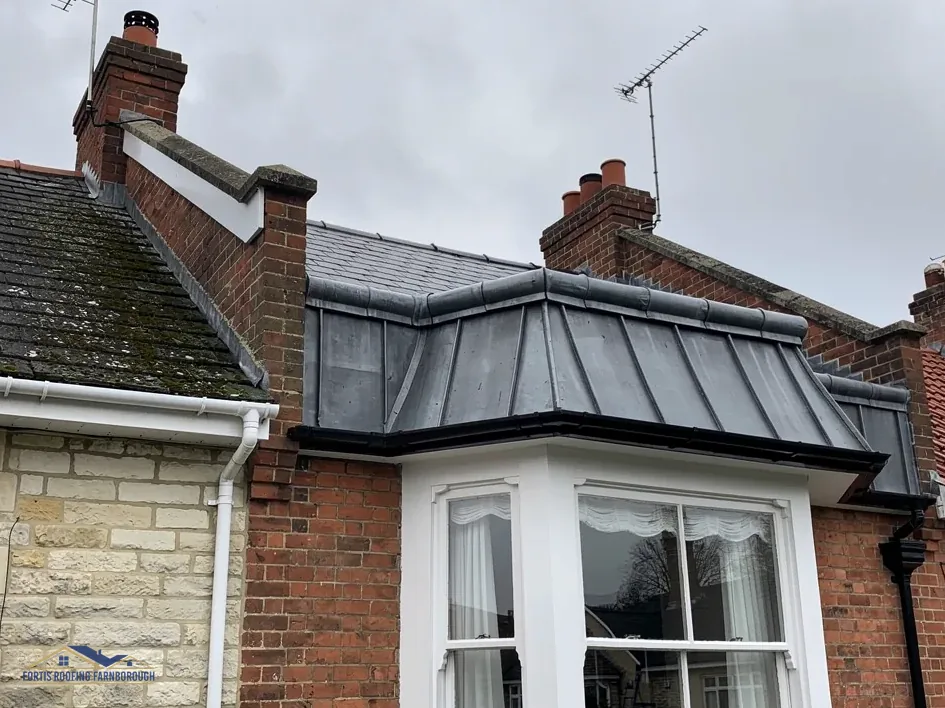 Lead flashing and soakers
 Stack rebuilds
 Redundant stack removal
The bricks are sound and only pointing, flaunching or lead have failed.
Bricks above the roof are spalled or loose, or the stack leans.
The flue is no longer used and the stack costs more to keep.
Chimney stacks, the figures
Weather averages, lead codes, wildlife law, Article 4 directions, party wall notice and scaffold licences for chimney work, each taken from its source and read against the stack on your own roof.
| No. | Chapter | The figure it turns on |
|---|---|---|
| 01 | Frost, rain and the mortar on a stack | Air-frost days a year: about 53 |
| 02 | Lead flashing, soakers and the back gutter | Code 4 lead: 1.80 mm |
| 03 | Pots, cowls, capping and nesting birds | WCA 1981 |
| 04 | Leaning stacks, rebuilds and removal | Party wall notice: 2 months |
| 05 | Article 4, conservation areas and listed homes | Hart's chimney directions: 1998 |
| 06 | Scaffold, access and what sets the price | Cooling-off period: 14 days |
Chapter 01 of 06
Met Office averages for its South Farnborough station
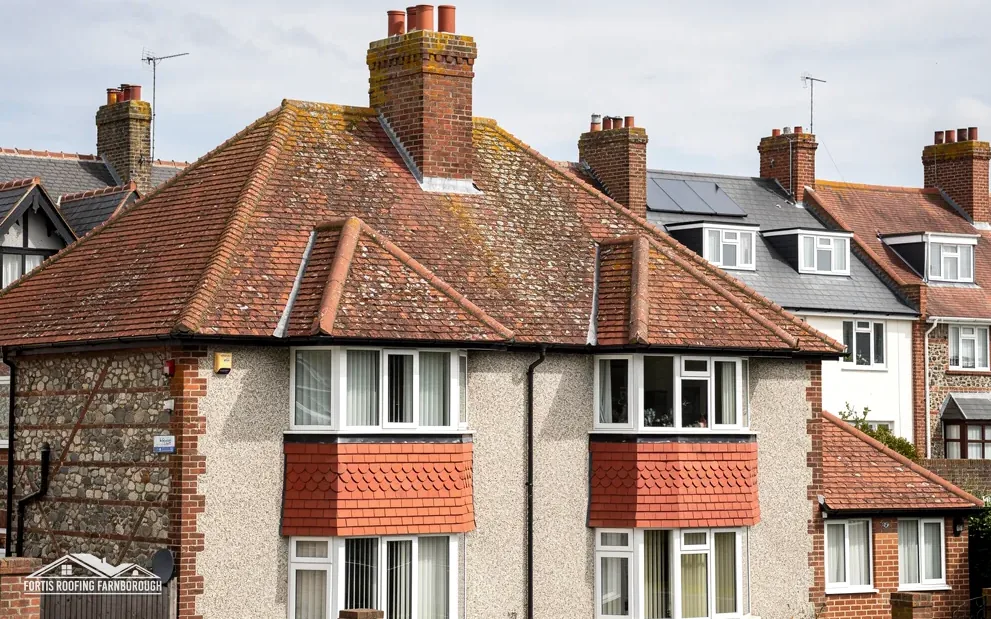
A chimney stack takes more weather than any other brickwork on a house. It stands clear of the roof with rain reaching all four faces, it dries out slowly, and its top is open to the sky. Below the roof it is part of the walls; above the slates or tiles it stands on its own. That is why a stack can be crumbling while the walls of the same house look sound.
The Met Office's averages for its South Farnborough station, over the years 1991 to 2020, give an annual rainfall of about 715 mm, falling on 118 days with at least 1 mm, and around 53 days of air frost. None of that marks Farnborough out from its neighbours. It simply means a stack here spends a good part of each winter wet, with frost to follow.
Water soaks into mortar joints and soft brick faces. When it freezes it expands, and over many winters that cycle opens the joints, loosens the sand in old mortar and pushes the faces off bricks. Flaking brick faces are called spalling. Once the hard outer face has gone, the softer body of the brick soaks up even more water, so the damage speeds up. Pointing, the mortar finish in the joints between bricks, is meant to be the part that wears: it is far easier to rake out and renew than the bricks it protects.
The top of the stack takes the worst of it. Flaunching, the sloped mortar cap the chimney pots are bedded in, throws rain off the top of the brickwork. Once it cracks, water runs straight down into the stack and the flue, and the pots it holds can loosen and shift in a gale.
Regular maintenance of a stack comes down to keeping its joints full. Repointing means raking the old mortar out to a sound depth and filling the joints with new mortar of a strength that suits the brick. A mortar much harder than the brick around it can trap water and make soft faces spall faster, so on an older stack the mix is matched to what was there. Bricks that have spalled deeply are cut out and replaced with bricks of matching size and colour during the same visit.
Repointing a whole stack needs safe access all the way round it, so the scaffold is a large part of the job, and it makes sense to do every repair the stack needs from the same scaffold. Our guide to chimney repointing explains when it falls due and what good joints look like once they are finished.
Chapter 03 of 06
| Law or guidance | What it says | What it means on a stack |
|---|---|---|
| Wildlife and Countryside Act 1981 (nests) | An offence if any person intentionally takes, damages or destroys a wild bird's nest in use or being built | A pot with an active nest waits until the nest is out of use |
| GOV.UK, wild birds | No licensing purposes permit development or construction | Building work is no reason for a licence |
| Wildlife and Countryside Act 1981 (bats) | An offence to intentionally or recklessly disturb a sheltering bat, or obstruct access to its shelter | A cap or mesh must not shut a bat in or out |
| Habitats Regulations 2017, reg 43(1) | Damaging or destroying a bat breeding site or resting place, with no intent needed | A suspected roost is checked before work |
| GOV.UK, bats | Repairing or replacing a roof can affect bats | Chimney work starts with a look for signs |
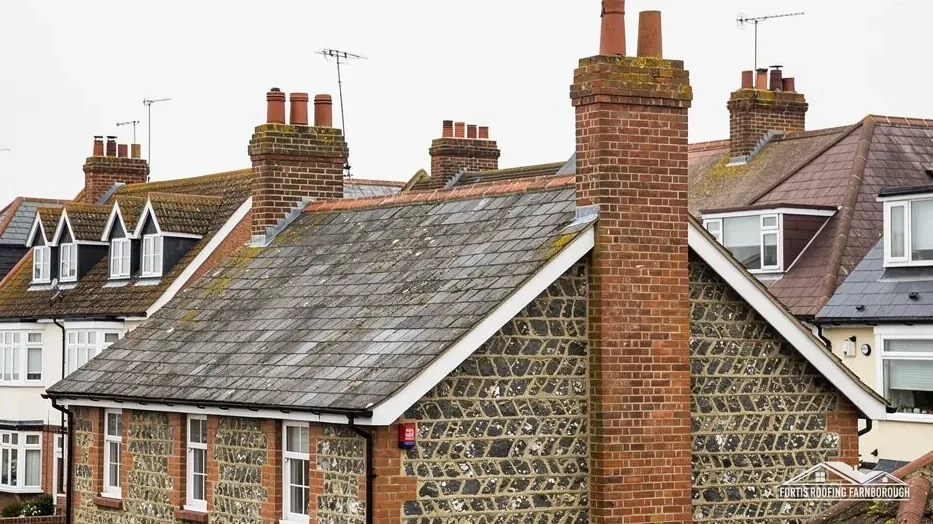
The top of a chimney carries more parts than it seems from the street. The pots sit in the flaunching, and a cowl or cap may sit in or on each pot. Each part fails in its own way, and the right repair depends on whether the flue below still serves an open fire, a stove or a boiler, or has been out of use for years.
Cracked flaunching is broken out and re-formed as a new sloped cap, shaped so it throws water clear of the brickwork. Loose pots are lifted and re-bedded, and a tall pot can be strapped. A cracked pot on a live flue is replaced like for like. A cowl on a pot can keep out rain and birds or help a flue draw, and the right one depends on what the flue serves. A flue serving an appliance needs its own checks from a sweep or heating engineer; a roofer's job is the masonry and weathering around it.
A chimney no longer in use can be capped to keep the rain out, but a flue sealed tight at both ends traps damp. Capping leaves ventilation at the top, with a vented cap or a slab raised clear of the pot, and a vent where the fireplace was inside, so air keeps moving up the old flue and the breast stays dry. Our guide to capping a chimney covers the ventilation in more detail.
Open pots attract nesting birds. Under section 1 of the Wildlife and Countryside Act 1981 it is an offence to intentionally take, damage or destroy the nest of any wild bird while that nest is in use or being built. GOV.UK adds that there are no licensing purposes to permit development or construction. So a pot with an active nest is left until the nest is no longer in use, and the cowl or mesh goes on afterwards to stop the birds returning.
Bats need the same care. Section 9(4) of the same Act makes it an offence to intentionally or recklessly disturb a bat while it occupies a structure it uses for shelter, or to obstruct access to that shelter. Regulation 43 of the Habitats Regulations 2017 makes damaging or destroying a breeding site or resting place an offence with no need for intent. GOV.UK lists repairing or replacing a roof among the activities that can affect bats. Where there are signs of bats around a stack, the work pauses until the position is clear.
For you, timing matters. A chimney you know birds use is best capped or fitted with a cowl once they have finished with the nest, before the next season starts.
Chapter 04 of 06
The rules behind taking a chimney breast or stack down

A stack that leans is a different problem from one that is crumbling. A lean can come from the mortar on one side wearing or swelling faster than the other, or from movement in the structure below the roof. The cause decides the fix. So a leaning stack is measured and photographed face by face, and where the lean is marked or the cause is unclear, a structural engineer's view comes before any price. A stack that has stood with a slight, settled lean for decades is a different case from one whose lean has grown since last winter, and comparing dated photos is the simplest way to tell the two apart.
When the bricks above the roof are spalled, loose or out of line, patching stops paying and the stack is taken down to sound brickwork and rebuilt. Good bricks are cleaned and reused so the new work matches; where too many are damaged, matching bricks are sourced. A rebuild takes in new flaunching, re-set pots and new lead at the roofline, because the flashings have to come out anyway. A rebuild in the same bricks, to the same height and detail, is a repair. Changing the height or look of a stack is a different matter, covered in the next chapter.
Removing a redundant stack to below the roof line ends its upkeep for good. The roof is tiled or slated over the gap and the flue below is capped and ventilated. Taking out the chimney breast inside is a structural job. The Planning Portal says Building Regulations approval will always apply when removing chimney breasts, as they are part of the building's structure. Whatever stays above, a stack on the roof or a breast upstairs, then needs support that building control accepts.
On a terrace or semi, the breast can sit on the party wall. The Party Wall etc. Act 1996 gives a right, in section 2(2)(g), to cut away any projecting chimney breast, jamb or flue from a party wall, and section 3 requires notice to the neighbour at least two months before the work begins. GOV.UK warns that you cannot assume no response means your neighbour agrees, and that a surveyor must be appointed if the two of you cannot agree. Party wall questions go to a party wall surveyor, not to building control.
A stack shared with the house next door brings the same point up on the roof: half of it may belong to your neighbour. Repairs to a shared stack go best when both owners agree the work and the access beforehand. Our guide to chimney breast removal sets out the order in which the approvals, notices and building work fall.
Chapter 05 of 06
| Where | What the council or law says |
|---|---|
| Cargate, Aldershot (Rushmoor) | Article 4 direction of 31 July 2020: installing, altering or removing a chimney or flue visible from a highway or open space |
| Wellesley, Aldershot (Rushmoor) | Article 4 direction covering antennas on a chimney, wall or roof slope facing a highway |
| Hart conservation areas, 1998 directions | Erecting, altering or removing a chimney on a dwelling (all except North Fleet) |
| Guildford, where a direction applies | Removing or altering a chimney needs permission first |
| Hart, non-listed buildings | No planning permission for repairs in a traditional manner, to the original details and in the same materials |
| Any listed building | Listed building consent for works affecting its character |
A like-for-like chimney repair, in matching brick, mortar and lead, does not normally need planning permission. Under section 55 of the Town and Country Planning Act 1990, works that do not materially affect the external appearance of a building are not development. Hart puts it in its own words for non-listed buildings: no permission is needed for repairs carried out in a traditional manner to the precise details of the original and in the same materials. Changing a stack is another matter where an Article 4 direction applies.
An Article 4 direction lets a council withdraw some permitted development rights across a defined area. Three councils near Farnborough have directions that name chimneys. Rushmoor's Cargate direction, covering part of Aldershot and made on 31 July 2020, takes in the installation, alteration or removal of a chimney or flue where the work is visible to anyone on a highway or open space nearby. Hart's 1998 directions on most of its conservation areas, all except North Fleet's, cover the erection, alteration or removal of a chimney on a dwelling; the list includes Crondall, Hartley Wintney, Crookham Village and North Warnborough. Guildford's guidance is that, where a direction is in force, a chimney may not be taken down or changed without permission, and its online map shows which addresses that affects. Everywhere else, ask your council whether an Article 4 direction covers your street before a stack comes down or changes height.
Rushmoor has nine designated conservation areas, among them South Farnborough, Farnborough Hill, Farnborough Street and St Michael's Abbey. Rushmoor also notes that flats have no permitted development rights, so a visible change to the stack on a block needs planning permission. Taking down a prominent stack in any conservation area is worth raising with the council's planning team before work is booked.
A listed house keeps its permitted development rights, but work that affects its character needs listed building consent as well, under section 7 of the Planning (Listed Buildings and Conservation Areas) Act 1990. A chimney can be part of that character, so even a rebuild in matching materials is checked with the council before it starts. On a listed or conservation-area stack, we record the bricks, the bond, the pots and the lead details before anything is touched, so the finished work can be checked against the original, detail by detail. Where the old bricks are too far gone to reuse, the council may want to see a sample of the replacement before it goes up, and that is easier to arrange before the scaffold is booked than after. Our answer on chimney repairs in a conservation area walks through the steps in order.
Chapter 06 of 06
Licences, notice, VAT and cancellation on a chimney job
Chimney work happens at the highest, narrowest point of a roof, and it cannot be done safely from a ladder resting on the tiles. A stack is reached from a scaffold: either a full scaffold up the front or back of the house with a platform round the stack, or a purpose-made chimney scaffold that sits on the roof itself. Which suits depends on where the stack sits, how tall it is, what lies below and how long the work will take. Our guide to scaffolding for chimney repairs compares the two.
A scaffold standing on the public highway needs a licence from the highway authority, under section 169 of the Highways Act 1980. Hampshire County Council is the highway authority for every Rushmoor and Hart address; its page puts the application with the scaffolding firm, acting for its customer, and the fee is £211.90 for the first 2 weeks and £72 for each further 2-week period, with no extensions. In the Surrey boroughs, Surrey County Council (until April 2027) charges £208 per 28-day period; there, we arrange the licence with the scaffolder. Scaffolding on private land, such as a driveway or back garden, needs no licence at all.
The access is a large part of what a chimney repair costs, which is why it pays to do everything a stack needs from one scaffold: pointing, flaunching, pots, cowls and lead together, not three separate visits. Beyond the access, the price turns on the height and size of the stack, the state of the bricks and whether the lead needs renewing or only re-fixing. MyJobQuote puts full chimney leadwork at between £350 and £920, with scaffold the main variable. Repointing is priced from the survey, once the joints and bricks have been seen close up.
VAT at the standard rate of 20% applies, so check that any quote you compare includes it, and the scaffold too. A contract signed in your own home, away from the trader's premises, counts as off-premises, and the cancellation period for a service runs for 14 days after the day it is made. That right does not cover a visit you specifically requested for urgent repairs or maintenance, such as making a dangerous pot safe. Citizens Advice recommends trying for written quotes from at least 3 traders before you choose, and a quote that names the same scope of work makes that comparison fair.
A stack loosened in a storm is reported to your insurer first, then made safe. For a leak that cannot wait, see our emergency and general roof repairs service.
We set up safe access, photograph the brickwork, flaunching and lead, then put one written price to you for the work.
| Job | Typical UK range |
|---|---|
| Full chimney leadwork, scaffold dependent (MyJobQuote) | £350 to £920 |
| Chimney breast removal (MyJobQuote) | £1,200 to £3,500 |
| Roof survey, average (MyJobQuote) | around £300 |
Source: MyJobQuote (chimney leadwork, September 2026; chimney breast removal, August 2026; roof survey, October 2026)
National guide figures, never our own prices. Repointing is priced from the survey, because access and the state of the brickwork decide it.
Short reads on repointing, flaunching, flashing, leaning stacks, capping and removal, written for homeowners with a chimney that needs attention.
Guide · 9 min read
Chimney work is priced by access and extent more than by the size of the repair. Typical UK…
Guide · 9 min read
Repointing replaces the mortar joints that frost and rain have worn out. Done in good time, it protects…
Guide · 9 min read
Flaunching is the sloped mortar that holds chimney pots in place and sends rain away from the flue.…
Both trades have a part. A roofer repairs the outside of the stack: the brickwork, pointing, flaunching, pots, cowls and the lead where it meets the roof. A sweep cleans the flue and checks that it draws. If you use an open fire or stove, the state of the flue is a question for a sweep or heating engineer.
Heavy, driven rain finds weaknesses that light rain misses: open mortar joints and porous bricks on the stack, cracked flaunching, a back gutter blocked with leaves, or a flashing pulled out of its joint. Damp that comes and goes with the rain points to water getting in from outside, and we trace it on the stack and photograph the cause.
It depends on the cause and the policy. The Financial Ombudsman lists gradual damage and wear and tear among common exclusions, so worn pointing is unlikely to be covered, while storm damage may be, under your policy's own storm definition. Contact your insurer before anything else, keep a record in photos and receipts, then get the stack made safe.
Yes. A redundant stack can be taken down to below the roof line, the roof tiled or slated over and the flue capped with ventilation, leaving the breast inside alone. Check first whether an Article 4 direction covers chimneys where you live: Cargate in Aldershot, Hart's conservation areas and some Guildford addresses have one.
Lead and capping work can go ahead in most weather, but new mortar must not freeze while it sets, so pointing and flaunching wait for a dry spell above freezing or are protected while they cure. A storm-damaged stack is made safe straight away, and the permanent repair follows when conditions allow.
Get your free roof quote
Send a photo of the stack from the street, or tell us where the damp shows inside.
10-year workmanship guarantee, in writing.



