The short answer
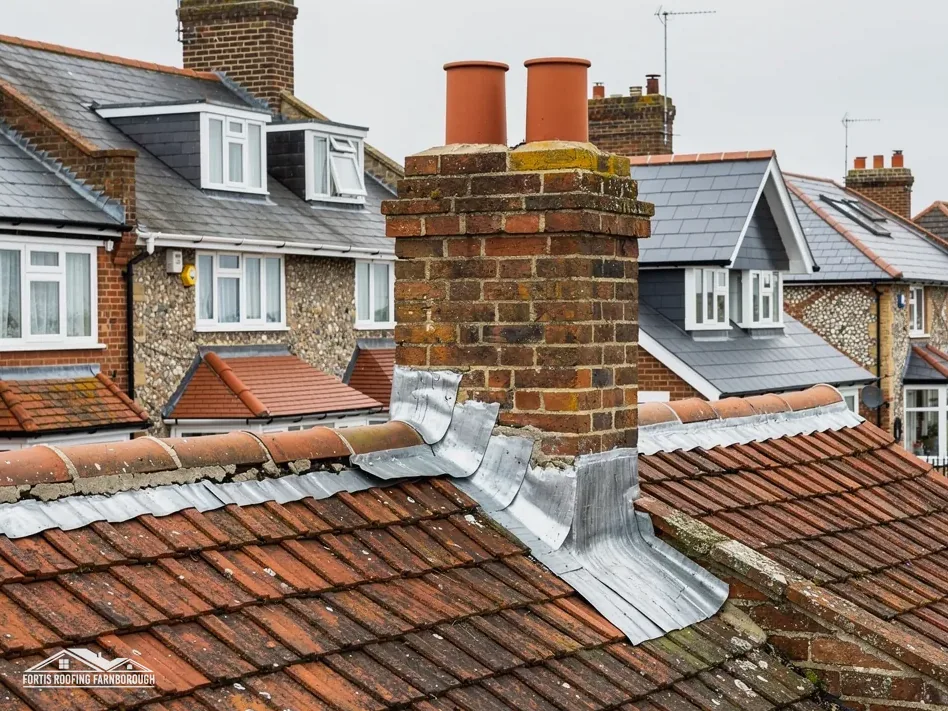
A roofer's chimney inspection covers the outside of the stack and everything that keeps water out of it: brickwork and pointing, the pot, the flaunching, the flashings and back gutter, and the lean of the stack. It is recorded with photographs. It differs from a sweep's check, which looks inside the flue and the appliance.
Brickwork, pointing and the lean of the stack
The inspection starts with the stack as a structure. A chimney is a tall, thin column of brick, exposed to wind and rain on every side, and it ages faster than the walls below.
From the roof we look at each face of the stack. Is the pointing, the mortar between the bricks, still full and sound, or has it eroded back so that the joints are hollow? Are any bricks spalling, which means the face is flaking off? Are there cracks, and if so, do they run along the joints or through the bricks themselves?
We also check whether the stack leans. A slight movement over decades can be harmless, but a stack that has tilted noticeably, or whose cracks have opened, is a different case. A leaning stack is judged on how far it has moved and whether the cracks are still widening.
Staining on the outside tells a story too. Dark streaks below a joint point to water running out of a defect, while white salt deposits on the bricks suggest that moisture is working its way through them from inside.
Each finding is photographed, so you see the brick you are being asked to pay for and not a description of it.
Pots, flaunching and the top of the stack
At the top of the stack the inspection turns to the pots. A pot sits in a bed of mortar, the flaunching, which is shaped to shed water away from the flue opening. Over time the mortar cracks or shrinks, and rain finds its way under it.
The checklist at the top includes:
- whether each pot is upright and firmly bedded, or rocks under light pressure;
- cracks or loose pieces in the flaunching, and whether water can reach the bricks beneath;
- chips and splits in the pot itself;
- the state of any cowl, cap or bird guard;
- signs of nesting material in or around the pot.
A loose or cracked pot is a falling hazard as well as a leak risk, which is why it is photographed and flagged early. Our answer on chimney pot replacement covers what follows if one has to come off.
If the flue is in use, the top of the pot may carry soot or tar deposits. Those are a matter for the sweep and the appliance installer, and we note them without trying to deal with them.
Flashings, the back gutter and where the roof meets the stack
Many chimney leaks begin where the roof meets the stack, not in the brickwork. The inspection therefore includes the leadwork around the base: the front apron, the stepped flashings up each side and the back gutter behind.
For lead, we look for cracks along folds, lifted edges, gaps at the brickwork and places where the lead has slumped. The joint into the brick is checked as well. Lead is dressed into a groove cut in the mortar, and the groove is filled and pointed. If that pointing has failed, water gets behind the metal even though the lead itself is sound. Royston Lead's cast-lead brochure lists code 4 lead at 1.80 mm for flashings, and heavier codes for gutters, so we also note the thickness where it can be seen.
The loft gets a look as well when it can be reached. Damp on the breast, rotted timber near the stack and daylight at the edge of the brickwork all point to a problem the outside views might miss. Our guide to chimney flashing sets out the parts.
The loft and roof views are paired in the photographs, so a stain inside can be matched to a joint outside.
How this differs from a sweep's check, and what you receive
A chimney sweep and a roofer look at different parts of the same structure. The sweep works from inside, cleaning the flue and checking that it is open and clear from the appliance to the top. A sweep deals with soot, creosote and blockages, and with the condition of the liner as far as it can be judged.
The roofer works from outside and above, and deals with the stack as part of the roof: its brickwork, pots, mortar and leadwork. A flue can be perfectly clear while the flashing leaks, and a stack can be watertight while the flue needs sweeping. Our guide on roofer or chimney sweep explains who to call for which problem.
After the inspection you receive the photographs, a plain account of what each one shows and what, if anything, needs doing. Where work is needed, the findings come with a single written price. Where nothing is needed, you have a record of the stack's condition to compare with in later years.
The chimney repairs hub lists the repairs that can follow. An inspection that finds nothing wrong is still a useful result.