The short answer
On a shared stack, the Party Wall etc. Act 1996 may apply to work that cuts into the party wall, such as cutting away a chimney breast or flue. The owner then serves notice two months ahead of the start. Silence from next door is not consent, and surveyors settle any disagreement. Ordinary repairs to your own side of the roof are a different matter.
What a shared stack is
Where two houses are joined, the chimney often sits on the line between them. One stack, one set of brickwork above the roof and a pair of flues, one for each house. The stack and the wall beneath it can be a party structure, belonging to or serving both owners.
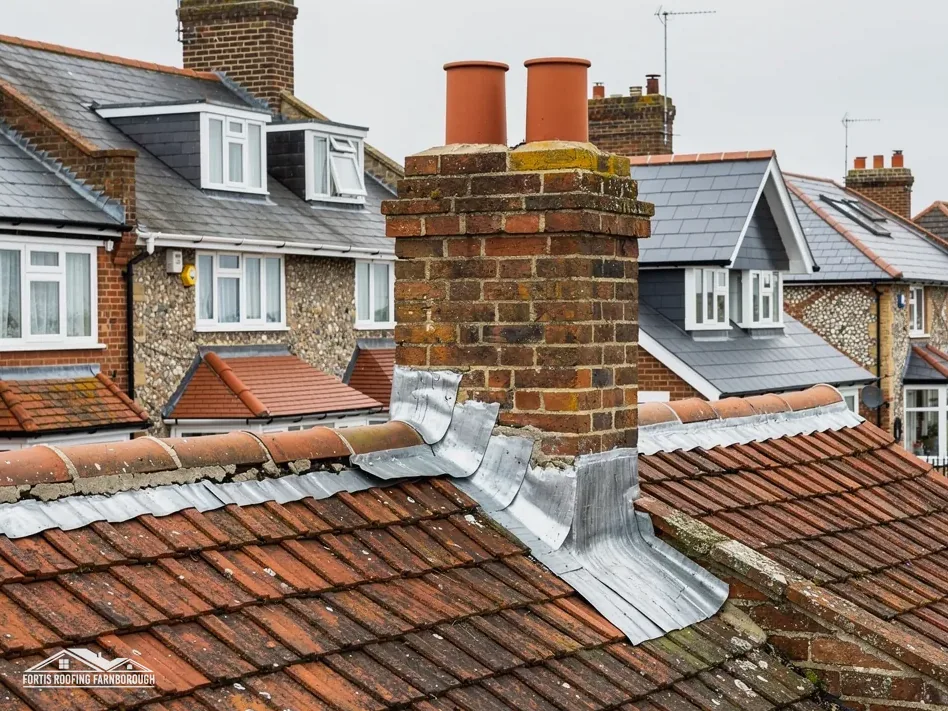
That has everyday consequences. A crack in the stack, a failing flaunching or leaking flashings can affect both properties, because water that enters at the top can show up on either side. A repair done well helps both houses, and one done badly can damage the neighbour's chimney breast as much as yours.
It also makes the pots, the brickwork and the leadwork matter to both homes. Neighbours see the stack from their own garden and loft, and they will notice scaffolding, noise and dust.
The first practical step is to find out how the stack is arranged. From the loft you can often see where the dividing wall runs and which flues belong to which house. A roofer's survey records this with photographs, and it shows which parts of the work reach the shared wall and which stay on your own side.
That line decides which legal route applies, as the next sections explain.
When the Party Wall Act comes in
The Party Wall etc. Act 1996 sets out rights and duties between neighbours when building work touches a shared wall. For chimneys, the relevant right is in section 2(2)(g): the building owner may remove a protruding chimney breast, with its jamb or flue, from a party wall.
That points to alterations, not routine maintenance. Removing a breast that juts out from a shared wall, or cutting into the wall to take out a flue, is the sort of work the Act addresses. Repointing your own side of a stack, or replacing a pot, is less clear, and the decision rests on whether the work affects the party structure. A party wall surveyor can advise on that point.
Where the Act does apply, section 3 sets out the notice. It must be served two months before the work is due to start. The notice has to be in writing and say what you propose to do.
These are separate from Building Regulations. Removing a breast always needs approval from building control, and the party wall process runs alongside it. Party wall questions go to a party wall surveyor, not to building control. Our answer on gallows brackets for chimney breast removal covers the support side.
If the neighbour does not agree, or does not reply
People often worry that a silent neighbour blocks the work. The government's guidance on party walls says you cannot assume that no response means they agree to the works. So silence leaves the matter unresolved and does not settle it either way.
The Act provides a route. Where the two owners differ, surveyors have to be appointed, and they settle how the work will be done and record the outcome. This is a formal process with its own costs and timescale, and it is better begun early than discovered halfway through a project.
A few practical points follow. Serve the notice in good time, and allow for the two months in your programme. Describe the work clearly, and attach drawings if there are any. Keep copies of everything, and note the dates.
Talking first helps. Most neighbours are reasonable when they understand what is happening, and a friendly explanation before the formal notice often avoids a dispute. Our answer on roof work and neighbours covers the courtesies.
If you are weighing up options, our survey gives you evidence to show next door, with photographs of the defect and the proposed repair.
Planning repairs on a shared stack
For routine repairs, the sensible approach is cooperation. A stack that leaks or leans is a problem for both houses, and a joint repair is often easier than two separate ones. Agreeing who does what, and when, avoids the situation where one side is repointed and the other is left to fail.
Practical questions to settle include whether one scaffold can serve both houses, how the cost is shared and which roofer is instructed. Each owner is responsible for their own flue, and the shared brickwork needs a clear understanding. Do not assume the other side will pay, because the Act and the law deal with notice and process but not with every question of cost, and a written agreement protects both parties.
On the survey, we record the stack from both slopes where access allows, and we note which defects belong to which side. Where the work could affect the neighbour's chimney, the photographs help explain what is proposed. If the stack is to come down below the roof line, our guide to removing a chimney stack below the roof line sets out the steps.
The written price covers the work you ask us to do on your property, and any party wall steps run alongside. More on the repairs themselves is on the chimney repairs hub.