Tiles and slates
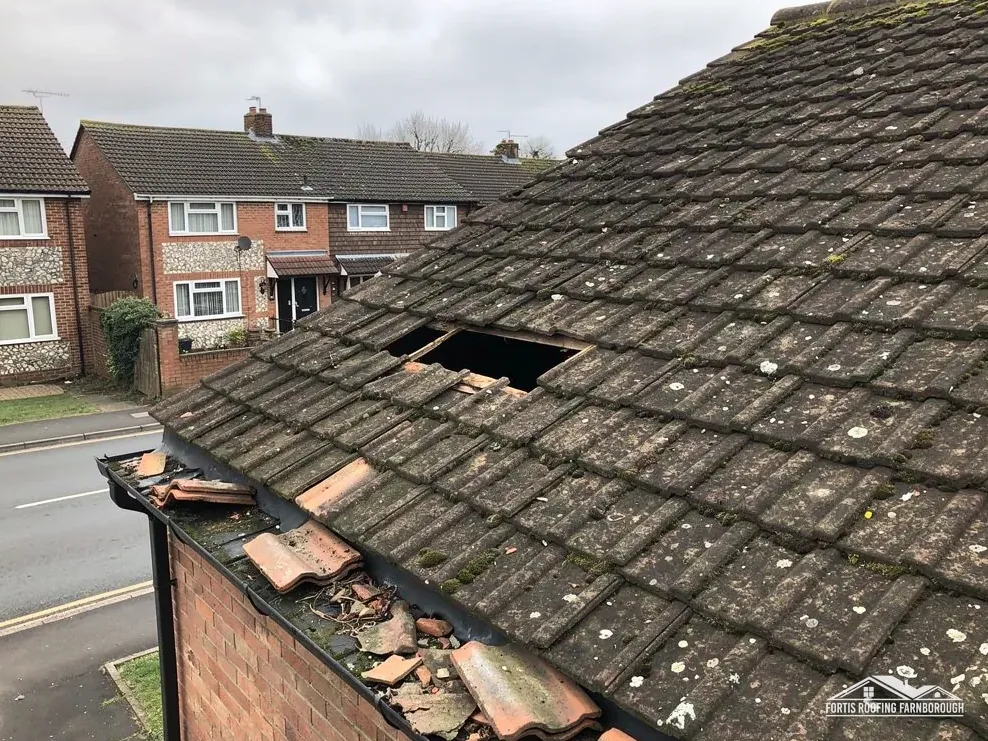
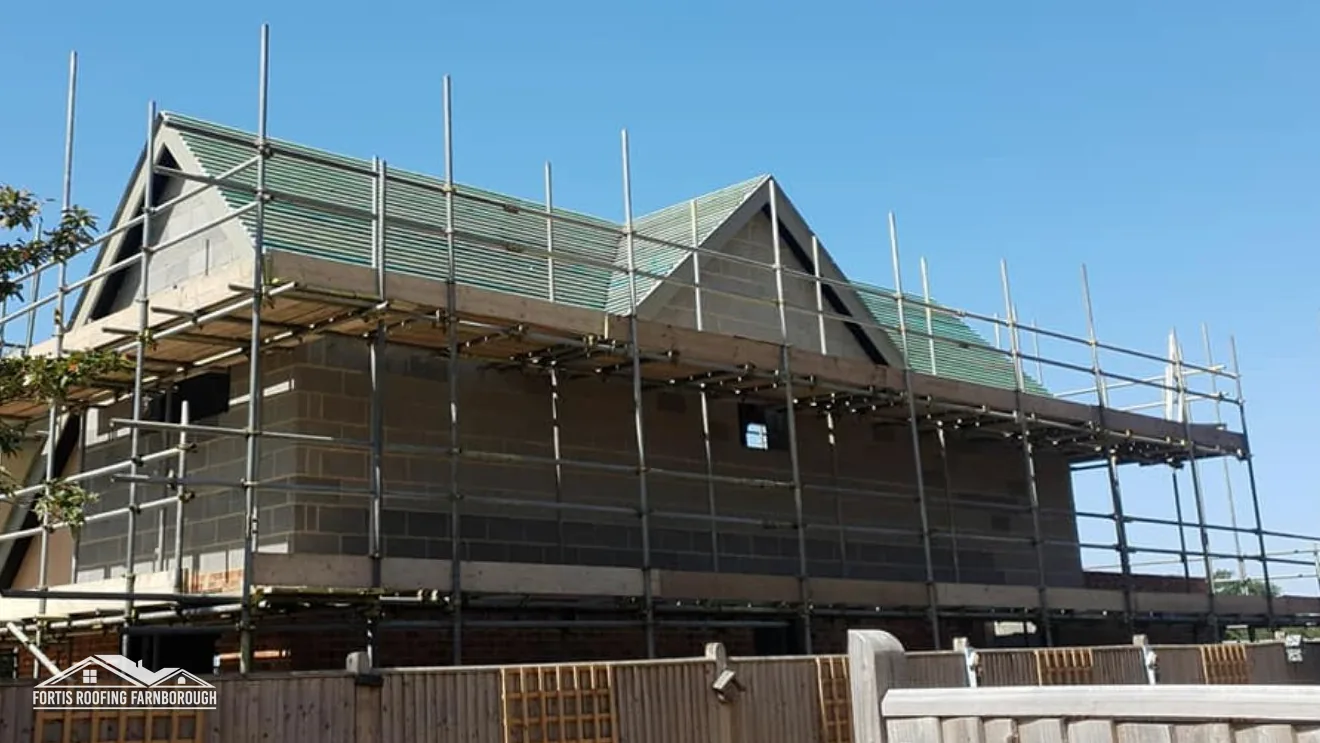
Matched to the original and refixed with mechanical fixings to BS 5534.
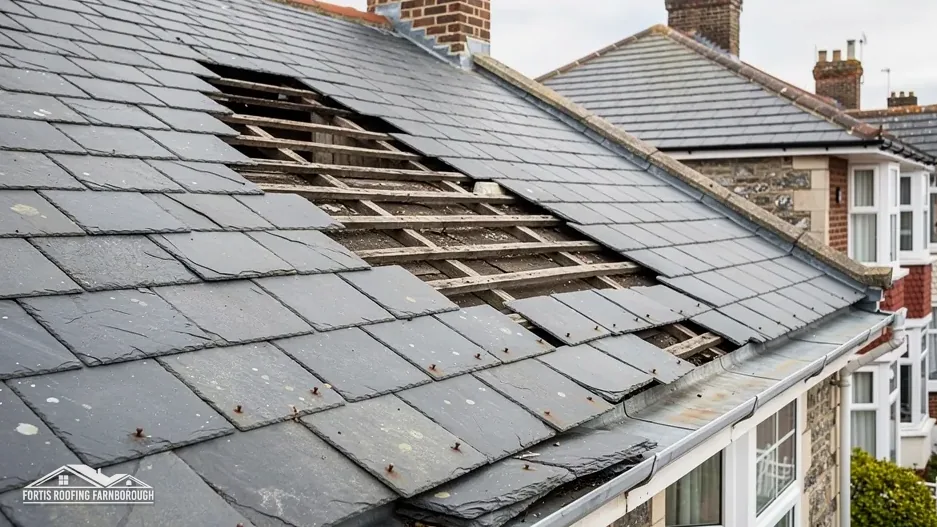
Leaks made safe first, then traced and properly repaired
When water is coming in, we make the roof safe, find where the leak starts, photograph it and explain the permanent repair in plain words.
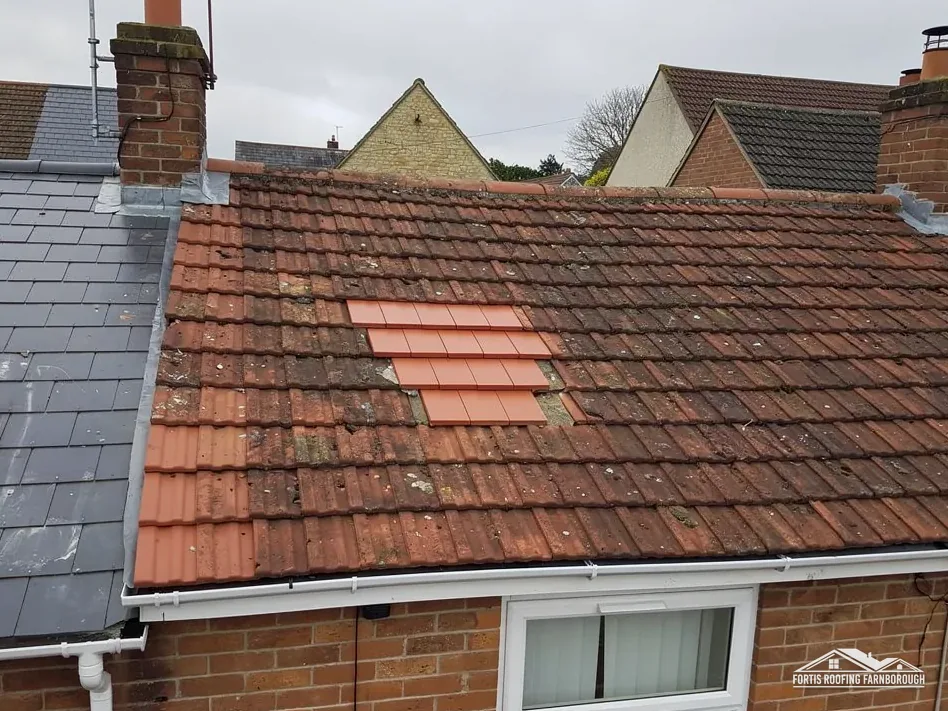
Matched to the original and refixed with mechanical fixings to BS 5534.
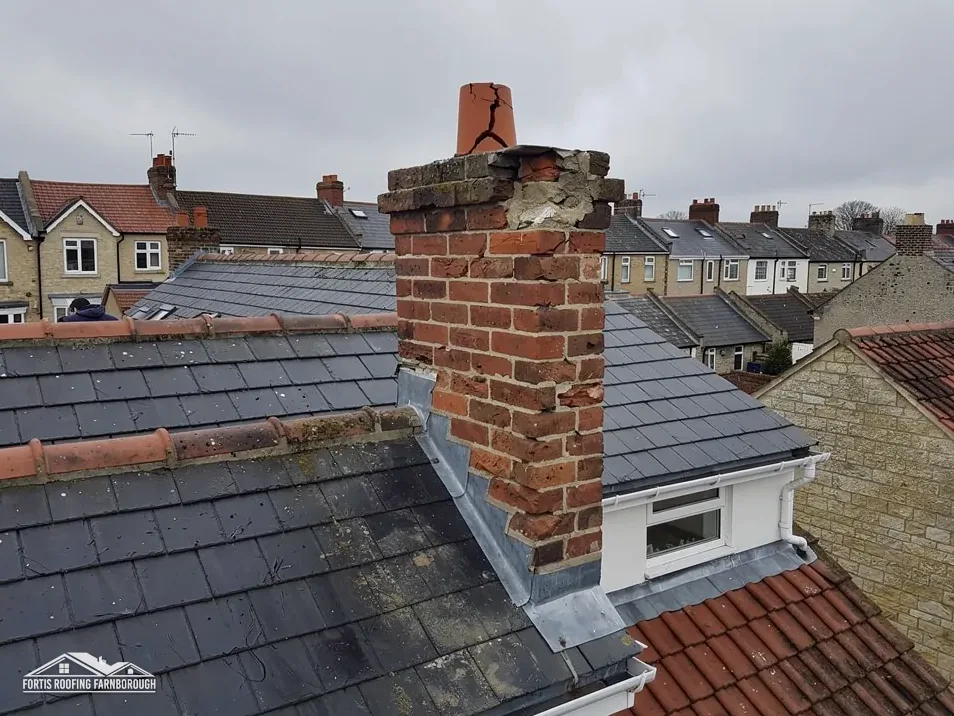
Chimney flashings, soakers and valleys, where roof meets wall or stack.
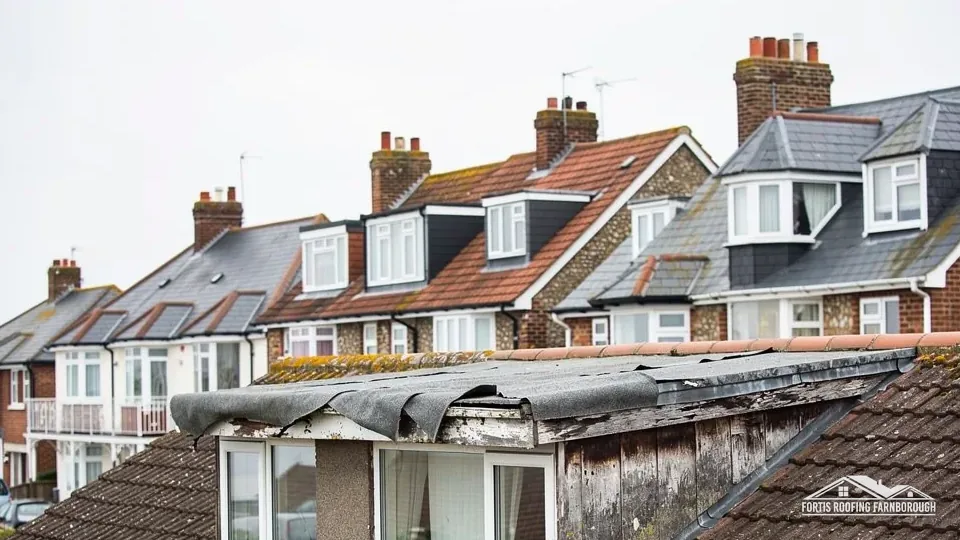
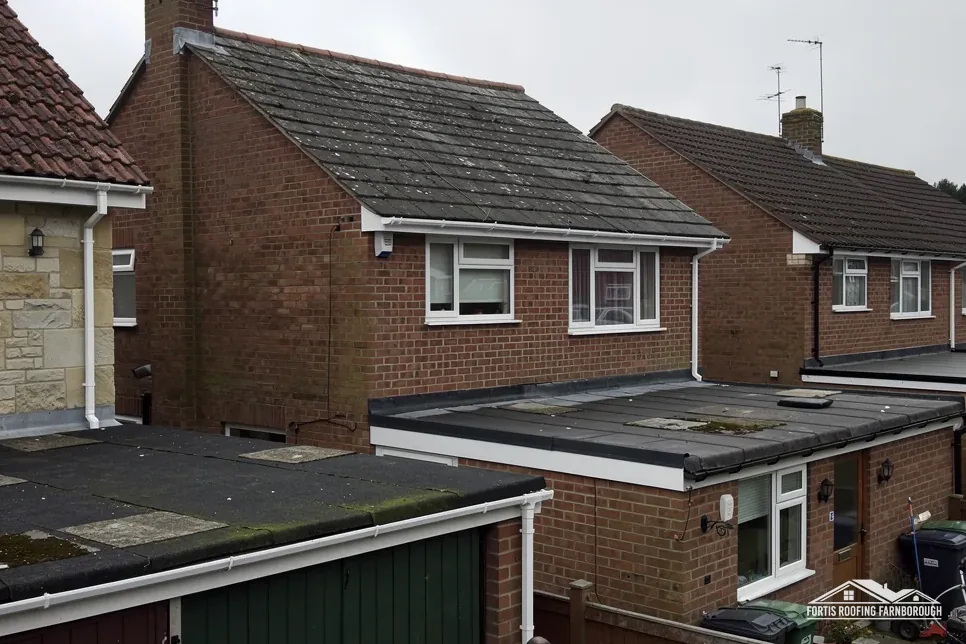
Torch-on felt, GRP fibreglass and EPDM rubber, patched or relaid.
 Leak tracing
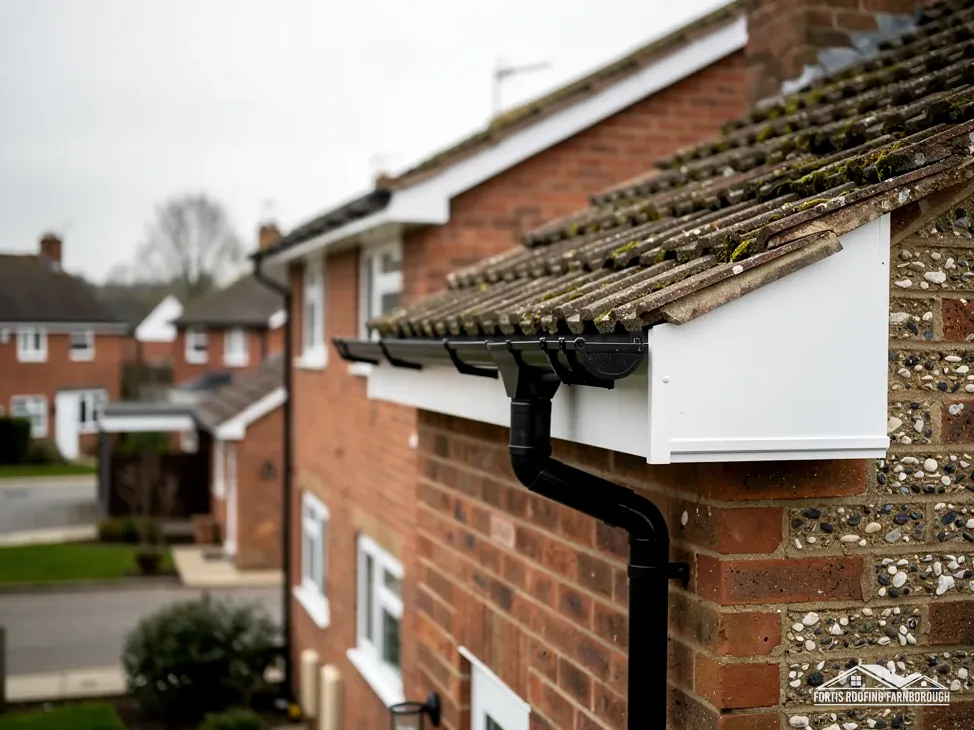 Make-safe covers
 Slipped tiles and slates
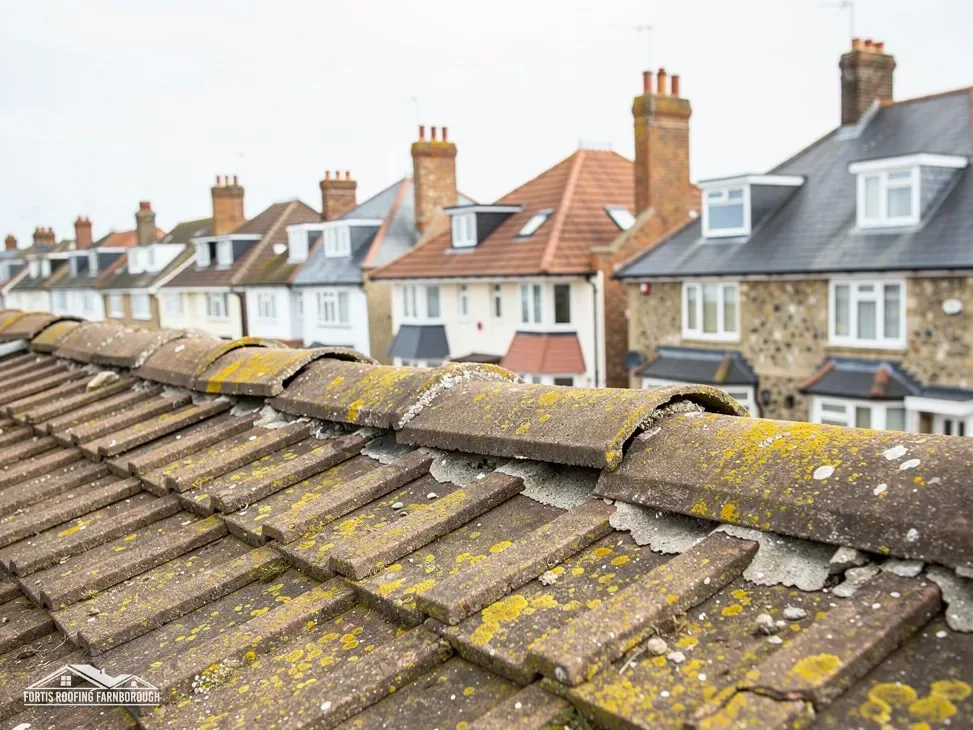
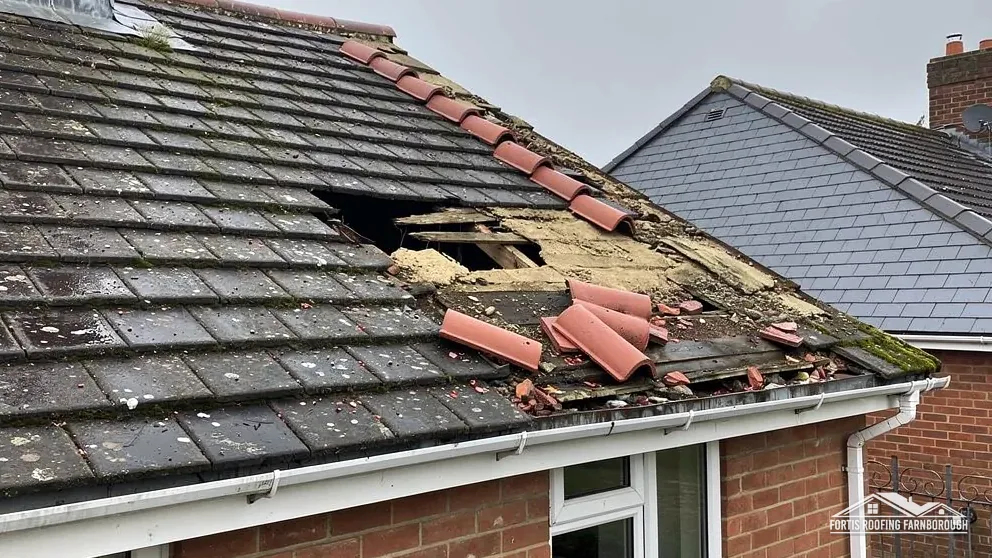 Ridge and verge re-bedding
 Flashing and valley repairs
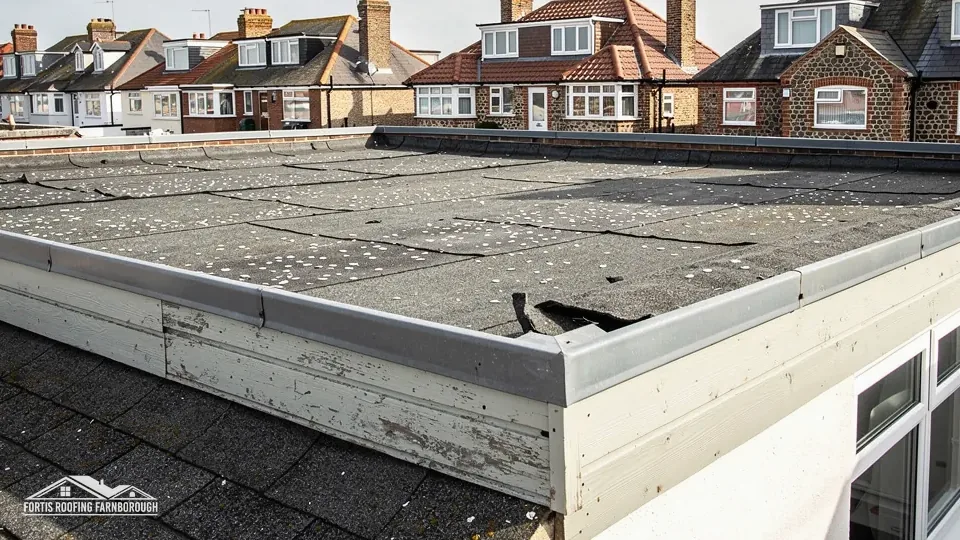 Flat roof patches
Water is getting in now, so the roof is covered until a proper repair.
The fault is local, and the covering, battens and underlay around it are sound.
Failures show on every slope, or the flat roof has reached the end of its life.
Leaks and repairs by the numbers
Rainfall averages, material lifespans, licence notice periods, insurance outcomes and consumer rules from the Met Office, national guides, councils and regulators, each read against a roof that is letting water in.
| No. | Chapter | The figure it turns on |
|---|---|---|
| 01 | Farnborough rain and where it gets in | 118 wet days a year |
| 02 | Making the roof safe before the real repair | 10 working days' licence notice |
| 03 | How long the parts that leak tend to last | Torch-on felt: 10-15 years |
| 04 | Storm damage, insurers and the Financial Ombudsman | 32% of 2024 storm claims paid |
| 05 | Repair or re-roof: where the line falls | Less than 50 per cent of the roof |
| 06 | Your rights when you call a roofer urgently | 14 days to cancel, with one exception |
Chapter 01 of 06
South Farnborough climate station, averages for 1991 to 2020
Met Office averages for its South Farnborough station, taken over 1991 to 2020, put total rainfall at about 715 mm a year, spread across 118 days that each bring 1 mm or more. The same records show around 53 days of air frost in a typical year. None of that marks the area out as unusual. What it does mean is long damp spells for every roof in the town, broken up by cold nights when standing water turns to ice, and that pairing hunts out any weak joint.
A sound tile or slate sheds water for a very long time. Leaks start where the covering stops and something else takes over: the mortar under the ridge (the capped line along the top of the roof), the lead flashing that seals a slope against a chimney or wall, the upstand where a flat roof turns up a wall, or the outlet where rain leaves a flat roof. Water that sits in a hairline crack and then freezes opens that crack a little further each time. Moss on the tiles holds water against them after every shower. A gutter blocked with leaves overflows at the eaves and runs back behind the fascia (the eaves board that carries the gutter) and into the soffit beneath it, which can look exactly like a roof leak from inside the room.
The first job on any leak is to find where the water actually enters, because it rarely shows indoors directly below that point. It runs down a rafter, along the top of a ceiling and out at the lowest place it can reach, often a light fitting or the edge of the coving.
What you can see inside narrows the search before anyone climbs a ladder:
Our guide on how roofers find a roof leak goes through each check in order.
Chapter 02 of 06
| Highway authority | Covers | Notice asked for |
|---|---|---|
| Hampshire County Council | Rushmoor, Hart, East Hampshire, Basingstoke and Deane | Ten clear working days; no extensions |
| Surrey County Council (until April 2027) | Surrey Heath, Waverley, Guildford, Woking | At least 10 working days; phone if a structure is unsafe |
| Wokingham Borough Council | Wokingham borough | A minimum of 10 working days |
| Bracknell Forest Council | Bracknell Forest | Not stated; each licence runs 6 weeks |
| Private land or a private road | Anywhere | No licence needed (Bracknell Forest, Wokingham) |

A make-safe is a temporary measure with one job: to stop more water getting into the house until a permanent repair can be done properly. It is not the repair, and we tell you that on the day. On a pitched roof it can mean easing a slipped tile back into place, fitting a spare where one is missing, or lifting off a loose ridge tile before it falls. On a flat roof it can be a patch over a split. Where the damage is larger, a heavy-duty tarpaulin goes over it, held down with battens (the timber strips that tiles hang from) so the wind cannot get underneath.
A temporary cover buys time. It does not dry out wet insulation, refix soft battens or explain why the roof failed. That comes next, on a proper survey once the weather allows, when the cause can be photographed and the permanent repair priced. Our guide to temporary roof repairs sets out what each method is good for and how long it tends to hold.
Indoors, you can help in safe ways: catch the drips, move furniture and rugs, and take photos of the damage. If water has reached a light fitting or a socket, switch that circuit off at the consumer unit if you can get to it safely. Never go onto the roof or up a ladder in wind or rain.
How the damage is reached decides how soon the permanent repair can follow. Ladders, a roof ladder hooked over the ridge, or a tower standing on your own drive need no permission. Scaffolding that stands on a pavement or road does: section 169 of the Highways Act 1980 makes it licensable by the highway authority, and the table shows the notice each one asks for. Hampshire County Council, the highway authority for Farnborough, Aldershot, Fleet and the rest of Rushmoor and Hart, expects the scaffold firm to make the application for its customer, and it wants ten clear working days between application and start. Surrey County Council (until April 2027) asks for at least 10 working days and says to call if an emergency licence is needed sooner because a structure is unsafe or there is a significant safety risk. In Surrey and Bracknell Forest, the licence is something we arrange with the scaffolder.
Licence notice
That notice period is one reason a make-safe is usually done from ladders or a tower, with scaffold following for the permanent work if the job needs it. Scaffolding that stands wholly on private land needs no licence, as Bracknell Forest and Wokingham both point out. Where scaffold is needed, it sits inside the written quote.
Chapter 04 of 06
Storm claims: an outcome figure and the complaint time limits
Storm claims turn on wording, so it helps to know whose wording counts. The Financial Ombudsman Service, which settles disputes between consumers and insurers, describes a storm as a spell of violent wind that normally brings rain, hail or snow with it, and it accepts that a heavy fall of rain, hail or snow on its own can count too. The Beaufort Scale forms part of its assessment, and it notes that some insurers only treat winds above a set point on that scale as storm-force. Your policy's own storm definition is where your insurer starts, so read that page of the policy before you ring.
When a homeowner complains that a storm claim was turned down, the Ombudsman works through three questions: was there a storm, is the damage consistent with storm damage, and were storm conditions the main cause. Policies commonly exclude gradual damage and wear and tear, so a roof that was failing before the wind arrived makes a harder claim. Which? reported that only 32% of storm-related claims made in 2024 resulted in a payout. That figure is a reason to gather good evidence, not a reason to give up on a fair claim.
If your insurer has not given a final response within eight weeks, or you disagree with the one it gave, you can take the complaint to the Ombudsman, and you have 6 months from the final response to do so. The service costs you nothing, and its helpline is 0800 023 4567. Keep the insurer's letters and emails together with your photos, because the Ombudsman will ask for the whole trail.
Tell your insurer first, before any permanent work starts, and keep every photo and receipt. Making the roof safe stops the damage spreading, and the record of that visit belongs in the same file. The Institution of Structural Engineers puts it plainly: "Photographs are vital for your insurance claim, as they provide visual evidence of the damage." Take your own from the garden and from inside the house, including stained ceilings and wet loft boards.
On the roof, we photograph the storm damage close up and the roof around it as well, so the condition of the covering before the storm can be seen alongside what the storm did. That gives you and your insurer the same picture. MyJobQuote puts extensive storm repairs at £1,200 or more as a typical UK figure; a few lifted tiles cost far less than a stripped section of roof, and the survey shows which you have. Our guides on what to check after a storm and on whether a roof leak is covered by home insurance go further.
Chapter 05 of 06
| Test or council | Published wording | Source |
|---|---|---|
| Building envelope | Less than 25 per cent affected: normally no application | Planning Portal |
| Roof area | Less than 50 per cent affected: normally no application | Planning Portal |
| Heavier covering | 15 per cent or more heavier: approval needed | Planning Portal |
| Bracknell Forest | Replacing roof coverings: may also need approval | Bracknell Forest Council |
| Basingstoke and Deane | Replacing roof coverings: might also need approval | Basingstoke and Deane |
| Windsor and Maidenhead | Re-tiling and re-felting on its list | RBWM |
Every roof reaches a point where patching stops being good value. The table gives the national test for when work on a roof needs a Building Regulations application, which is one useful marker of scale. On the Planning Portal's guidance, an application is not normally required if the work touches under 25 per cent of the building envelope and under 50 per cent of the roof. Any replacement covering that adds 15 per cent or more to the roof's weight does need approval, and the Planning Portal advises asking a structural engineer or surveyor to look first. A repair to a few tiles or one flat-roof patch sits far below both lines.
A repair is the right buy when the fault is local and the roof around it is sound. The evidence starts to point the other way when:
None of those settles it alone. We photograph what we find and explain what each photo shows, so you can see why we are recommending a repair or a new roof. When a flat roof needs replacing, our flat roofing service covers felt, GRP and EPDM. Approved Document L treats a new waterproof layer on a flat roof as renovation of that roof, which can bring the energy rules into the job, so it is worth settling before the work is priced.
For homes in Rushmoor and Hart, the council route is the Hart and Rushmoor Building Control Partnership, based at the Rushmoor council offices in Farnborough (01252 398715). You can also use a registered building control approver, the private route that has run under a statutory register since 6 April 2024. Rushmoor and Hart set no re-roofing percentage on their own pages and send people to the Planning Portal's guides instead.
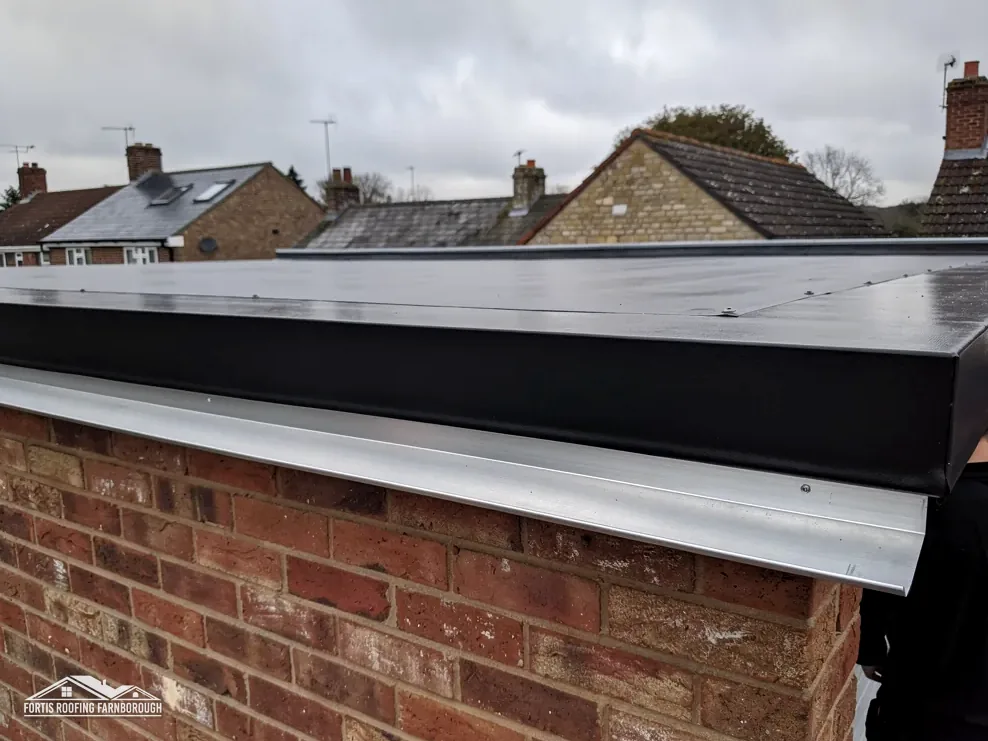
Across the county lines the wording changes. Bracknell Forest Council names new coverings on a pitched or flat roof as work that may also need approval, Basingstoke and Deane's page reads much the same, and RBWM, the Windsor and Maidenhead council, puts re-tiling and re-felting on its own list. None of the three gives a percentage, and none says a re-roof always needs approval. For addresses in those areas we check with the council before a re-roof begins, and we pass on exactly what we were told.
Chapter 06 of 06
Consumer rules that apply to roof repair contracts
An emergency call-out is a different kind of contract from a planned job, and the law treats it differently. Under the Consumer Contracts Regulations 2013, a contract you agree away from where the trader does business, say at home once the survey is done, is an off-premises contract. For a service, you can cancel it for any reason within 14 days, counted from the day after the contract is made. Citizens Advice says that cooling-off right applies if the business approached you away from its premises and the service costs £42 or more. If the trader gives you no cancellation information at all, that window stretches, by as much as 12 months. Those rules apply to any trader you invite in, not only roofers, and they are worth knowing before a stressful week rather than during one.
There is an exception that matters on a leaking roof. Regulation 28(1)(e) removes the cancellation right where "the consumer has specifically requested a visit from the trader for the purpose of carrying out urgent repairs or maintenance". Citizens Advice words it the same way: there is no automatic cooling-off if you invite a business into your home for urgent repairs. So the make-safe visit you asked for normally sits outside the 14-day right.
The permanent repair is often a separate piece of work, priced after the survey. If you agree to it at home, ask whether it carries the 14-day right. Where you want that work to start inside the 14 days, the regulations need your request on a durable medium, such as an email or a signed form. Whichever way the work was booked, the Consumer Rights Act 2015 says a service must be performed with reasonable care and skill.
Once the roof is safe and dry, the pressure is off and you can take your time over the permanent repair. Citizens Advice recommends collecting written quotes from 3 or more traders before choosing one. When you compare them, check that each one includes VAT and scaffolding, so the totals sit on the same footing. VAT on roof repairs is charged at the standard rate of 20%. Under section 308 of the Digital Markets, Competition and Consumers Act 2024, a trader must also point you to any alternative dispute resolution on offer, should a complaint end in a result you cannot accept.
For free advice on any of this, the Citizens Advice consumer helpline is 0808 223 1133. Our answer on cancelling an emergency roof repair covers the timing in more detail.
Tell us where the water is showing, and we will make the roof safe, find the cause and price the permanent repair.
| Job | Typical UK range |
|---|---|
| Average roof repair in 2026 (MyJobQuote) | around £650 |
| Emergency roofer call-out (MyJobQuote) | £150 to £300 |
| Between one and six standard tiles renewed (Which?, ex VAT) | £75 to £400 |
| Clear out all gutters, front and back (Which?, ex VAT) | £75 to £350 |
Source: MyJobQuote roof maintenance and emergency roofer guides (October 2026); Which? cost guide (November 2025, prices ex VAT)
National cost guide figures, not our prices. Yours comes after the survey, in writing, as one total.
Short reads on finding a leak, temporary covers, storm claims, repair costs and your rights when you call a roofer out in a hurry.
Guide · 9 min read
National guides put an average roof repair at around £650, with small tile jobs far below that and…
Guide · 9 min read
An emergency visit to make a roof safe is priced differently from the permanent repair that follows it.…
Guide · 9 min read
A repair is cheaper on the day. A new roof can be cheaper over the years. Which one…
When water is coming through a ceiling or running near wiring, or when tiles, a ridge or a chimney pot are loose above a path or drive. A single slipped tile with a dry loft can wait for a booked survey. Either way, stay off the roof and off ladders yourself, and let the roofer go up.
Put buckets under the drips and move furniture, rugs and electrical items out of the way. If a ceiling is bulging with water, keep everyone out of that room. Switch off any lighting circuit the water has reached, if the consumer unit is safe to get to. Then photograph everything for your insurer.
The answer turns on how your policy defines a storm and on the state of the roof beforehand. Insurers commonly exclude wear and tear and gradual damage. Contact your insurer before any permanent repair and keep photos and receipts. If a claim is refused and you think that is wrong, the Financial Ombudsman Service can look at it.
There is no national grant for a new roof or for general roof repairs. A Disabled Facilities Grant can pay for adaptations, and the Warm Homes: Local Grant covers insulation where household income is usually £36,000 a year or less. ECO4 runs until 31 December 2026. Each scheme sets its own rules, so check eligibility first.
Weigh the repair against what a new roof costs and how much life the old one has left. Which? puts replacing the whole roof on an average three-bedroom house at £7,000 to £21,000 ex VAT, while HomeBuilding gives £10,000 to £15,000 for a 65 m² semi in plain concrete tiles. Failures across the whole roof tip the balance.
A roofer who will find where the water gets in and show you before pricing the fix. A leak at a chimney can need lead and brickwork skills together, and water that has reached wiring needs an electrician to check the circuit. For a planned repair, take the time to compare more than one written quote.
Get your free roof quote
Send a photo of the stain or the damage, and we will arrange to make the roof safe.
10-year workmanship guarantee, in writing.