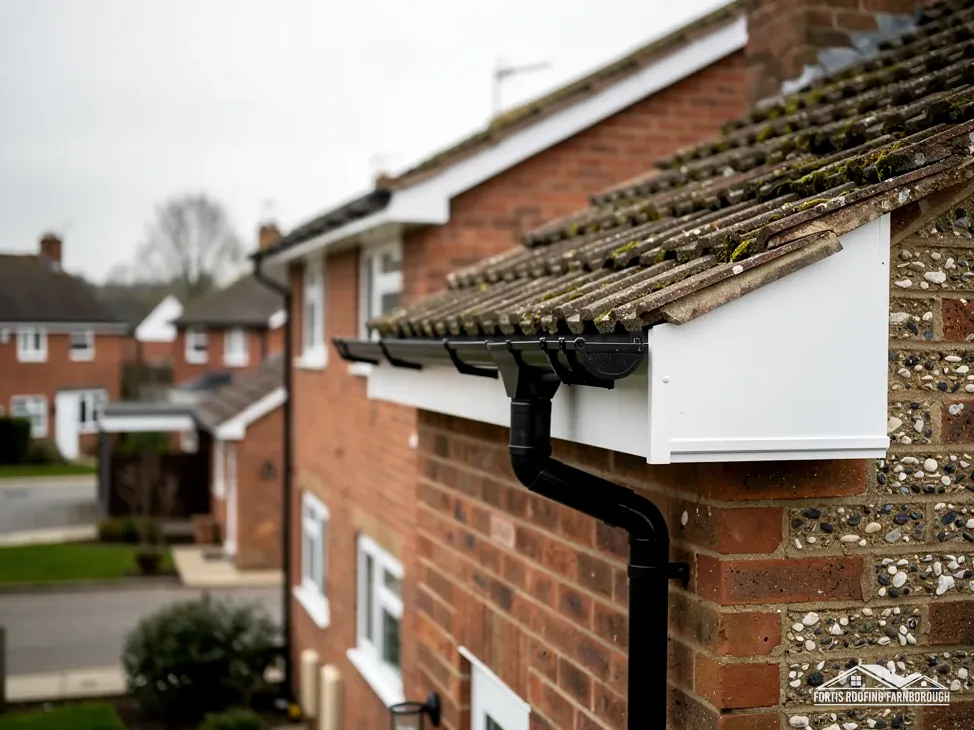
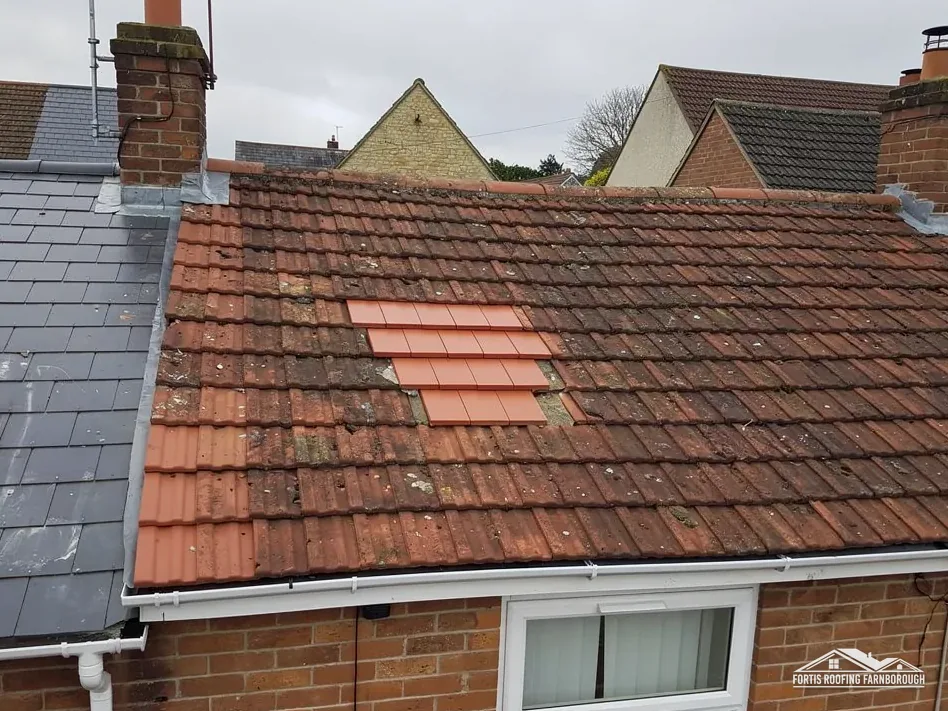
Roofs are repaired in sections all the time. A run of slipped tiles, a failed valley, a ridge that has lost its mortar, a patch of felt that has split: none of them calls for a new roof, and treating them as if they did would be an expensive mistake. A well-scoped repair to a roof that is otherwise in good order is as good value as roofing gets.
The catch is the phrase "otherwise sound". A section repair only makes sense if everything around it can be relied on to keep going. If the covering is worn out, a patch on one slope is a short pause before the next failure. So the real question is whether the roof around the damage is good enough to justify doing it.
This post sets out the signs for each answer, the practical business of matching new materials to old, and the Planning Portal's test for when roof work needs building control. After that come costs from published guides and the way a survey settles the choice.
The roof repairs page explains how we deal with leaks and storm damage.
When a section repair is the right call
A repair of one part of a roof makes good sense when four things hold together: the damage is local, the cause is known, the covering elsewhere is in good order, and the structure underneath is sound.
Typical cases
- A few tiles or slates that have cracked, slipped or blown off.
- A ridge or hip with failed bedding in one stretch.
- A valley or flashing that has failed at a single point.
- A small area of flat roof membrane that has split or lifted.
- Damage from a fallen branch or a storm in one place.
What the survey needs to show
The roof around the repair has to be checked, not just the visible damage. If the battens are sound, the underlay is intact and the other slopes are in the same good state, the repair stands a good chance of lasting. If the surroundings are failing too, the repair only moves the problem along.
The economics
A section repair costs a fraction of replacement and can be done quickly, with less disruption. For a roof that has years of life left, that is the better buy. HomeBuilding gives clay tile 60-80 years and concrete tile 40-50, so a roof of that kind that is well short of the range can often be patched for a long time.
A repair done properly
A good section repair identifies the cause, fixes it and leaves the area watertight, with photographs taken of the work as a record of what was done. Before and after pictures of the same spot are the simplest proof, and they are useful later if you sell the house or make an insurance claim. It also helps to note the date and the materials used, so the next person who works on the roof knows what is there.
When a patch will not hold
There are cases where repairing a section is the wrong answer, and a good roofer will tell you so.
Signs the whole covering is tired
- Tiles or slates are slipping in many places, not just one.
- The same area has been repaired more than once.
- The covering is crumbling, delaminating or heavily worn on every slope.
- There are leaks in several rooms with no single source.
- The roof is near or beyond the typical range for its covering.
Problems below the covering
The battens and underlay are out of sight, and they can fail while the covering still looks fine. Where the battens are rotten or the underlay has perished, new tiles sit on a weak base and the repair will not last. The same applies to a flat roof whose deck is soft: a new patch of membrane on a failing deck is wasted.
The cost of repeating
Each repair carries a call-out, access and materials, so a roof that needs patching every year can cost more over five years than one proper job. The aim is to avoid paying for the same scaffold again and again.
What a survey decides
The survey covers the whole roof and not just the damaged part, which also gives you a baseline to compare against if the same area fails again. If the evidence says the covering has had its day, you are told, with photographs. If it says a repair will do, the repair is what gets priced. Our guide to repairing or replacing a roof goes through the decision in more detail.
Matching new work to old
A section repair leaves new material next to old, and getting the match right is half of what makes it look sound and behave well.
Tiles and slates
A new tile is cleaner and brighter than one that has weathered for decades, and the difference shows for a while. Concrete tiles come in many profiles, and a profile that is no longer made can be hard to find. Reclaimed tiles of the right type are an option, and they weather to match. For slate, the size, thickness and origin all matter, and so does the fixing method. HomeBuilding gives Welsh slate 100+ years and Spanish natural slate 75-100, so a slate roof is worth repairing with care.
Minimum pitch and compatibility
Each tile has a minimum pitch its maker will support, so a replacement tile has to suit the slope. Marley's published minimums run from 12.5 degrees for its Mendip 12.5 interlocking tile up to 40 degrees for the Canterbury clay plain tile, and its advice is to check the data sheet for the exact tile.
Flat roofs
A patch on a flat roof has to bond to the existing membrane. Different materials do not always join well, so the repair method depends on what is already there. Felt, EPDM and GRP each have their own jointing methods, and mixing them can fail at the junction.
Lead
Lead repairs are made in lead, with the right thickness and detail. Our guide to roof repair cost sets out typical ranges for the common jobs.
The 25 and 50 per cent tests
Building Regulations apply to some roof work, and the extent of the work matters. The Planning Portal's guidance is the national test.
The test in outline
The Portal sets two limits that must both be met: work touching less than 25 per cent of the whole building envelope, and less than 50 per cent of the roof, goes ahead without an application in the usual case. The envelope is the outer shell of the house, which takes in every wall, the floor, the roof and all openings in them.
What this means for a section repair
Replacing a few tiles or a stretch of ridge is nowhere near either limit, so no application is called for. The question only becomes live as the work grows towards half the roof. At that point, ask building control, because the answer depends on the building and the council.
Two other triggers
Approval is also required when the new covering adds at least 15 per cent to what the roof weighs, or would respond in a markedly different way in a fire. The first brings a structural check with it. Both apply however small the section.
What councils say
None of the councils around Farnborough sets its own percentage. Bracknell Forest and Basingstoke and Deane each include roof re-covering in their lists of work that could need approval, and RBWM (Windsor and Maidenhead) has its own list covering re-roofing; each applies to that council's own area only. For Farnborough, Aldershot and Fleet the building control service is the Hart and Rushmoor Building Control Partnership, which refers people to the Planning Portal.
What a section repair costs
Published guides give typical UK ranges for small jobs. These are national figures rather than our prices, and your own roof is priced once it has been surveyed.
Tiles
Which? (November 2025, ex VAT) gives £75 to £400 for replacing between one and six standard roof tiles. MyJobQuote says the average cost of replacing roof tiles is around £215 (updated 6 October 2026).
Ridge and general repairs
Which? gives £80 to £300 for a new ridge tile, ex VAT. MyJobQuote's average for a roof repair in 2026 is around £650 (updated 6 October 2026), and its ridge repair range is £225 to £550 (updated 1 October 2026).
What moves the price
Access is the biggest factor on many jobs. A repair that needs scaffold costs more than one reached from a ladder, and where the scaffold would stand on the footway or in the road, the highway authority must grant its licence beforehand. The area, the covering, the height and whether the job is urgent also play a part.
Compared with replacement
A section repair is a fraction of the cost of replacing the roof. Which? gives £7,000 to £21,000 to cover the whole roof of an average three-bedroom house, ex VAT, and HomeBuilding puts a 3-bed semi in concrete tiles at between £10,000 and £15,000. MyJobQuote puts it near £5,250. The figures disagree, which is why the survey of your own roof matters more than any average.
Our guide to roof repair cost goes through the common jobs.
Listed buildings and conservation areas
A listed house, or any house within a conservation area, needs thought even for a section repair, because the rules turn on appearance.
Like for like
Under the Town and Country Planning Act, work that leaves the outward appearance of a building unchanged does not count as development, so a straight copy repair seldom raises a planning question. A repair that changes the covering, the pitch or the look of the roof is different.
Conservation areas
Permitted development for dormers is withdrawn on this land, and some areas have Article 4 directions. Rushmoor's covers chimneys at Cargate, and Basingstoke's four town-centre areas cover roof changes and roofline. Where one applies, ask the council before any change.
Listed houses
Permitted development rights stay with a listed house, but consent for listed buildings is also required for work that would reach its special character. A repair that uses different materials from the original may need consent even though it is small.
Flats
Flats carry no permitted development rights, so only a straight like-for-like swap avoids a planning application.
Ask first
The council's planning team can say what applies to an address, and it is much easier to ask before a repair than to put something right afterwards. Then book a survey, which gives you the photographs and measurements for the conversation, and a single written price.