Cast lead sheet
Codes 3 to 8, from small soakers up to box gutters.
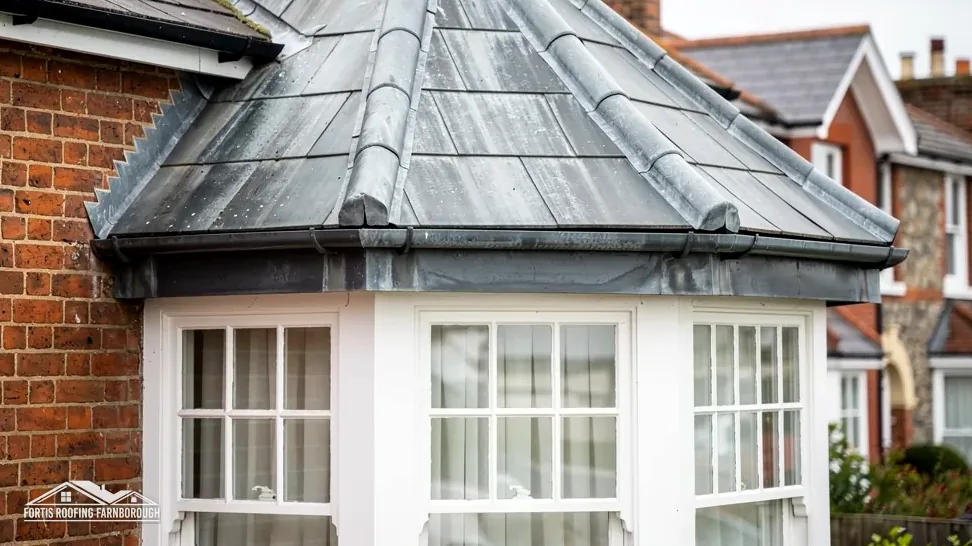
Flashings, valleys and lead roofs, in the right code
We inspect the lead where your roof meets walls, chimneys and dormers, photograph every joint, and tell you which pieces need re-fixing and which need renewing.
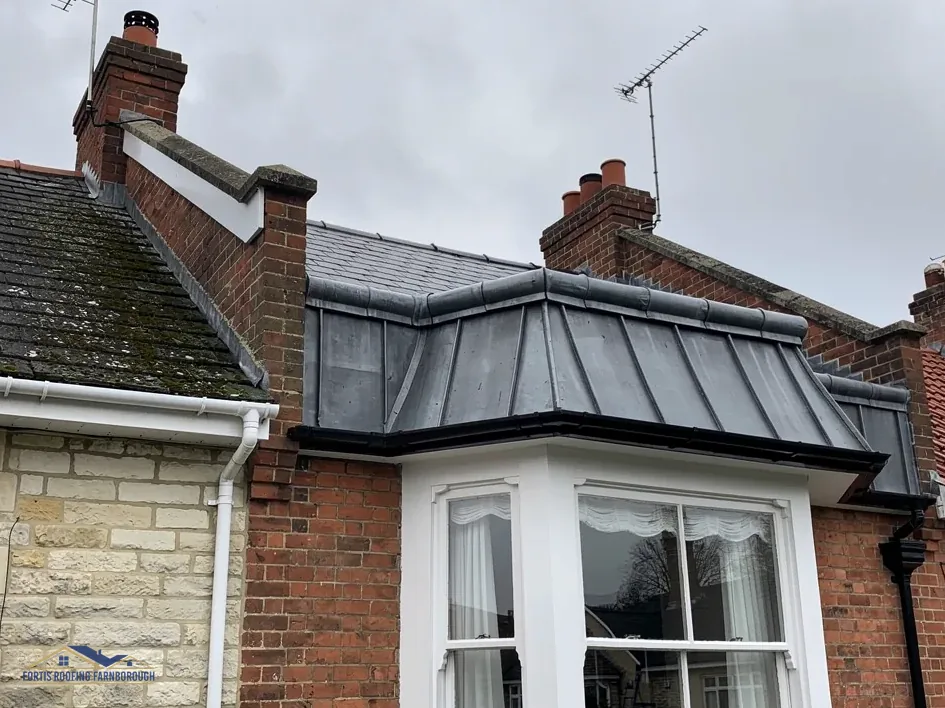
Codes 3 to 8, from small soakers up to box gutters.

HomeBuilding gives lead on a flat roof 60-100 years.

Over 80 years for lead flashing, on MyJobQuote's figure.
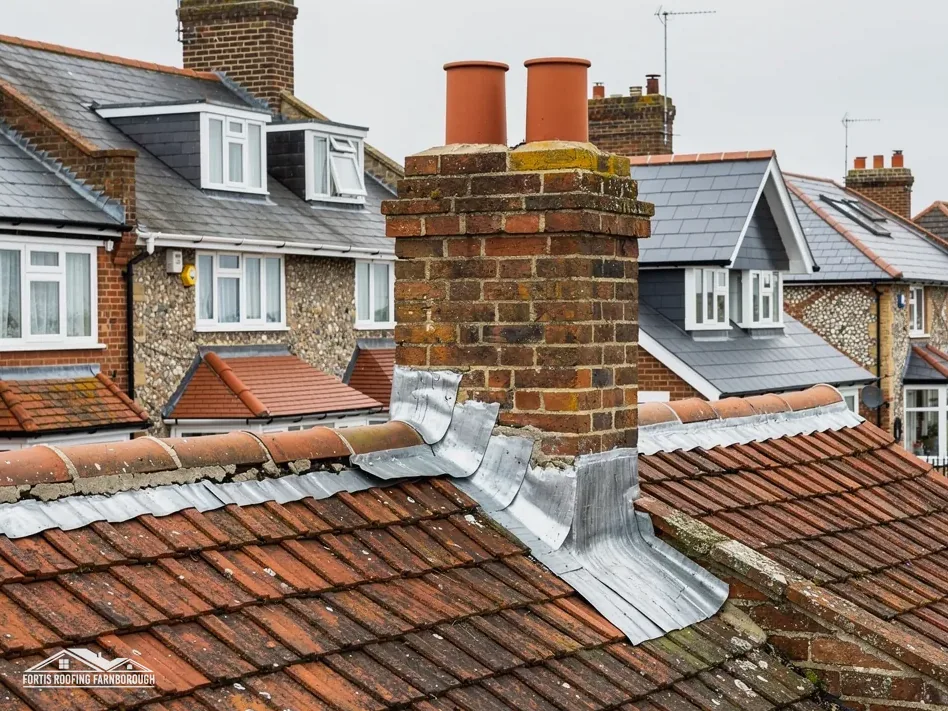 Chimney flashings and aprons
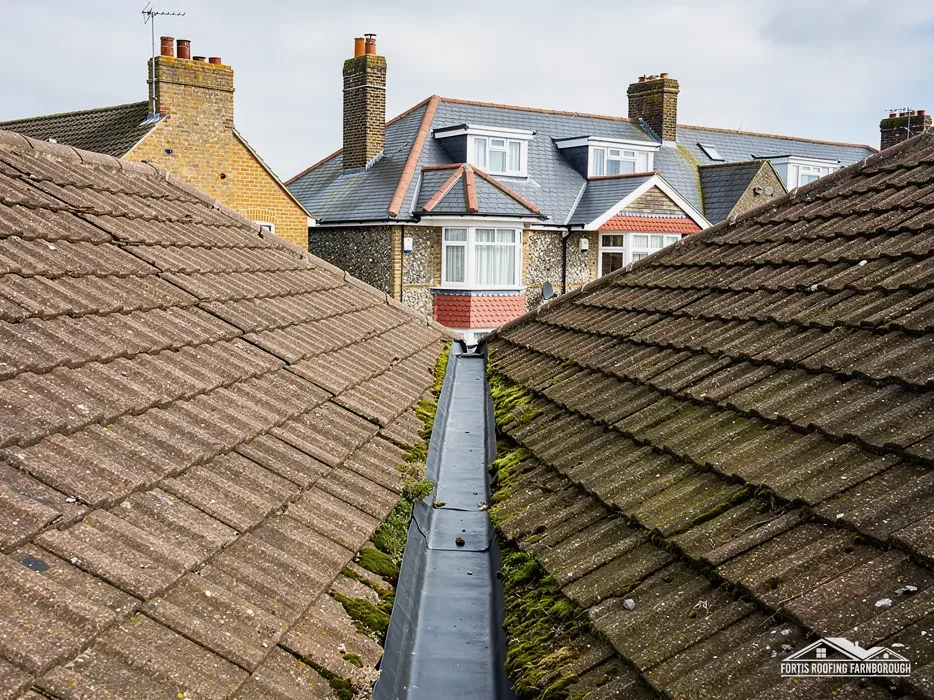 Soakers and step flashing
 Lead valleys
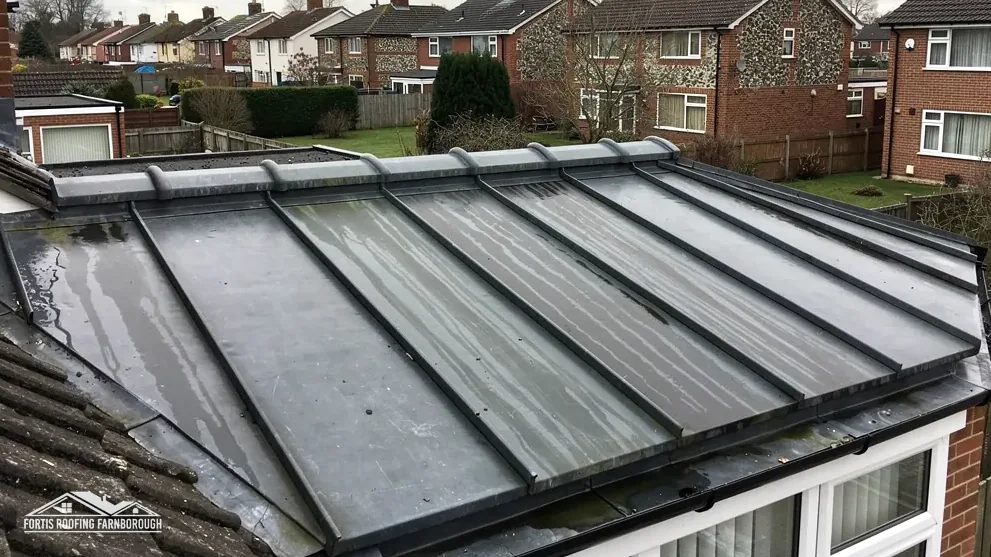 Bay and porch roofs
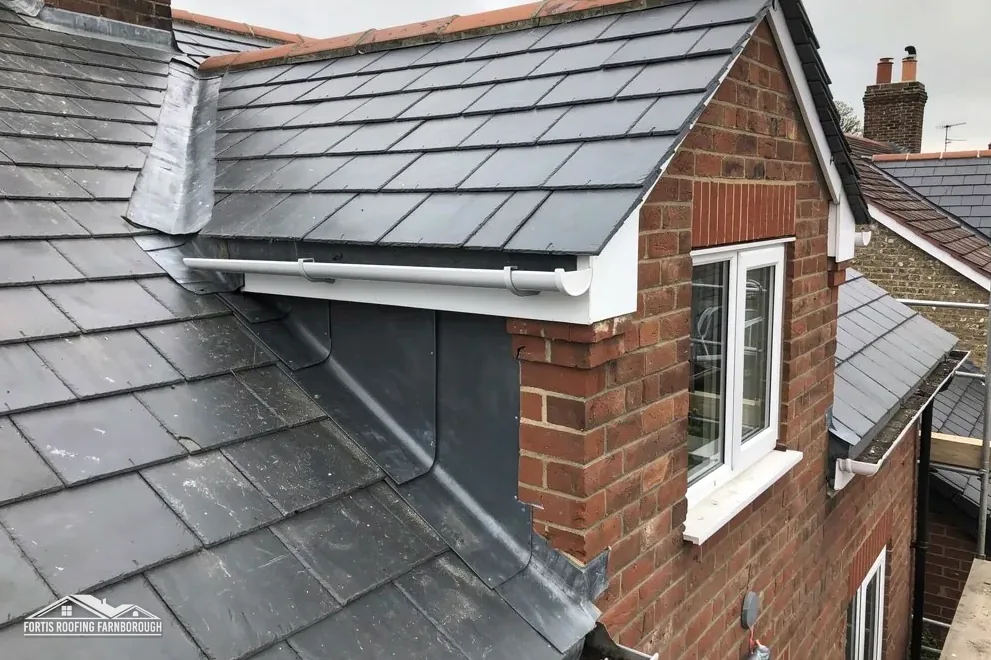 Dormer cheeks and tops
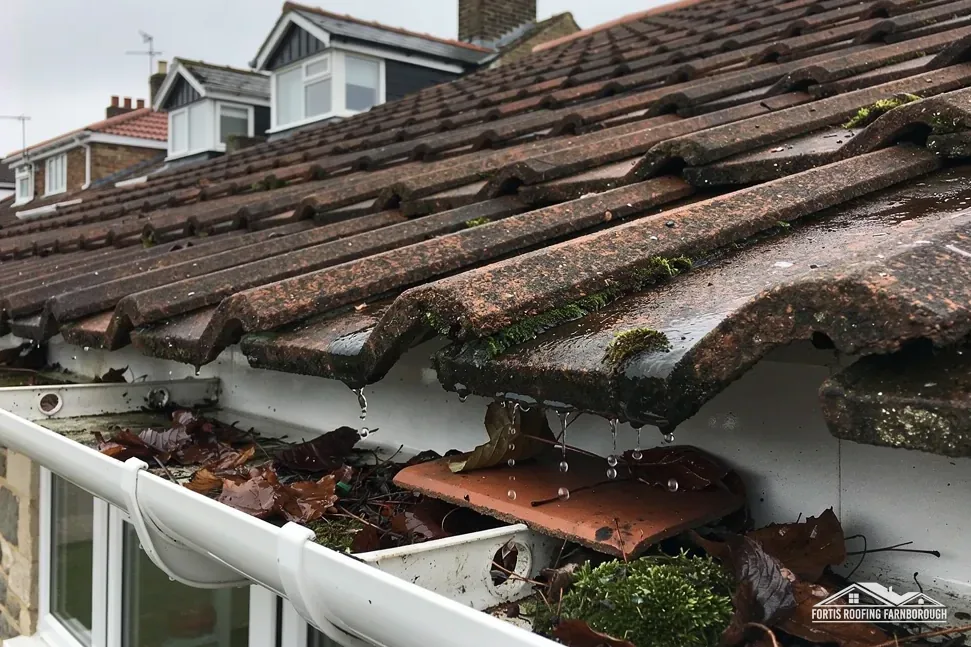 Box and parapet gutters
The lead is sound but has slipped from its chase or lost its wedges.
One piece has split or was cut short, and the rest is in good order.
The lead is thin, cracked in several places or the wrong code for the job.
Leadwork, code by code
Lead codes and weights, typical lifespans beside other coverings, conservation rules and the energy standard for a relaid lead roof, with every figure tied to the guide or council that published it.

| No. | Chapter | The figure it turns on |
|---|---|---|
| 01 | Where lead sits on an ordinary house | Codes 3 to 8, 1.32 to 3.55 mm |
| 02 | Matching the lead code to the job | Code 4: 1.80 mm, 20.41 kg/m² |
| 03 | How long lead lasts beside other coverings | Lead flat roof: 60-100 years |
| 04 | Leadwork on listed and conservation homes | Hart's 1998 directions cover frontage slopes |
| 05 | Relaying a lead roof: the energy rules | 0.35 to 0.16 W/(m²·K) on renovation |
| 06 | Re-dress, repair or renew old leadwork | Chimney leadwork renewals cost £350 to £920 |
Chapter 01 of 06
The range of cast lead sheet and the standard it follows
Lead seals the joints that a tile or slate cannot. On a house in Farnborough, Camberley or Farnham you can expect to find it in up to five places: soakers, flashings, aprons, valleys and the small flat roofs over bays, porches and dormers. Each piece is sheet lead cut to size, then dressed (beaten and folded with wooden tools) to fit the brick, tile or timber it meets. Approved Document C, the Building Regulations guidance on keeping moisture out, points to BS 6915:2001 for lead sheet roofing. The flat-roof standard BS 6229 is written for membranes, not for lead.
Where a tiled slope runs up beside a wall or chimney, a soaker sits under each course of tiles: a small square of lead, turned up against the brick, that carries water back out onto the tiles below. Over the soakers runs a step flashing, cut in steps to follow the brick courses. Its top edge is tucked into a groove in the mortar joint called the chase, held there with folded lead wedges and sealed with mortar pointing. Across the downhill face of a chimney or the bottom of a dormer lies an apron flashing, dressed over the tiles. Behind a chimney, a back gutter of lead on the high side turns rain around the stack.
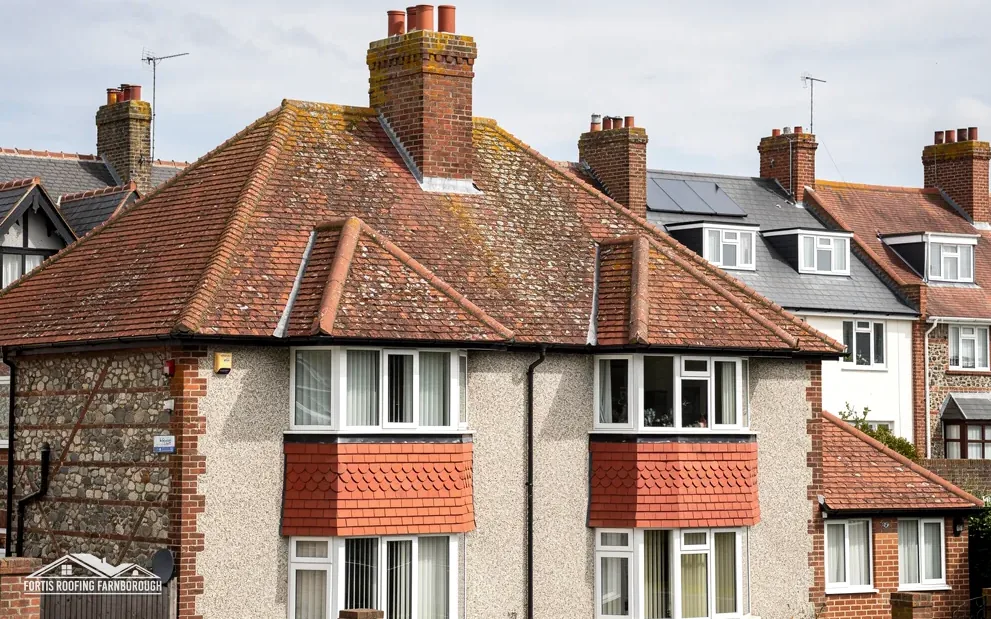
On some older houses there are no soakers at all, and a sloping fillet of sand and cement does their job. That fillet shrinks and cracks away from the brickwork over the years, and the damp patch it causes on a chimney breast is a common reason for a call about leadwork.
Valleys are the inside corners of a roof, where two slopes meet and drain into one lead-lined channel that runs the rain from both down to the gutter. Bay windows, porch canopies and dormer tops are small flat or shallow roofs, and on period houses many are covered in lead laid over timber boards, with rolls and drips (raised joints and small steps) where one sheet meets the next. Dormer cheeks, the triangular side walls of a dormer, can be clad in lead as well.
Every one of those details is a joint, and a joint is where a roof leak begins when something moves, cracks or was fitted short. The lead itself is seldom the first part to go. Far more often the mortar in the chase drops out, a wedge works loose and the flashing lifts in the wind, or an earlier repair smeared sealant over a joint instead of re-fixing it. Our guide to lead flashing repair follows a proper repair from raking out the chase to the final pointing.
Chapter 02 of 06
| Code | Thickness and weight per m² | Royston lists it for |
|---|---|---|
| Code 3 (green) | 1.32 mm, 14.97 kg | Soakers and nothing else |
| Code 4 (blue) | 1.80 mm, 20.41 kg | Soakers, flashings, pitched valleys, dormers |
| Code 5 (red) | 2.24 mm, 25.40 kg | Flashings, every valley and box gutter type, dormers |
| Code 6 (black) | 2.65 mm, 30.05 kg | The same uses as Code 5 |
| Code 7 (white) | 3.15 mm, 35.72 kg | Valley, parapet and box gutters, dormers |
| Code 8 (orange) | 3.55 mm, 40.26 kg | Valley, parapet and box gutters, dormers |
Each lead code stands for a fixed thickness and weight of sheet. The table sets out Royston Lead's figures for its cast lead range, with the colour mark that identifies each code on a roll and the jobs its brochure lists the code for. The pattern is simple: the harder a piece of lead has to work, and the more water it has to carry, the heavier the code it is listed for.
Code 3, at 1.32 mm and 14.97 kg per square metre, is listed for soakers only. Soakers sit hidden under the tiles and carry a small amount of water each, so a light sheet does that job. Code 4, at 1.80 mm and 20.41 kg, is the lightest code Royston lists for flashings, and it also covers pitched valley gutters and dormers. On a typical chimney, the step flashings, apron and back gutter are therefore Code 4 or heavier, and the soakers beneath can be Code 3 or Code 4.
A step flashing cut from Code 3 is a short cut. It will dress into place and look the same from the ground, but it is thinner than any code listed for that use, and that difference shows when the inspection gets close to it.
From Code 5 upwards, Royston adds parapet, box and tapered valley gutters to the list. A box gutter is a lead-lined channel running behind a parapet wall or between two roofs, where water sits and runs for its whole length rather than draining straight off a slope. Codes 7 and 8, at 3.15 mm and 3.55 mm, are listed only for valley gutters, parapet and box gutters and dormers, not for flashings, since that weight of sheet is more than a flashing needs.
The colour marks matter on site. A roll of new lead carries its code's colour, so when we propose a code you can see the matching mark on the material when it arrives. On old work the colour is long gone, so we measure the thickness of a cut edge where we can reach one, and record it with the photos.
Our answer on Code 4 against Code 5 lead works through the choice for chimneys, valleys and bay roofs one job at a time.
On a domestic chimney in Farnborough or Fleet, a full set of leadwork means soakers, a step flashing down each side, an apron across the front and a back gutter behind. Each piece has its own job and its own listed code, so a quote that names one code for everything is worth a question before you sign it.
Chapter 04 of 06
| Council | Published position | Roof detail |
|---|---|---|
| Rushmoor | Nine designated conservation areas | Cargate direction: chimneys and flues |
| Hart | 1998 directions on most conservation areas | Frontage roof slopes and chimneys on a dwelling |
| Guildford | Article 4 used to control conservation area changes | No removing or altering a chimney without permission |
| Basingstoke and Deane | Four town-centre conservation areas | Roof changes need planning permission |
| Waverley | 44 conservation areas | No roof direction listed; check by address |
Lead is part of how many older houses look, from the bay roofs of a Victorian terrace to the flashings on a tall chimney, so changing it can be a planning matter as well as a roofing one. On an ordinary house, Class C of the permitted development rules normally covers re-roofing, and a repair that does not materially affect the outside appearance is not development at all. Flats have no permitted development rights, and listed buildings need listed building consent for works that affect their character, on top of any other permission.
In a conservation area, an Article 4 direction can withdraw permitted development rights for named kinds of work. Rushmoor has nine designated conservation areas, including Farnborough Hill and Farnborough Street (both 2025), South Farnborough and St Michael's Abbey. Its Cargate direction in Aldershot, an immediate direction made on 31 July 2020, covers chimneys and flues: putting one in, changing one or taking one out, on a face visible from a road or public open space. Hart's 1998 directions cover most of its conservation areas, including Crondall, Odiham's West Street and Hartley Wintney, and take in works to a frontage roof slope and to chimneys. In Guildford, any address under a direction needs permission before a chimney is altered or taken down. Basingstoke and Deane says original materials such as Welsh slate and clay tiles should be retained in its four town-centre areas.
Hart's guidance is helpful on repairs: an unlisted building needs no planning permission for repairs carried out the traditional way, to the exact original details and in the same materials. Renewing a lead flashing or bay roof in lead, matching the original, fits that description. Swapping lead for a different material on a front-facing roof may not, so it is checked with the council first. Everywhere else in the area, check whether an Article 4 direction applies with your council before a change of material. The boundaries of each conservation area are on the council's own map, so check your address there before planning any change to a bay, porch or chimney that faces the street. Small roof repairs in lead are ordinary work, but on a listed house the consent question is about character, not about how big or costly the job is.
Roof directions
A Church of England church in use goes through the faculty system rather than the council. Roman Catholic, Methodist and URC churches use their own systems: St Michael's Abbey in Farnborough, a Benedictine monastery, goes through the Catholic Church's own approval route. Our guide to lead roofing on listed and period buildings covers consent and like-for-like detailing in more depth.
Chapter 05 of 06
Approved Document L figures for a renovated roof in an existing home
Relaying a lead bay, porch or dormer roof is more than a roofing job in the eyes of the Building Regulations. Approved Document L classes the replacement of a flat roof's waterproofing as renovation, and renovation brings the energy standard into play. The figures in the panel come from Table 4.3, which deals with existing elements of a home.
Under Table 4.3, where a roof being renovated has a U-value worse than 0.35 W/(m²·K), it should be improved to 0.16. The U-value is a measure of heat loss, and the lower the figure, the less heat escapes. Paragraph 4.13 adds a test of sense: if the 0.16 target cannot be met for practical or technical reasons, or the cost would take longer than 15 years to win back in saved energy, the aim becomes the best result achievable inside that 15-year payback. Once upgraded, a roof should generally be no worse than 0.7. For dormer windows, Table 4.3's note says the roof includes the roof parts of the window.
On a small bay or porch roof, the practical limit is height. Insulation added above the boards raises the roof, and that changes where the lead meets the window head, the wall and the flashing above it. Insulation added below, from inside, avoids that but needs ceiling access. Which route is feasible is a question for the survey, and the answer goes to your building control body.
The lead details have to be set out again over the new build-up as well. Rolls and drips are re-formed on the new deck, and the upstands against the wall still need to rise far enough under the flashing to keep the joint watertight in driving weather. We show you both insulation options with the photos before you choose.
The standard is changing. AD L 2026 takes effect on 24 March 2027 for work in England, renumbering the tables as 3.2 and 3.3 and moving the payback rule to paragraph 3.14. Work before that date follows the 2021 edition.
Approved Document C asks that roofs resist rain getting in and that condensation inside them does not harm their structure or insulation. It also accepts that a little roof over a porch or bay can sometimes manage without ventilation, so each one is judged on its own build-up. In Rushmoor and Hart the council route is the Hart and Rushmoor Building Control Partnership on 01252 398715; a registered building control approver is the private alternative. Our chimney repairs service picks up the stack when flashing work shows the brickwork needs attention too.
Chapter 06 of 06
| What we find | What it points to | Usual answer |
|---|---|---|
| Flashing pulled out of its chase | Pointing failed, lead still sound | Re-wedge, re-dress and repoint |
| Split along a fold or fixing | Piece too long or held too tightly | Replace that piece in the right code |
| Sealant smeared over a joint | A stopgap from an earlier visit | Strip back and redo the lead |
| Valley lead thin or pitted | Near the end of its working life | New valley lining in a listed code |
| Mortar fillet in place of soakers | No lead at the abutment | Lift tiles, fit soakers and flashing |

Old lead is often better than it looks. A flashing that has pulled out of the wall is usually sound metal whose fixing has failed, and the table sets out the faults we find most on inspection and what each one points to. Approved Document C wants every part of a roof fixed in an appropriate manner, and for lead that means wedged into the chase and pointed, never glued on. Where the same fault turns up on several chimneys or valleys across one roof, it points to how the lead was first fitted, and that is worth knowing before deciding how far a repair should go.
A tube of sealant along the top of a flashing is the quickest answer to a drip, and it can hold for a season. It does not put the lead back into the chase, replace the wedges or stop the mortar behind it crumbling, so the water runs round it. Sealant over a split also stops the lead moving, which can open a new split beside the old one. Our guide on why sealant is not a lead repair goes into the detail.
Re-dressing is the next step up: the lead is eased back into shape, re-wedged and the chase repointed. Where a piece has split, that piece is cut out and replaced in a code listed for its use. Where valley lead has worn thin across its length, a new lining is the answer, and the tiles either side are lifted and relaid to fit it. Our answer on whether to repair or replace old leadwork sets out the evidence for each.
MyJobQuote puts full chimney leadwork at between £350 and £920, depending on scaffolding, and says most full roof valley replacements cost around £540. Those are typical UK figures, not ours. The things that move a price are access, the size and number of pieces, the code, and what the inspection finds behind the lead. A chimney flashing reached from a roof ladder is a different job from one that needs scaffold on a pavement, which in Hampshire means a licence from Hampshire County Council with ten clear working days' notice. Chimney repointing often goes with flashing work, since lead wedged into crumbling mortar will not stay put.
If you are weighing up quotes, look for VAT and scaffold in each total, and ask which lead code is proposed for each piece. Roof repairs to lead are small in area but often awkward to reach, around a chimney stack or behind a parapet, so planning the access is part of every price we give.
Tell us where the damp shows, and we will inspect the lead, photograph each joint and price the repair or renewal.
| Job | Typical UK range |
|---|---|
| Full chimney leadwork, depending on scaffolding (MyJobQuote) | £350 to £920 |
| Full roof valley replacement (MyJobQuote) | around £540 |
| Lead for a flat roof, supply only (HomeBuilding) | £170 per m² |
Source: MyJobQuote leadwork and roof valley guides (September 2026); HomeBuilding (September 2025)
UK cost guide figures, not ours. After the inspection you receive one written total for your roof.
Short reads on lead codes, flashings, bay and porch roofs, listed homes and why sealant is no substitute for lead dressed into the wall.
Guide · 9 min read
A bead of sealant over a leaking flashing looks like a quick repair, and for a few months…
Guide · 9 min read
Many leaking lead flashings need a repair, not a rebuild: lead put back where it belongs, wedged tight…
Guide · 9 min read
A lead bay window roof is small, exposed and full of joints. It can last for decades when…
Only for a short while. Sealant can slow a drip, but it does not put the lead back into its chase, replace lost wedges or repair the mortar that let go. The lasting repair is to rake out the joint, re-dress and re-wedge the lead, then repoint it so the flashing is held mechanically again.
Usually because the mortar in the chase has cracked and dropped out, often after years of rain and frost. Without that mortar the wedges loosen, and wind can then lift the flashing and let water run behind it. The lead itself is often still sound and can be re-dressed, re-wedged and repointed.
The soakers and flashings at walls and chimneys have to come out when the tiles beside them are stripped, so a re-roof is the natural time to check them. Sound lead can sometimes go back, while thin or split pieces and worn valley linings are renewed. The survey photos show which applies to yours.
After rain, check the chimney breast and the ceiling next to it for damp, and look for stained timbers around the stack in the loft. From the ground, flashing that has lifted, gaps in the pointing above it or a line of sealant are clues. A close inspection then pins down the entry point.
On a house, not normally: like-for-like repairs that do not change the outside appearance are not development, and Class C permitted development covers re-roofing. Flats have no permitted development rights, a listed building may need listed building consent, and an Article 4 direction can apply in some conservation areas, so check first.
Get your free roof quote
Send a photo of the flashing or the damp patch, and we will arrange to inspect the lead.
10-year workmanship guarantee, in writing.