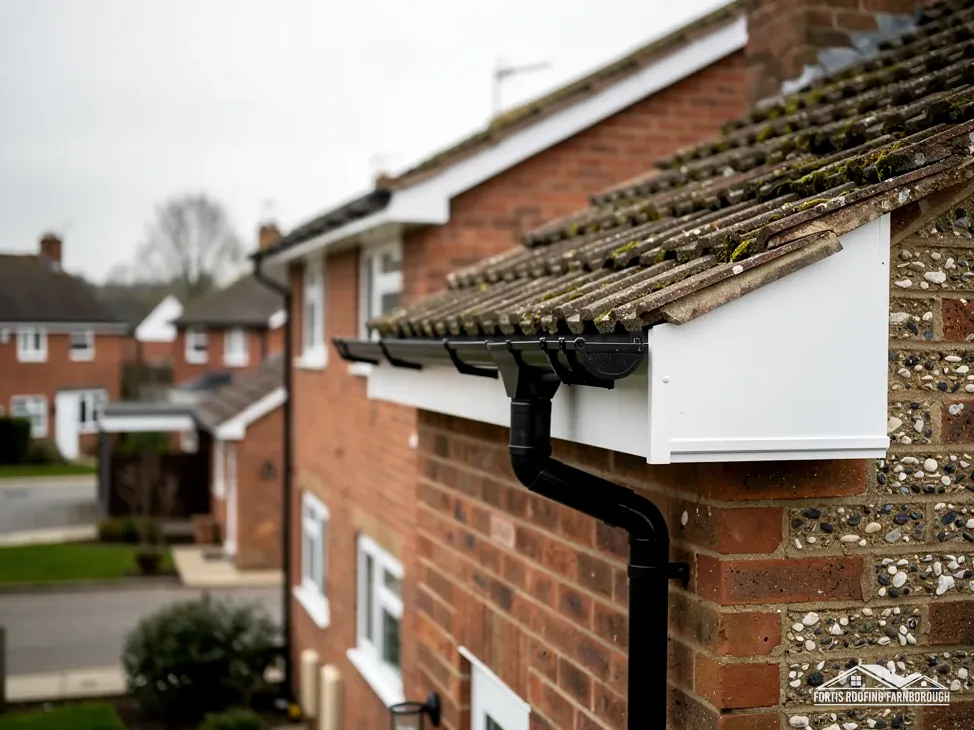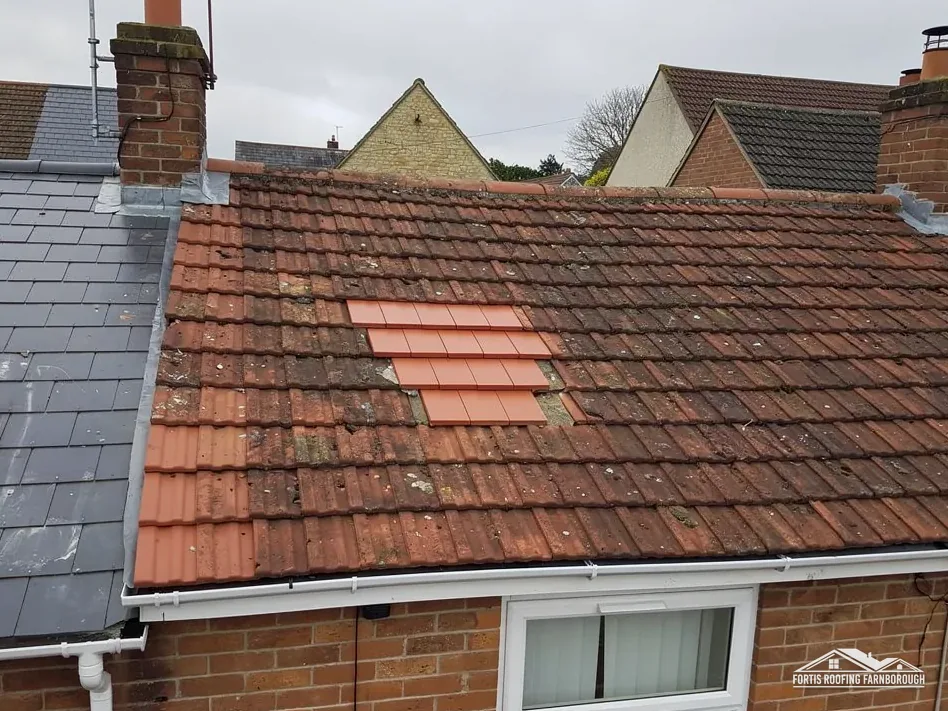
Roof repairs cost anything from the price of a few replacement tiles to over a thousand pounds, and the national guides show where the common jobs sit. MyJobQuote's guide to roof maintenance puts the average roof repair near £650 in 2026, and its emergency page puts extensive storm repairs at £1,200 or more (Oct 2026). Which? gives £75 to £400 per job, ex VAT, for a small tile job (Nov 2025). Those are typical UK ranges from third-party guides, not Fortis Roofing Farnborough prices.
A repair price is not set by the repair alone. Two identical slipped tiles can cost very different amounts if one is on a low garage roof and the other three storeys up over a conservatory. What matters is the scope of the work, the access it needs, the materials and what turns up beneath the covering once it is lifted.
This guide lays out the published ranges for common roof repairs with their sources, then goes through the things that move a price up or down. It explains why a survey comes before a number, and what to check on a written quote so that you are comparing like with like.
Published ranges for common roof repairs
Several national guides give figures for repairs. None reflects your roof, but together they show the shape of the market. Which? figures are ex VAT, and come from a survey of traders gathered in November 2025. MyJobQuote pages carry their own update dates, shown in the table. The two guides use different units, so some rows describe one tile and others a whole run, and the table keeps the wording as each source gives it.
| Repair | Typical figure | Source |
|---|---|---|
| Small tile job, up to six tiles | £75 to £400 per job, ex VAT | Which?, Nov 2025 |
| Replace five roof tiles | Around £215 | MyJobQuote, Oct 2026 |
| Put in a new ridge tile | £80 to £300, ex VAT | Which?, Nov 2025 |
| Replace ridge tiles | £225 to £550 | MyJobQuote, Oct 2026 |
| Dry verge system | £500 to £2,000 | MyJobQuote, Oct 2026 |
| Chimney leadwork, full | £350 to £920 | MyJobQuote, Sep 2026 |
| Roof valley replacement | Around £540 | MyJobQuote, Sep 2026 |
| Average roof repair | Around £650 | MyJobQuote, Oct 2026 |
| Extensive storm repairs | £1,200 or more | MyJobQuote, Oct 2026 |
The chimney leadwork range depends on scaffold, as MyJobQuote notes, and the valley figure is for a full replacement. Read each as a signpost, not a price. Roof repairs also vary with the time of year, the length of the job and whether it is a first visit or a return to finish, and none of those shows in a national average. Repairs on a flat roof, to gutters or to lead have their own pages, and the figures there differ again.
Why the same fault costs different amounts
If you collect three quotes for what looks like the same repair, they can differ by a surprising amount. The differences are usually real, and they sit in four places.
Scope
A slipped tile and a slipped tile with a rotten batten behind it are different jobs. One is a replacement, the other is a small carpentry repair with a section of underlay let in. The surface looks the same from the ground. Our survey photographs show the layers underneath so that the scope is clear before the work starts.
Access
A repair on a ground-floor extension or garage needs a ladder. A repair on a main roof above a first-floor window, or over a conservatory, may need a tower or full scaffold. Scaffold erected over a public pavement or road needs a licence under Highways Act 1980 section 169, and none is needed on private land. Check whether the quoted figure covers access too.
Materials
A common concrete tile is easy to match. An old clay tile, a lead flashing or an unusual ridge section may have to be ordered, which can mean a second visit. Matching a weathered roof is also a skill: new tiles are brighter than old ones, and a good roofer places them where they will be least noticeable.
Time on site
Hours matter as much as materials on a repair.
A repair done in one visit is cheaper than one that needs two. Poor weather, awkward positions and limited working hours all add time. A roofer who quotes the same price for a roof in a calm spring and in a storm is either wrong about one or generous about the other.
Small repairs: tiles, ridges, verges and valleys
The lower end of roof repair covers the jobs that are limited in extent and put right in a single visit.
Tiles and slates
Putting back up to six broken or missing tiles is the classic small repair. A few new tiles go in, and any loose ones are refixed. If the battens are sound, the job is simple. If they are rotten, the work grows. Our guide on repairing or replacing a roof explains where the line falls.
Ridge tiles
Ridge tiles cap the highest line of the roof, and they take the full force of wind. If the mortar bedding has cracked, tiles lift or fall. A repair re-beds the affected tiles, or fits a dry-fix system, which holds the ridge with clips and screws and is tested to BS 8612. Which? and MyJobQuote give different ranges, partly because they define the job differently, one a single tile and the other a run.
Verges
At a gable end the roof finishes in a sloping edge called the verge. Its mortar bedding can crack, and the tiles can lift in wind. A dry verge system fixes the edge mechanically. MyJobQuote's range for installing one, £500 to £2,000, reflects how much the length of the verge and the access vary.
Valleys and flashings
A valley carries water from two slopes, so a failure causes a visible leak. Relining one with lead or a modern membrane is a defined job. Chimney leadwork also sits in this band, and depends on scaffold more than on the lead itself.
Bigger repairs: storm damage and structural faults
Above the small repairs sit the jobs that involve a larger area, a hidden fault or the roof structure. MyJobQuote's figure of £1,200 or more for extensive storm damage belongs here, because storms rarely cause one fault.
Storm damage
A storm is usually a bundle of faults, not one. Wind can lift ridge and hip tiles, loosen verges, slip runs of tiles and tear flashings in a single event. Our guide to storm damage to roofs explains the pattern. The cost covers several repairs plus access, and a make-safe if the roof is open to rain.
Rotten battens and underlay
When tiles are lifted, battens or underlay beneath may be found wet or rotted. Renewing a section of batten and letting in a new piece of underlay adds labour and materials. We photograph what we find, so you see why the work has grown.
Structural timber
Rafters, wall plates or a ridge board that have rotted are structural. An engineer may be asked to advise, and the work is carpentry as well as roofing. It costs more than a covering repair, but if it is local, it is still well below the price of rebuilding the roof.
When the repair is not the answer
If the repair price starts to approach a large share of a new covering, or the same roof keeps failing in new places, a re-cover may be the better buy. MyJobQuote's average for a new roof is around £5,250, and Which? gives £7,000 to £21,000, ex VAT. The two sit far apart, and your own survey is what settles it.
How a repair quote should look
A good repair quote comes as a single total, on paper, after a survey, and says what is being done and where. It names the repair, the materials and what is included.
What to check
- The location of each repair, so you can see it matches the fault.
- The materials, such as the tile type, the lead code or the membrane.
- Whether the figure includes scaffold or access equipment, and VAT.
- What happens if rotten timber or failed underlay is found once the covering is lifted.
- Who removes the waste, and where it goes.
Compare quotes carefully
Citizens Advice suggests collecting at least three traders' written quotes. When you have them, check that each describes the same repair at the same location. A low figure for a job described in a few words may leave something out, and a higher figure may include a part the others forgot. Ask each roofer to say in plain terms what they would do, and look for the one who has actually seen the roof.
VAT
The standard rate of VAT is 20 per cent, and Which? figures exclude it. If a roofer is VAT-registered, the figure you are quoted should say whether VAT is in it. Our quote states clearly whether VAT is included.
The domestic reverse charge is a rule for VAT-registered firms dealing with each other under the Construction Industry Scheme, so a homeowner simply pays VAT if the roofer charges it.
Keeping repair costs down
You cannot control the weather, but a few habits reduce what repairs cost over the years.
Look early
A slipped tile found in spring is a small job. The same tile left for a winter becomes a wet batten and a stained ceiling. Look at your roof from the ground after storms, using binoculars if you have them, and note anything that has moved. Photograph it with the date, so that a later comparison is easy and any claim has a record. Never climb up to check, because the repair costs less than a fall.
Keep gutters and valleys clear
Blocked gutters back water up under the lower tiles and into the fascia. Leaves and moss in a valley make it overflow. Clearing them is a small regular job, and the cost of a gutter clean from Which? is £75 to £350, ex VAT, front and back (Nov 2025).
Have a survey when something changes
A survey costs money, and MyJobQuote's roof survey average is around £300 (Oct 2026). It pays back if it finds a fault early, or tells you that the roof is sound. It also gives you photographs that you can use if you later sell or claim. Our guide to what a roof inspection includes shows what the visit covers.
Fix causes, not symptoms
Sealant over a leaking flashing and a patch over a failing underlay both look like repairs. They do not last, and the second repair costs more than a proper first one would have. Ask what is causing the fault and how the repair deals with it.
For the range of repairs we carry out, start at our roof repairs page.