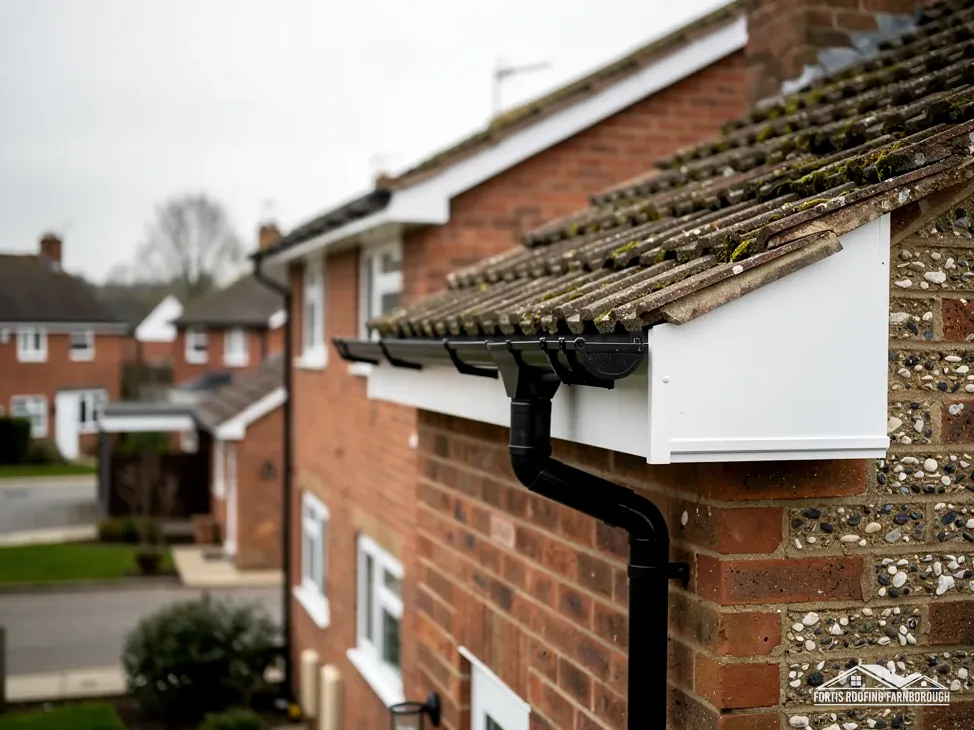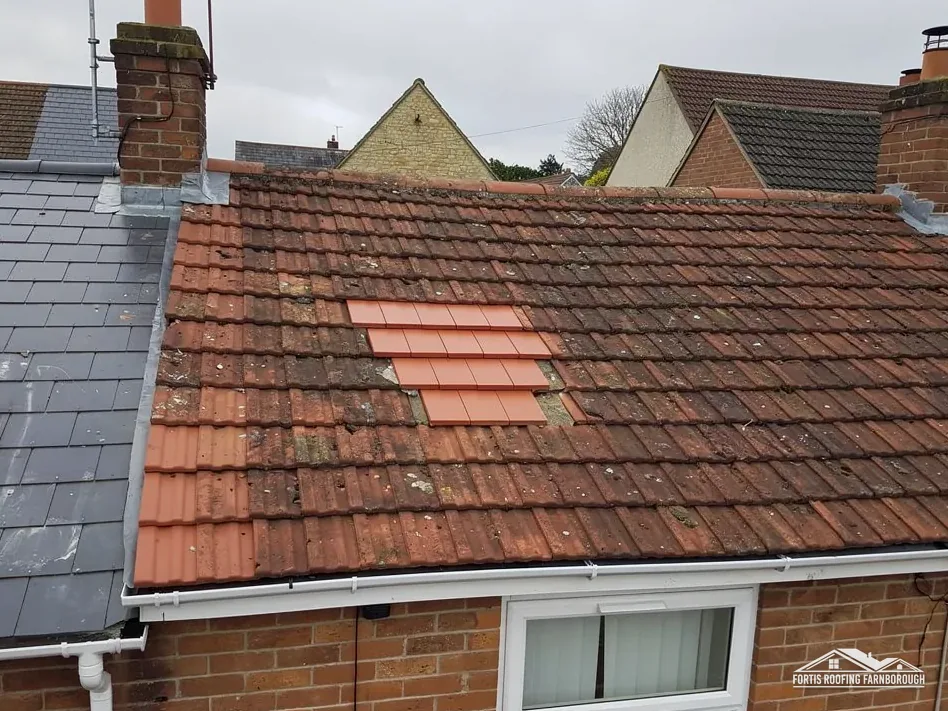
Storm damage to a roof usually shows up in a few familiar places: ridge and hip tiles lifted or gone, verge tiles loosened at the gable, a run of slipped tiles, flashing torn from a wall or chimney, and debris or a fallen branch lying on the covering. Wind finds every weakness at once, so a roof that looks mostly intact from the garden may have several faults that only show up when someone goes up to look.
The sensible order is to stay safe, check what shows from the garden, make the roof weatherproof, tell your insurer if you plan to claim, and then have the permanent repair surveyed and priced. Doing it in that order protects the inside of the house first and leaves the roofing decisions until the facts are on the table.
This guide describes what storms do to a roof, how to check it safely from the ground, how the Financial Ombudsman Service describes a storm, what to do about insurance in general terms, and how make-safe and permanent repair fit together. It cannot tell you whether a particular claim will succeed, because each policy sets its own terms, and that is a matter for the insurer.
What a storm does to a roof
A storm acts on a roof through wind, rain, falling objects and sometimes hail or snow. Each leaves its own marks, and knowing them tells you where to look.
Wind lift
Wind flows over a roof and creates suction at the edges and the ridge. That suction tries to lift whatever is not held down firmly. Ridge and hip tiles, which sit on top, and verge tiles, which run along the gable edges, are the first to go. Roofs fixed to BS 5534 are held mechanically as well as by mortar. Marley explains that the 2014 revision of BS 5534 stopped treating mortar alone as enough to hold ridge and hip tiles in wind, and BS 8612 is how dry-fix systems are tested. An older roof bedded only in mortar is more exposed.
Slipped and broken tiles
A run of tiles can slide if the nails or the battens behind have weakened. Broken tiles are often struck by debris. Either leaves gaps that rain can reach.
Flashings and chimneys
Lead and other flashings can be lifted or peeled back by wind. Chimney pots and flaunching, the mortar cap, can crack or shift.
Falling objects
A branch, an aerial or a neighbour's fence panel can fall on a roof. A tree that fell on the house needs urgent attention, and our answer on a tree fell on the roof sets out the first steps.
The roof's age matters. A tired covering is more likely to give way in strong wind than one in good order.
Checking the damage safely from the ground
There is no need to climb onto the roof, and you should stay off it. A wet or windy roof is slippery, and falls from roofs cause serious injuries. Plenty can be learned from the garden and from inside.
Outside
- Walk round and look at the roof from each side. Binoculars help.
- Look for missing, shifted or broken tiles, and gaps along the ridge and gable edges.
- Check for tiles or pieces of ridge in the garden, on paths and on cars.
- Look at the chimney, the pots and the flashing around its base.
- Check gutters and downpipes for movement, blockage or debris.
Inside
Go into the loft with a torch if you can reach it safely from the hatch. Look for daylight where there should be none, wet insulation, drips and stained timber. Check ceilings and the tops of walls for new marks. Tracing a stain back to its source follows the same logic whatever caused the water.
Record it
Take dated photographs of every fault and of any debris, from several angles. They help the roofer, and they help your insurer. Do not move or throw away broken tiles until they have been photographed.
Keep clear
If a tree, a chimney or a large section of roof looks loose, keep people away from underneath it, and phone a roofer or the emergency services as the situation requires. Never try to move a fallen tree off the roof yourself.
A ground check cannot replace a survey, because the worst damage is often out of sight. It tells you whether the roof needs a make-safe before the next rain.
How the Ombudsman approaches storm claims
Whether damage counts as storm damage matters if you plan to claim on home insurance. The Financial Ombudsman Service (FOS) sets out how it judges a complaint about a refused claim, and a homeowner is better off knowing the main points before a dispute arises.
What counts as a storm
FOS does not insist on a gale. It describes the usual storm as strong wind with some form of precipitation, yet it accepts that a sudden deluge of rain, hail or snow may qualify with hardly any wind at all. It looks at the Beaufort Scale, the numbered measure of wind force, and notes that some policies name a minimum force. Where precipitation is the cause, it asks whether the amount in a short time was unusually large or the weather extreme.
What the Ombudsman weighs
Three questions recur. Did a storm happen? Is the damage the kind that event would cause? Was the storm the dominant reason for it? A roof already in a sorry state, with the owner aware of it, makes a complaint harder. So does damage that is really long-term deterioration, since many policies leave out gradual damage and wear and tear. That is why the age and state of the covering come up so often in claims.
Start with your own wording
The definition in your policy is the one that applies, so read it before the weather turns. If you disagree with an insurer's decision, take it up with the insurer first and with FOS afterwards. The service is free, and its helpline is 0800 023 4567. Time limits apply: eight weeks without a final response, or a final response itself, opens the route to FOS, and a complaint must then be brought within six months.
Insurance steps in plain terms
A claim goes more smoothly when the steps follow a sensible order. What follows is general guidance on what insurers tend to expect, and your policy sets the details.
Step by step
- Make sure people are safe and keep clear of anything loose.
- Tell your insurer, and ask what they need from you.
- Make the roof safe and weathertight to stop further damage, and keep every receipt.
- Photograph the damage before and after any temporary work.
- Keep any damaged parts until the insurer has seen the evidence, if they ask.
- Get the permanent repair surveyed and priced in writing.
Why photographs matter
According to the Institution of Structural Engineers, photographs are vital in a claim, since they are the visual evidence of the damage. We photograph the damage as part of every survey, with measurements, so you have a record.
Do not expect a promise
Which? reported that only 32% of storm-related claims made in 2024 resulted in a payout. That does not mean yours will fail, but it is a reminder that claims depend on the wording, the evidence and the condition of the roof. Whether a claim succeeds rests with your insurer and your policy, and nobody else can promise it.
Our answer on whether a roof leak is covered by insurance goes into the question in more detail. If the insurer needs a repair estimate, a survey with photographs gives you one total in writing to send.
Make-safe first, then the permanent repair
Storm repair usually happens in two stages, and it helps to understand why.
Stage one: make safe
The aim is to stop water coming in and remove any danger. That might mean securing loose ridge tiles, covering a gap, refitting a few slipped tiles or fixing a tarpaulin over a damaged slope. It is a short-term measure, done from the safest access available. A leaking roof gets its make-safe before anything else. Our guide to temporary roof repairs covers which fixes hold and for how long.
Stage two: the permanent repair
When conditions are dry and the damage is understood, the lasting repair tackles the causes. That could be bedding the ridge again or fitting a dry-fix system, refixing a verge, replacing tiles and any rotted battens, renewing a flashing or relining a valley. If the covering is old and failing across a wide area, the survey will say so, and the choice between repair and re-covering is yours.
Why the order matters
Rushing a permanent repair in bad weather risks a poor job, and leaving a roof open risks a wet house. The two-stage approach protects the inside first and gives the repair the conditions it needs. The photographs from the make-safe show the roofer, and the insurer, what was found.
Access
A make-safe can often be done from ladders or a tower, while a lasting repair on a high roof may call for scaffold. Highways Act 1980 section 169 requires a licence for anything erected over a public road or pavement, and the notice period can be ten working days or more, so ask who is applying and when.
The cost of a storm repair varies with the scope, and MyJobQuote gives £1,200 or more for extensive damage (Oct 2026).
Heading off the next storm
You cannot stop the weather, but a roof in good order loses less in a storm than a tired one. Some sensible habits, and a few checks, lower the risk.
Check the fixings
Ridge and verge tiles are the first to be lifted. If yours were bedded in mortar many years ago, the bedding may be cracked or loose. A survey can tell you whether they are firm, and a dry-fix system, which holds them mechanically, is one way to improve them. BS 5534 sets the fixing rules for tiles and slates, and Approved Document C paragraph 6.8 asks that every sheet, tile and roof section be fixed in an appropriate manner.
Look after the details
Flashings, valleys and gutters take the brunt of heavy rain. Keeping them clear and sound reduces both leaks and overflow. A gutter that is blocked sends water under the lower tiles in a storm.
Trees and neighbours
Branches that overhang a roof can break tiles or fall in high wind. A tree surgeon can cut them back, with the owner's consent. A tree with a preservation order, or one in a conservation area, needs notice to the council first. Rushmoor, for instance, asks for six weeks' notice for trees in a conservation area.
Keep a record
A set of dated photographs of your roof in good order is a baseline. After a storm, comparing it with new photographs shows exactly what changed. That helps the roofer, and it helps any claim.
A survey now and then
If your roof is old, or you have never had it looked at, a survey in calm weather finds weaknesses before the wind does. Start at our roof repairs page.