The short answer
A roof that stays dry in ordinary rain but leaks in a downpour is being overwhelmed or tested at its edges. Valleys and gutters can overflow when water arrives faster than they can carry it away, and wind-driven rain can be pushed under tiles, flashings and verges that shed light rain well. The fault is usually small, but it needs finding.
Valleys and gutters under pressure
A valley is the trough where two roof slopes meet, and it gathers water from both. In heavy rain the flow is large and fast, and if a valley is lined badly, blocked with moss or leaves, or has a narrow gutter, water can climb over its edge and run under the tiles beside it.
The lining matters. Lead valleys are made in sheet of different thicknesses, and Royston's cast-lead brochure lists codes 4 to 8 as suitable for a pitched valley gutter, with thicker codes for the largest runs. A thin lining, a split along the fold or a poorly lapped joint will pass light rain without trouble and fail in a downpour.
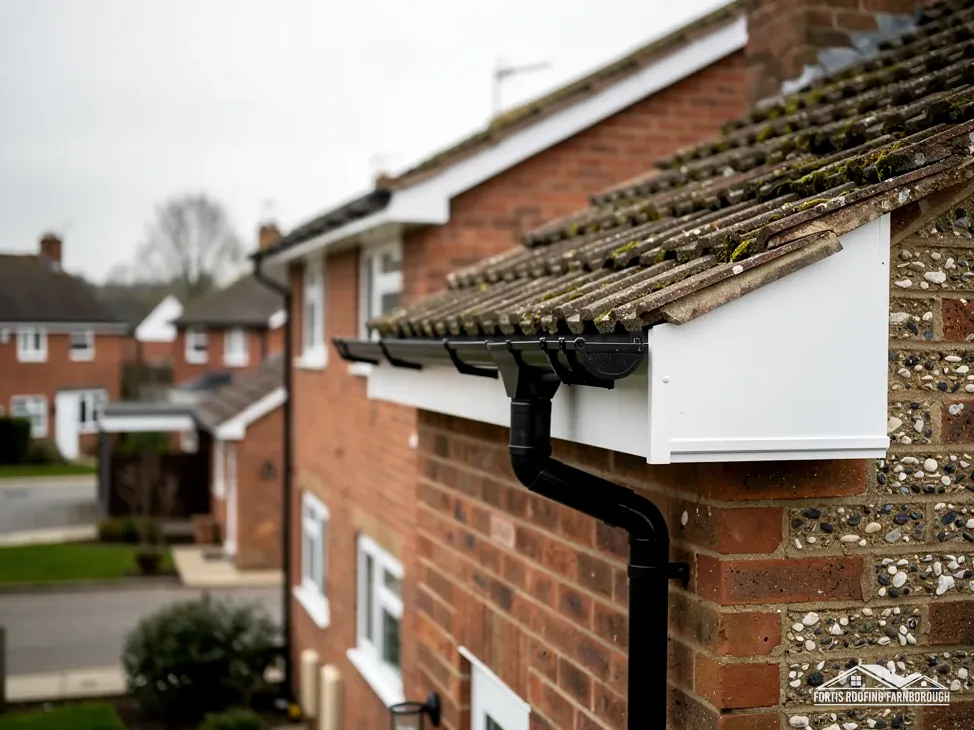
Gutters have the same limit. If a gutter is blocked, set with too little fall, or too small for the roof area that drains into it, water spills over the front or back. Spill at the back runs behind the fascia and into the roof edge, which then looks like a roof leak. Brett Martin gives a fall of 1 mm for every 600 mm of gutter as a guide, and a sagging section that holds a pool will overflow first.
Look for staining below gutter joints and a tide of dirt where water has overflowed. Our page on finding a roof leak explains how the path of the water is followed.
Wind-driven rain
Rain does not always fall straight down. In a strong wind it arrives at an angle, and it can be forced sideways and upward into places that a vertical shower would never reach. Roofs are built to shed water downward, so these are the weak points.
Common entry points are the gaps beneath a verge, where tiles meet the gable wall and are sealed with mortar or a dry-fix system, the junction of a roof and a wall, protected by lead flashing, and the gaps at the ridge and hips. A flashing that has lifted slightly or a cracked mortar bed can let wind-driven rain past.
Tiles themselves may let water in when the wind drives it up the slope, over the lap, if the pitch is shallow or the overlap is too small for the exposure. Cracked or displaced tiles make this worse, and so does worn underlay, which is the second line of defence.
A clue is direction. If the leak appears only when heavy rain comes from one side, the fault is on that elevation. If it follows storms from several directions, the cause is more likely a general weakness, such as a failing felt or a blocked valley, than a single junction.
How the cause is pinned down
Diagnosis starts with a log. Note the date, the strength of the rain, the wind direction and exactly where water appears indoors. A pattern across several downpours is worth more than a single sighting.
The roofer then works from the inside out. In the loft, we look for stains, wet timber and daylight, trace each mark uphill along the rafters, and note where water has run. Outside, we study the covering above that line: valleys, flashings, ridge, verges, chimney junctions and gutters.
Sometimes the water entry point still is not obvious. A controlled water test, where a hose is played on one part of the roof at a time while someone watches inside, can reproduce the leak and identify the source. It is slow, but it avoids the cost of replacing parts that were never at fault.
Once the cause is found, the repair is usually modest: clearing and re-lining a valley, re-dressing a flashing, re-bedding a verge or replacing a gutter section. If the evidence shows the covering is failing more broadly, we tell you and show you the photographs and measurements.
The roof repairs hub describes how surveys are run.
What you can do meanwhile
You cannot fix the roof from the ground, but you can limit the harm and help the diagnosis. Put a bucket under any drip and a towel around it, and move furniture and valuables away from the area. If the ceiling is bulging with water, do not stand beneath it.
Look at your gutters from the ground during the next downpour. Water streaming over the front edge, or pouring down the wall behind a downpipe, points to a gutter problem you can describe to the roofer. A torch and a phone camera in the loft capture stains while it is raining.
Resist the urge to climb up and fill gaps with sealant. Sealant over a moving joint often cracks within weeks, and it can trap water and hide the real cause. A leaking roof is also a hazardous place, and a ladder in wet weather adds to the danger.
Do not assume the leak has gone because it stopped when the rain eased. Intermittent leaks usually return, and the damp they leave can spread into insulation and timber in the meantime.
Where water is dripping near wiring, read what to do about a roof leak near a light fitting before anything else.