The short answer
Not every repair does. A small fix low on a roof can be tackled from a ladder or a mobile tower, while work high up, along an edge or over a long stretch usually calls for scaffold so that people have a proper platform. Scaffold that sits over a public road or footway also needs the highway authority's licence. Standing on your own land, it does not.
Ladders, towers and scaffold compared
Three kinds of access are in everyday use. A ladder gets someone up to a short, light task, such as swapping one tile near the eaves or clearing a gutter outlet. It gives a way up but no stable platform to stand on or to carry materials.
A mobile tower is a free-standing frame with a deck and guard rails. It suits a moderate repair where the roof is not too tall and the ground beneath is firm and level, and it can be wheeled along the wall as the work moves.
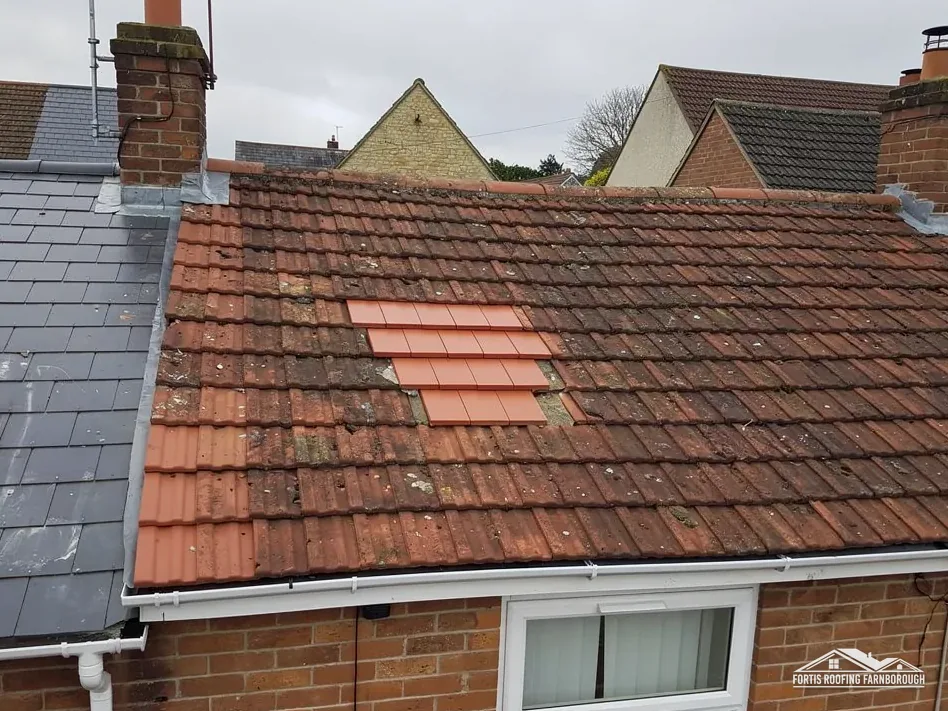
Scaffold is a fixed structure built around the work, with boards, rails and toe boards at each lift. It is the sensible choice for tall houses, long runs of roof edge, chimney work and any repair that keeps people up there for more than a short spell.
The decision is about safety before cost. A roofer who works from a ladder on a job that needs a platform, simply because scaffold costs more, is taking a risk that you ultimately bear. Height, roof edge and ground conditions are recorded at the survey, and the access method is chosen from those facts.
When scaffold needs a highway licence
Section 169 of the Highways Act 1980 is the source of the licence rule. Any frame that obstructs a road or footway, whether it stands on it or reaches over it, requires permission from the authority responsible for that highway first, and leaving it up without that permission breaks the rule.
A drive or private estate road is a different case. Bracknell Forest Council and Wokingham Borough Council each say on their pages that no licence is involved for a structure on private ground.
Hampshire County Council looks after the highways for four districts in our area: Basingstoke and Deane, East Hampshire, Hart and Rushmoor. On its page, applying is the scaffolder's job, done for the customer. Hampshire County Council charges £211.90 for the opening 2 weeks and £72 for each further 2 weeks, with a minimum notice period of ten clear working days before the planned start. If a job overruns, the application starts again.
Elsewhere the council responsible for the road has its own forms, fees and lead times. The licence is arranged through the scaffolder, and the written price tells you whether scaffold is part of the total.
Safe access as a legal duty
Building law treats work on your home as a project with a client. The HSE's guidance for domestic clients covers householders who commission building work on their own homes.
Under CDM 2015 the added roles of principal designer and principal contractor come into play only when more than one contractor is involved. A single contractor on a project must still produce a construction phase plan. A roof repair by one firm therefore needs a written plan covering how the job will be carried out safely, including how people reach the work.
For an owner, the practical meaning is plain enough. Safe access belongs inside the price and should not be a favour to negotiate. Treat with caution any quote that never mentions how the roofer will get up, particularly on a high roof.
Put three questions to any firm: what access is planned, whether scaffold is included, and who deals with a licence if one is needed. The answers reveal a good deal about how carefully the work will be managed, and a firm that has thought about them will answer without hesitation.
How we choose for your roof
At the survey we take eaves and ridge heights, look at the ground below and note anything in the way: paving, steps, a lean-to, a neighbour's boundary. Those details settle the choice between ladder, tower and scaffold.
A handful of slipped tiles on a low rear slope may only need a tower or roof ladder. A ridge, a chimney or a long valley is another matter: scaffold usually wins there, because the work is longer and a fall is more serious.
The photos and measurements come to you with the reasoning, so you can see why one method was picked. Access is frequently the biggest single driver of what a repair costs, and we point that out when it applies. A roof over a conservatory, a steep drop at the back or a narrow side passage can change the answer on its own.
The quote is a single written total, and it says whether scaffold and VAT are inside it. The roof repairs hub covers the range of jobs, and our page on how long a roof repair takes shows how access shapes the programme.