When something is wrong with a chimney, it is not always obvious who to ring. A fire that smokes back into the room, soot falling down the flue, a damp patch on the breast and a pot that looks loose can all be described as chimney trouble, yet they belong to different trades. A sweep and a roofer overlap only at the very top of the stack.
The distinction is simple in principle. A chimney sweep cleans the flue from the inside, removes soot and blockages and checks that the smoke draws away. A roofer works on the outside of the building, on everything from the pots down to the lead at the point where the stack meets the roof.
This guide sets out who does what, how to tell which of them a particular symptom calls for, where the two trades need to work together and which order produces the best result. We are roofers, so we describe the stack and the roof in detail. For the inside of a live flue, we explain when you need a sweep or a heating engineer, because the right person for each part saves money and avoids repeat work.
Two trades, two parts of the chimney
A chimney has two zones. Inside the house runs the flue, the passage that takes smoke and gases upward. Above the roof, there is the stack, the brickwork and the pots that finish it off. The trades divide along that line.
The sweep: inside the flue
A sweep brushes soot and debris from the flue walls. Cleaning keeps a live flue clear, and it reduces the build-up of deposits that can catch fire. A sweep may also run a camera or a smoke test to check the flue is clear and draws properly, and will tell you if the flue lining looks damaged or blocked.
The roofer: outside, above the roofline
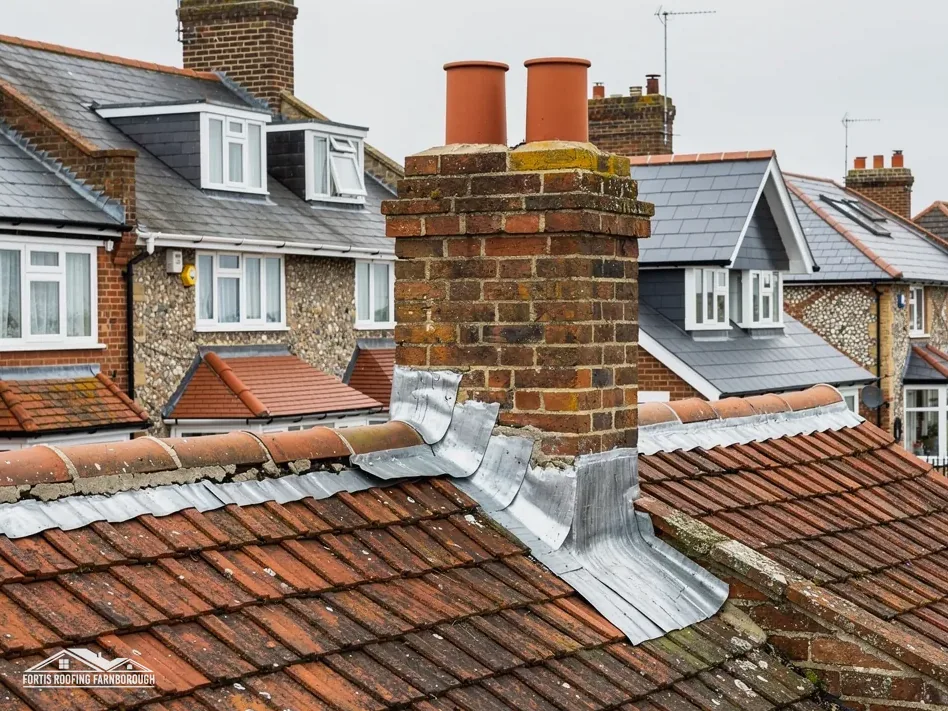
A roofer deals with the structure of the stack, which keeps water out and the pots in place. The list runs from repointing and flaunching to new pots, caps, cowls and flashings and, where it is needed, a rebuild. It also takes in the roof around the stack, where tiles and slates meet the brick.
Where they meet
The two zones touch at the top of the flue, where the pot sits. A cap or cowl is a roofer's fitting, but it affects how the flue breathes and draws. Our guide to capping a chimney explains how that choice depends on whether the fire is in use.
What neither does
Neither is the right person for a gas boiler flue or an oil appliance. Those belong to a qualified heating engineer, and a flue connected to one should not be altered by either trade without that engineer's say.
What a sweep sees, and what stays hidden
A sweep looks from below, and the view has limits. It helps to know what a sweeping visit can and cannot tell you about the stack.
What it shows
Soot, tar, nests, fallen pot fragments and mortar debris are all found by sweeping. A camera inspection can show the lining, a crack or a blockage. If your fire smokes, or the flue seems blocked, a sweep is the right first call.
What it does not show
From inside, a sweep cannot see the outside of the stack. How the joints, flaunching, pots and flashing are faring can be judged only from the roof. Damp that comes through a failed flaunching, or a stack that has started to lean, is a roofer's diagnosis.
Debris that points upward
Sometimes a sweep finds fragments of mortar, brick or pot in the fireplace. That is a sign that something has broken higher up, and a roofer should look at the stack. Lumps of mortar in the hearth are the clearest case.
Soot and stains
Soot falling into the room is a flue issue, and stains on the breast that appear in wet weather point to the roof. Our guide to a damp chimney breast tells the two apart.
A record
Ask a sweep what they will give you in writing after a visit. A note of what was found is useful to a roofer, and to an insurer if a claim ever follows a chimney fire.
Pass information on
If the sweep notes cracks or a gap in the lining, tell your roofer before the stack is repaired.
What a roofer does at the stack
A roofer's job starts at the top of the flue and works outward, covering each part in turn. The inspection covers every part above the roofline, and it is done from a safe platform.
The survey
The survey takes in the pots, caps and cowls, the bed under them, the joints, the brick faces, any lean and the lead at the base. Each part is photographed, and a tap on the mortar tells us whether it is firm. You receive the images and a written explanation.
The repairs
Typical stack work includes repointing, rebuilding flaunching, replacing pots, fitting a vented cap or bird guard, renewing lead and, where the brick has failed throughout, rebuilding the stack above the roof. Our short answer on chimney inspection describes what a roofer looks at.
The roof around the stack
The roofer also checks the tiles beside the stack, the underlay and the timbers visible in the loft. A leak at a chimney often begins in the roof surrounding it.
Access
Reaching a stack safely usually means a scaffold or a tower. We plan the access before pricing, since it is a significant part of the work.
Not a flue specialist
We do not service appliances or test flues for combustion. If we see signs of a problem inside a live flue, we tell you and suggest a sweep or heating engineer.
Why call a roofer first for a leak
If the symptom is water, the roofer goes first. A sweep will not find a failed flashing, and sweeping will not stop rain coming in.
Problems that need both
Many chimney problems cross the line between the two trades, and the table shows who to call first for the common symptoms. It is a guide and not a rule, since a stack can have two faults at once, and the survey photographs settle which one came first.
| Symptom | Call first | Then |
|---|---|---|
| Damp patch on the breast after rain | Roofer | Sweep if the flue is live |
| Fire smokes into the room | Sweep | Roofer if the pot or cowl is damaged |
| Soot or debris in the hearth | Sweep | Roofer if mortar or brick is falling |
| Birds or a nest in the flue | Sweep, after checking the nest is empty | Roofer to fit a guard |
| Leaning or cracked stack | Roofer | Engineer where the cause is structural |
| Unused flue, musty smell | Roofer | Sweep to clear it first if it is to be capped |
Nests
Under section 1 of the Wildlife and Countryside Act 1981, intentionally destroying a nest in use is an offence, so confirm a nest is empty before anyone clears it, and wait if it is not. Our answer on birds nesting in a chimney sets out the options.
Unused flues
A flue you plan to cap should be cleared of debris first, so that a sweep goes ahead of the roofer, and the cap goes on afterwards.
Appliances
If an appliance is connected, the heating engineer's advice overrides both trades.
The sensible order of work
When both trades are needed, the order matters. A little planning avoids paying for the same access twice, or undoing work.
For a live flue that needs repair
Have the flue swept and inspected first, so that any damage inside is known before scaffold goes up. That way the roofer can allow for what the sweep found, for example a cracked lining or a blocked pot, and the access is used once. Then the roofer repairs the stack. Afterwards, a final sweep removes any mortar and dust that fell into the flue during the work.
For an unused flue that will be capped
Sweep first to clear soot and nests. Then the roofer repairs the stack top and fits the vented cap. The aim is a clean flue that can breathe.
For a stack being rebuilt
The roofer takes the stack down and builds it again. Because rubble falls into the flue, a sweep afterwards, before any fire is lit, is sensible. A new lining may be fitted at the same time.
For a damp breast
The roofer deals with the stack top, flashing and joints. Once the wall has dried, any internal work can follow. A sweep may be needed if the flue is in use.
Scheduling
Scaffold is the largest cost on many stack jobs, so we aim to complete all roof-end work in one visit. Tell us if a sweep is booked, and we will sequence around it, leaving the final sweep until the last mortar has been cleared from the flue.
Sweep before repairs on a live flue, and again after a rebuild. Roofer first when the symptom is water.
Questions to ask whoever you call
A few questions sort out whether a caller understands the stack, whichever trade they belong to.
Ask a roofer
- Will you survey the whole stack, including pots, flaunching, joints and flashings, and send photographs?
- What access will the job need, and is it in the price?
- Is the flue in use, and have you checked that nothing is connected to it?
- If the stack is in a conservation area or the house is listed, will you check consent first?
Ask a sweep
- What will you check beyond sweeping, and will you give me a written record?
- If you find damage, will you tell me what it means and who should fix it?
- Is it safe to light the fire afterwards?
Beware cold calls
A stranger who knocks, says your chimney is dangerous and offers to fix it on the spot deserves suspicion. Our guide to spotting a dodgy roofer lists the pattern, and the sensible reply is to ask for a survey and a written price.
Get it in writing
Whichever trade you use, ask for a written description of the work and the price. Citizens Advice suggests at least 3 written quotes for any substantial job.
Our part
We are roofers, so our part is the stack and the roof around it. Where the flue itself needs attention, we tell you and suggest who to ask, because the right trade for each part avoids paying twice for the same scaffold. The chimney repairs page lists what we do on the stack.