A chimney that is no longer used is still a hole in the roof. Left open, it lets rain run down the flue, gives birds a place to nest and drops soot and debris into the room below. Sealed tight, it can trap damp air, and the moisture shows up as stains on the chimney breast or a musty smell in the room.
A cap is the answer to both problems when it is chosen and fitted properly. It sits on top of the stack or pot, sheds the rain and has gaps that let air move through. The detail matters, because the wrong cap on a live flue is a safety problem and the wrong cap on a dead flue is a damp problem.
This guide explains why ventilation matters, how a flat cap differs from a cowl or a pot, what to do with a flue you no longer use, and how the top of the stack is made weathertight. It also covers a flue that still serves a fire or boiler, where capping is a different matter altogether and a heating engineer needs to be involved. We see the stack from the roof.
Why a chimney needs a cap at all
Three things come down an open flue: rain, birds and the weather itself. A cap is cheap compared with the damage any of them can do.
Rain
Rain falls straight into the top of an open pot. The water runs down the flue, wets the brick lining and eventually soaks the breast on every floor. If the fire below is not lit, nothing dries it. The damp then shows up as brown stains on wallpaper or plaster, flaking paint and salts on the surface. Our guide to the damp chimney breast explains how to tell this from other causes.
Birds and debris
Jackdaws and other birds will build in an open stack. A nest can block the flue and, if the fire is lit, becomes a fire risk. A cap with a mesh stops them settling. Our answer on birds nesting in a chimney covers what to do when a nest is already there. Under section 1 of the Wildlife and Countryside Act 1981, intentionally destroying an occupied nest is an offence, so look before any work starts.
Leaves and rubble
Leaves, twigs and crumbled pot fragments fall down an uncapped flue and collect at the bottom. A cap keeps the flue clear, and so a sweep has less to remove if the fireplace is ever brought back.
Where the roof is concerned
Approved Document C asks that roofs resist the penetration of precipitation. A chimney stack that lets rain straight in is working against that aim, even though the rain does not come through the tiles.
Why an unused flue still needs air
The common instinct is to seal an old flue completely. It feels tidy, but it can make the damp worse.
What goes wrong in a sealed flue
Warm, moist air from the house reaches a cold flue and condenses. If the flue has no way to ventilate, that moisture stays. Brickwork absorbs it, and the damp migrates into the breast, the plaster and the wall beyond. Approved Document C includes a requirement that roofs be built so that their structural and thermal performance are not adversely affected by interstitial condensation, which is condensation inside the structure. The same physics applies inside a chimney.
What ventilation does
A vented cap lets the air in the flue move, however slowly. That keeps the lining dry and carries moisture out at the top. In many homes the flue is also vented lower down, with an air brick or a vent in the breast. Which arrangement suits your house depends on the flue and how the room is used.
Ask before you seal
If the flue was lined for a gas fire or serves another appliance on a different floor, sealing it can affect that appliance. A heating engineer should confirm that nothing is connected before a cap goes on. We look at the stack from outside, and we ask who last used each flue.
Practical advice
For a flue you are not going to use again, a cap that sheds rain and allows air through is normally the right pairing. Some owners also fit a vent at the breast in the room, which lets moist air out and keeps the lining dry, though it should be positioned with advice.
Caps, cowls and pots compared
These terms get mixed up, so it helps to separate them. The chimney pot is the ceramic or clay tube at the top of the flue. A cap or cowl is fitted on or over the pot.
| Fitting | What it does | Best suited to |
|---|---|---|
| Pot | Finishes the flue, gives the smoke an exit | A flue in use or likely to be |
| Rain cap or hood | Sheds rain, keeps air moving round it | Unused flues and fires used rarely |
| Mesh bird guard | Stops nests and large debris | Any flue where birds are a problem |
| Cowl | Shapes the airflow at the top, can reduce downdraught | A live flue with smoke problems |
| Sealed cap | Blocks the flue completely | Rarely correct; needs a vent elsewhere |
What a cowl is for
A cowl sits on the pot and is shaped to cope with wind. On a live flue, it can help with downdraught, which is wind pushing smoke back into the room. Our answer on chimney cowls goes through when one is worth fitting.
What to avoid
A flat slab bedded over the pot with no gaps does the job of keeping rain out, but it also stops the flue breathing. If you inherit one, ask a roofer whether the room below has damp and whether the flue is ventilated lower down.
Material and fixing
Clay, terracotta, concrete and metal caps all exist. Whatever the material, the cap should be fixed so that wind cannot lift it, and the joint with the pot or stack top should be sealed to keep rain out.
Weatherproofing the top of the stack
A cap on a pot is only as good as the stack beneath it. The top of the brickwork takes the heaviest weather, and a failing top lets water in no matter what is fitted above.
The flaunching
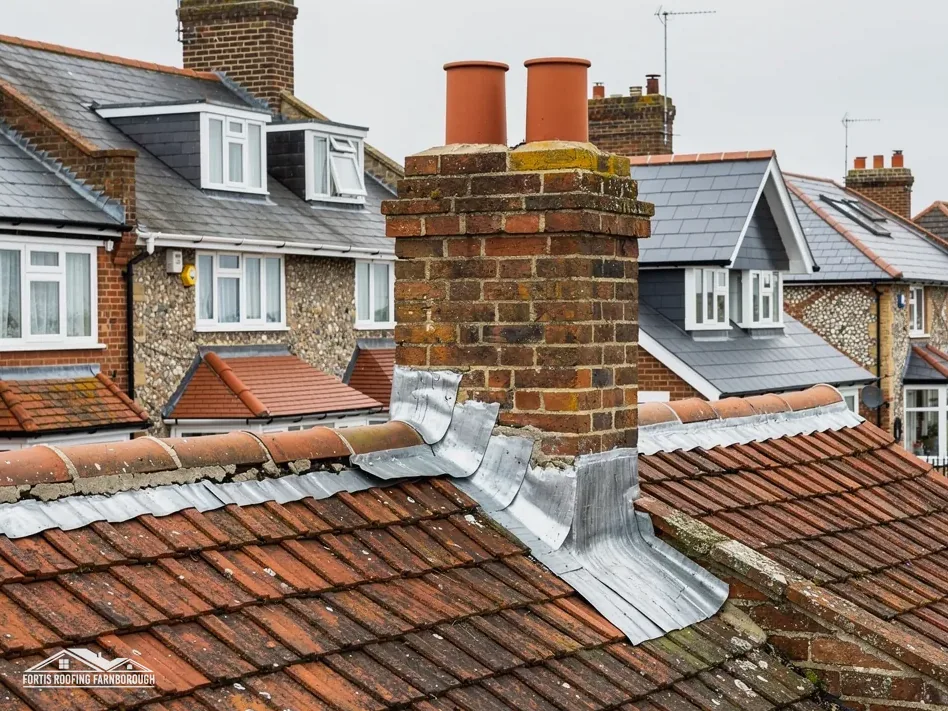
Flaunching is the sloped mortar at the top of a stack that holds the pots in place and sheds rain outward. Over the years it cracks, shrinks and falls away. Once the cracks open, water runs behind the pot and into the brickwork. Our guide to chimney flaunching repair shows how that repair is done.
Pointing and brick faces
Open mortar joints and bricks that have lost their faces let water into the stack. Repointing is a standard job, and the mortar needs to suit the age and hardness of the brick, so a modern cement mix over soft old brick can do harm.
Flashings and the roof
At the base of the stack, lead flashing seals the join with the roof. A stack that looks fine at the top can leak from the bottom. We inspect the whole stack from pot to flashing, and photograph each part.
Capping a stack with no pot
Some stacks have lost their pots altogether. The top is then finished with a purpose-made cap or a sloped slab with ventilation gaps, and the flaunching is renewed beneath.
Work at height
Reaching a stack safely usually means scaffolding or a tower. That is part of the access we plan before pricing, and it is why capping is not a quick job from a ladder.
Live flues, fires and boilers
Everything above applies to unused flues. A flue that serves an appliance is a different matter, and capping it wrongly is dangerous.
Solid fuel and open fires
An open fire or stove needs a clear flue and an outlet that cannot be blocked. A rain cap with generous gaps, or a cowl designed for the job, is common. A sealed cap would send smoke and fumes into the room. If you use a fire, have the flue swept and inspected before the season.
Gas and oil appliances
Gas and oil flues have their own requirements, set by the appliance manufacturer and by the regulations that cover heating installations. Cap or terminal choice for these belongs to a qualified heating engineer. We do not advise on the appliance, and we recommend that you do not alter a terminal without one.
Carbon monoxide
Any blockage on a flue that serves a fuel-burning appliance can allow carbon monoxide to build up. An alarm in the room is a sensible precaution wherever a flue is in use. If an alarm sounds, leave the room and get advice.
Chimney sweep or roofer
A sweep clears and inspects the inside of a live flue, and a roofer deals with the stack, pot, flaunching and flashings on the outside. Our guide to a roofer or chimney sweep explains who to call for which problem. Where a flue is live and the stack needs work, the two usually visit one after the other.
Cap a dead flue so that it can breathe. Never cap a live flue in a way that stops the smoke leaving.
Fitting a cap and what the visit covers
Fitting a cap is a small job on paper, and in practice it begins with a close look at the stack.
What we check first
We look at the pots, the flaunching, the pointing, the brick faces and the flashing. A new cap bedded on weak flaunching will not last, and we tell you before work begins. We photograph each part from the roof, so you can see what we saw.
What we ask you
We ask whether the flue has been used, which rooms it served, whether any appliance is connected and whether there has been damp in the breast. The answers tell us whether to fit a vented cap or whether a heating engineer must be involved first.
The fitting
The cap is fixed to the pot or the stack top with mortar or fixings suited to it, set so that rain sheds clear and air can pass. Where the flaunching is cracked, we renew it at the same visit, since it is the same access and the same scaffold or tower.
Afterwards
If the breast has been damp, allow time for it to dry before decorating. A cap does not dry a wall on its own, so the stain may take a season to fade. If it persists, the cause may lie elsewhere, and a flashing or a roof leak should be checked.
Next steps
For the full list of chimney work we do, see our chimney repairs page. One written price follows the survey, and it covers access and the work together.