The short answer
Leave an occupied nest where it is, and do not light the fire or stove while a nest may be blocking the flue. An occupied nest, or one under construction, is protected against intentional harm by the Wildlife and Countryside Act 1981. Once the birds have gone, the flue can be cleared, and a cowl or bird guard stops it happening again.
Signs that something is nesting in the flue
A chimney is a tempting place to build. It is high, sheltered and open at the top, and an unused one has no smoke to put birds off. The first sign is often debris: sticks, straw or feathers in the fireplace, or soot disturbed from higher up.
Other clues are noise and sightings. Scratching or chirping from the chimney breast, especially in the morning, suggests a nest with young. Birds flying in and out of the pot, or the same pair perching on the stack day after day, tell the same story from outside.
A stove or fireplace connected to a flue that holds a nest is a safety matter as well as a wildlife one. Sticks and straw can choke the passage that carries smoke and combustion gases away. If the fire is lit, fumes can enter the room instead of leaving through the pot. Keep the appliance unlit until the flue has been checked, and fit a carbon monoxide alarm if the room does not already have one.
Do not poke at the nest from below with a brush or a pole. That is how a nest is damaged, and it may bring the whole thing down into the grate.
What the law covers
Section 1 of the Wildlife and Countryside Act 1981 is aimed at anyone who intentionally removes or wrecks a wild bird's nest at a time when the birds are using it or building it. Two tests apply. The act has to be intentional, and the nest has to be live at the time.
The practical consequence for a chimney is simple. An active nest is left alone until the birds have finished with it. A sweep or roofer who knows about it cannot clear it without risking an offence, and a homeowner who asks them to is in the same position.
GOV.UK's guidance on wild birds names no licensing purpose for development or construction, so a repair is not a reason to apply for permission to remove an occupied nest. The usual route is to wait.
An old nest, empty and not being rebuilt, falls outside that part of the section and can be cleared. We do not attach dates to any of this, because what counts is the state of the nest on the day. If you are unsure whether it is occupied, watch the pot for activity over a couple of days before deciding.
Clearing the flue once the nest is empty
When the birds have left, the flue needs clearing before the appliance is used again. A chimney sweep can do this, and removing a nest is part of ordinary sweeping once it is empty. A sweep also checks that the flue is open from bottom to top, which is a job for the sweep and not for the roofer.
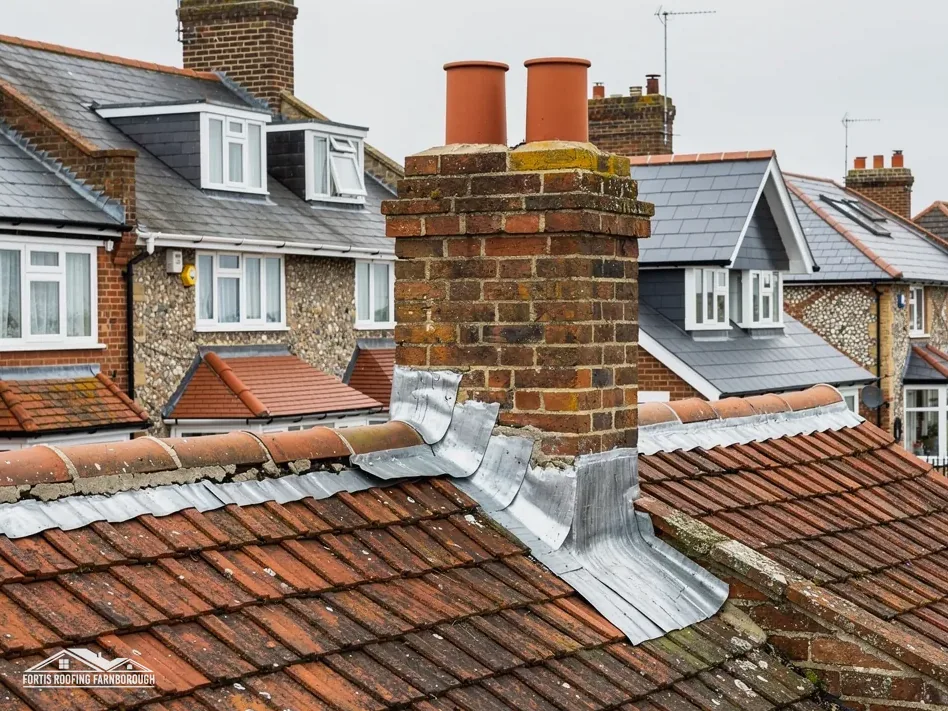
Where the nest sat close to the top, the roofer's inspection comes in as well. Nests often build up on the flaunching, the mortar bed that holds the pot in place, and birds scratch and pull at weak mortar. A pot that has worked loose, a cracked flaunching or a gap between pot and mortar is hard to see from the garden.
Our survey photographs the top of the stack, so you can see the pot, the flaunching and the brickwork. If the mortar has started to fail, the photographs show it and the repair goes into the written price. Our guide on whether you need a roofer or chimney sweep sets out which job belongs to which person.
If the flue serves a fire you never use, it still needs ventilation. Closing it off completely can lead to damp inside the breast, which is why a cowl is usually better than a blank cap.
Keeping the next nest out
A cowl or bird guard is the usual fix. It sits on the pot and covers the opening so that birds cannot drop in, while still letting the flue breathe. Our answer on whether you need a chimney cowl compares the types and what suits an unused flue.
The choice depends on how the flue is used. A working fire needs a guard with openings wide enough for smoke. An unused flue needs ventilation, so a vented cap is better than a solid one. A roofer can fit either from a ladder or a small scaffold, usually in a short visit.
Timing matters because an occupied nest cannot be covered over. Fitting a cowl while birds are using the pot would trap them or cut off their access, which risks the intentional harm the Act is aimed at. Wait until the nest is empty.
While the roofer is at the top of the stack, the survey is a good moment to check the rest. Look at the flashing at the base, the pointing and the pot bedding. Everything we find comes with photographs and one total price in writing. Our chimney repairs hub sets out the repairs on offer.