The short answer
Sometimes, and only as a finishing step. A breathable water repellent on sound but porous brickwork can reduce how much rain the stack absorbs. It cannot close open joints, replace failed lead flashings or repair cracked flaunching, which are the usual leak routes. A coating that is not breathable can trap moisture and make damp worse.
What a water repellent does
Brick and mortar are porous, which means they take in water like a hard sponge. In a wet winter, the face of a chimney can hold a good deal of rain, and on an exposed stack that moisture works its way inwards. A water repellent is a liquid that soaks into the surface and lines the pores, so that water beads and runs off instead of being absorbed.
The best-known type is a breathable one. It lets water vapour inside the brick escape while keeping liquid rain out, so the wall can dry. That breathing is the key quality, because brickwork always holds some moisture, and a treatment that seals it in makes matters worse.
A repellent works on the surface of the masonry only. It does nothing about water that enters in other ways, and that includes gaps, cracks and joints that have eroded back. It also wears off over time, and the protection fades over the years as the surface weathers, so it is not a permanent fix.
The aim, then, is modest. On a stack that is otherwise sound, a repellent can cut the amount of rain soaked up by the bricks. Its value depends on the condition of everything else.
What it cannot fix
Most chimney leaks do not come from rain soaking through sound brick. They come through defects, and a repellent has no effect on those.
Open joints are the first. Where the pointing has worn back, water runs straight in. Painting a repellent over a hollow joint is like painting over a hole. The joint needs repointing, as described in our guide to chimney repointing.
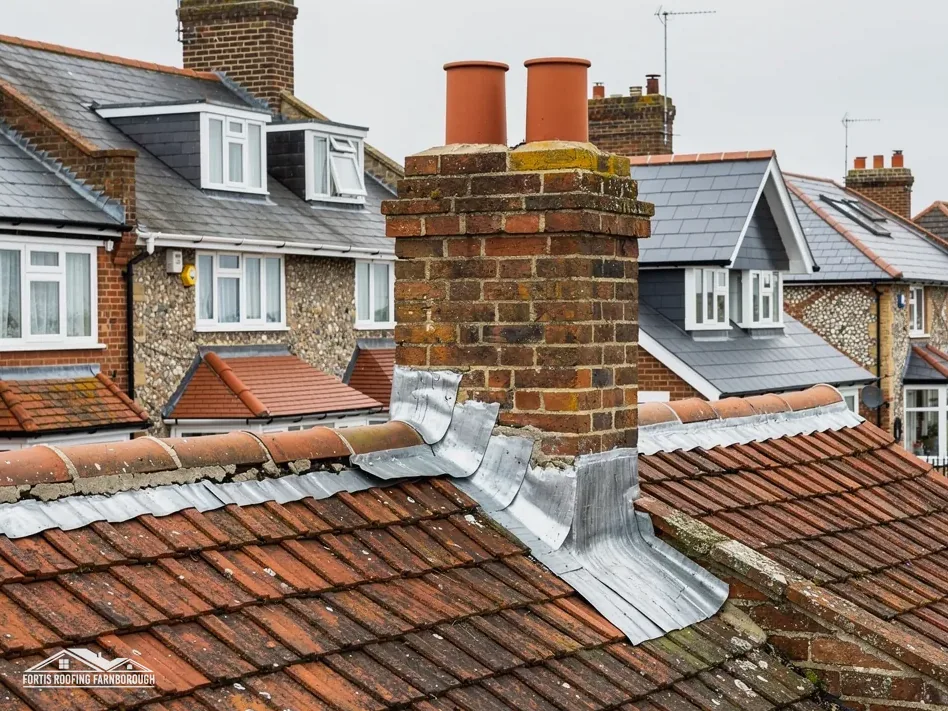
Failed leadwork is the second. The flashings and the back gutter are the stack's main waterproofing at the roof junction, and lead is built for the job. Royston Lead's brochure lists code 4 at 1.80 mm for flashings, with heavier codes for gutters. If the lead has cracked or lifted, a coating will not seal it.
Cracked flaunching and cracked pots are the third. Water enters at the top of the stack and runs down inside, far from any treated face.
Spalling bricks, where the face flakes away, are a fourth case. A repellent will not rebuild a face that has gone, and putting it on bricks that are already breaking up traps moisture behind the surface. Our answer on spalling chimney bricks explains the repair.
When it is worth considering
There is a narrow case where treatment makes sense. It is a stack that has been repaired properly, with sound pointing, good flashings and a secure pot, and whose bricks are porous enough to stay wet for long periods. On an exposed, tall stack, where the face takes the weather, a breathable repellent applied to dry, clean brick can help it dry out faster and take less rain.
The conditions are strict. The brick must be dry and clean, the weather must be dry for long enough afterwards, and the product must be one made for masonry that states it is breathable. Cheap sealers that form a film on the surface are the ones that cause trouble, because they hold water inside and can make bricks flake in frost.
The repair comes before the treatment. If you apply a repellent first and find leaks later, the cause is hidden and the cost is wasted. A survey that looks at every part of the stack tells you whether the bricks are the problem or just the place where the symptom appears.
The Marley position on roofs is a useful parallel: cleaning methods that damage the surface reduce life. The same caution applies to chimney treatments, so ask what a product does before it goes on.
What we check first
When someone asks us about waterproofing a chimney, we begin with a survey of the stack and the roof junction. The photographs show the joints, the face of the bricks, the pot and the flaunching, and the leadwork at the base.
Most often the cause is one of those parts, and the repair is repointing, new flaunching, renewed lead or a rebuilt top. Each of these deals with a leak route, where a coating only reduces absorption. If the stack is sound and the bricks are simply porous, the report records that, and a breathable repellent can be added as the last stage of the job.
You see the evidence either way. Staining inside the house is matched with the photographs outside, and the repair is explained in plain words. The price comes as a single written figure for the whole job, with access and any scaffold included.
If you have been offered a waterproofing treatment as the answer to damp, ask what it is, whether it is breathable and what repairs come first. Our guide to a damp chimney breast sets out the usual causes, and the chimney repairs hub lists the full range of work.