The short answer
Spalling is when the outer face of a brick flakes or breaks away, leaving a rough, crumbling surface. On a chimney it is usually caused by water getting into the brick and freezing, often made worse by hard cement mortar or a coating that traps moisture. A few bricks can be swapped for new ones, but widespread spalling points to a rebuild.
What spalling is and why a chimney suffers
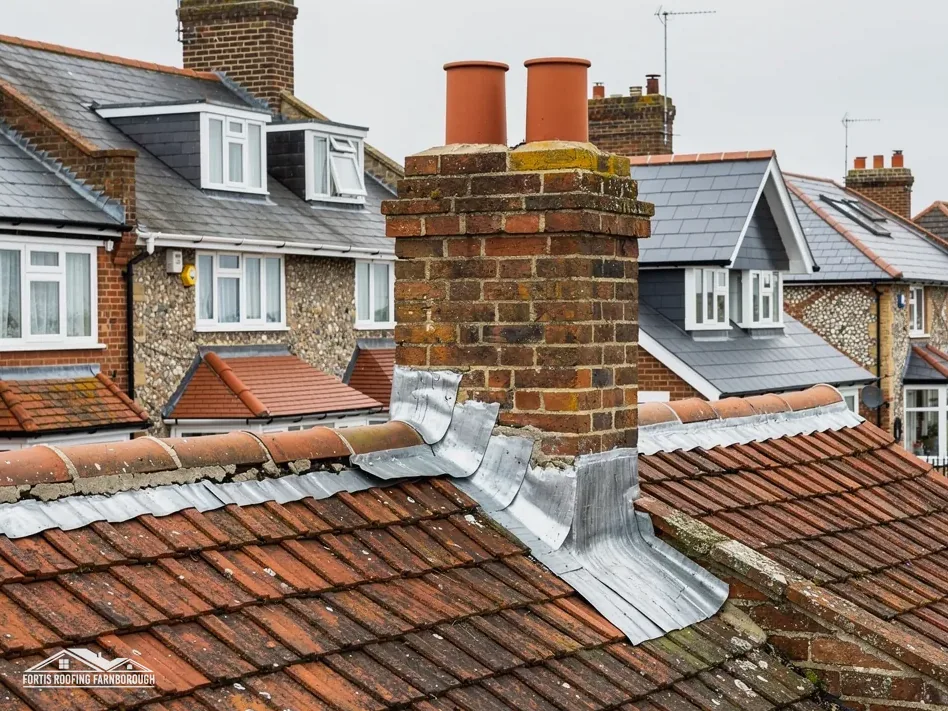
A brick has a hard outer skin and a softer interior. When the skin breaks away in flakes or chunks, that is spalling. What remains is rougher and more absorbent than the original face, so the damage tends to speed up once it begins.
Few parts of a house are as exposed as the stack. It rises free of the roof, takes wind and rain on every face and has no shelter. It is also cold at the top: the stack cools quickly, and in a frost it chills right through. Flue gases can add to the strain from inside, since smoke from a fire carries moisture and acids that attack the brickwork.
The mechanism is water and frost. Rain soaks into the brick through its pores or enters through open joints. In a freeze the water turns to ice and expands, pushing at the brick from inside. Repeated freeze and thaw loosen the face until it flakes off.
Met Office figures for South Farnborough (1991 to 2020) show about 53 air-frost days in an average year and annual rainfall near 715 mm, so repeated wetting and freezing belong to the local winter. A brick that was fine for decades may suddenly fail once its skin has been breached.
Mortar, coatings and other contributing causes
Frost alone does not explain every case. Several things make a stack more likely to spall.
Hard mortar is a common culprit. A modern cement mortar can be stronger than the bricks around it. When the stack moves with temperature and moisture, the stress goes into the bricks rather than the joints, and their faces give way. Older stacks were built in softer lime mortar that acts as the sacrificial element.
Failing pointing lets water in. Where the joints have eroded back, rain reaches the bricks' edges and soaks into them from the side, so the water has a way in and no easy way out.
Coatings can trap moisture. A film-forming sealer or paint on a stack stops the brick breathing, so water that gets behind it freezes and blows the face off. A breathable treatment on sound brick is different, as our answer on chimney waterproofing explains.
The flue plays a part as well. A cracked liner, or condensation from a boiler or stove flue, feeds moisture and sulphates into the brickwork from the inside, and the damage shows on the outside faces.
A softer brick type, such as an underfired common brick, spalls more readily. That is a feature of the material, not a fault of the owner.
What can be repaired
What can be mended depends on how much of the stack is affected and how deep the damage runs.
A few spalled bricks in an otherwise sound stack can be cut out and swapped for matching ones. The roofer or bricklayer chisels out the damaged brick, cleans the bed and sets a matching brick in fresh mortar. Finding a match is the challenge, since colour, size and texture have to fit, and reclaimed bricks are often the best option for an older stack.
Where the face has gone but the brick is otherwise firm, there are repair mortars that rebuild the surface. They are a short-term measure on an exposed stack and rarely last as long as a replacement brick.
Widespread spalling, with many bricks flaking or the faces gone on a whole elevation, tells you the stack is close to the end of its useful life. At that point the sensible repair is to rebuild the affected courses, or the whole upper stack, in matching brick and appropriate mortar. Our guide to a chimney rebuild describes the process.
Repointing is part of almost every spalling repair, since failed joints are the cause or a contributor. Our chimney repointing guide covers the mortar and the method.
What we check, and how to stop it coming back
The survey photographs every elevation of the stack and records where the spalling is, how deep it goes and whether the joints, flaunching and flashings are sound. Water that enters at one of those weak spots is usually what starts the damage.
We also look for the cause. If the mortar is harder than the brick, the repointing uses a softer, compatible mix. If water is entering at the top, the pot bedding and the cowl come into the plan. If lead has failed, it is renewed. A repair that treats only the flaking face and leaves the cause is a repair that will be needed again.
Timing matters, because mortar work needs dry weather and frost-free days. Damaged bricks left through another winter lose more of their faces, so a stack with active spalling should be booked in before the cold season.
You receive the pictures, the diagnosis in everyday words and one written price. If a repair is enough, the report says so, and if a rebuild is the better buy, it gives the reasons.
The chimney repairs hub lists the repairs available.