The short answer
You can look at a chimney yourself, but the repair belongs to a roofer. A stack crowns the roof, usually needing scaffold or a tower, and falls are the main risk. Safe checks include looking from the ground with binoculars and inspecting the loft. Shared stacks, scaffold on the highway and breast removal bring rules that apply to owners too.
Why the stack is a hard place to work
Repairing a chimney means working at the top of the building, on the edge of a slope, with a tall column of brick beside you. A fall from that height is the main risk, and it is the reason roofers use proper access: scaffold, a tower or a roof ladder with a safe anchor.
A ladder against the stack is not safe. The brickwork may be loose, and the bricks and mortar are exactly what is in doubt. A ladder bearing on a damaged stack can bring part of it down.
The job itself is awkward. Repointing means raking out old mortar with tools held overhead, then working fresh mortar into joints on a surface that is wet, dusty or icy. Bricks, pots and mortar are heavy, and lifting them to the top of the stack is a hazard in its own right. Lead flashing has to be cut, bent and dressed into the brickwork, which takes practice.
Mistakes cost more than the repair. A badly pointed stack lets in water, a badly bedded pot can fall, and a badly dressed flashing can leak for years without showing. The saving on labour is easily lost to a second visit.
A listed house, or one in a protected area, adds rules on materials and consent that make a DIY job harder still.
What you can safely check yourself
Looking costs nothing and puts no one at risk, and it lets you describe the fault clearly when you call. Keep both feet on the ground or inside the house.
From the garden, with binoculars or a phone zoomed in, look for:
- cracks or open gaps between the bricks, and bricks whose outer faces have flaked away;
- a stack that leans, or a pot that sits at an angle;
- moss, plants or white salt deposits on the brickwork;
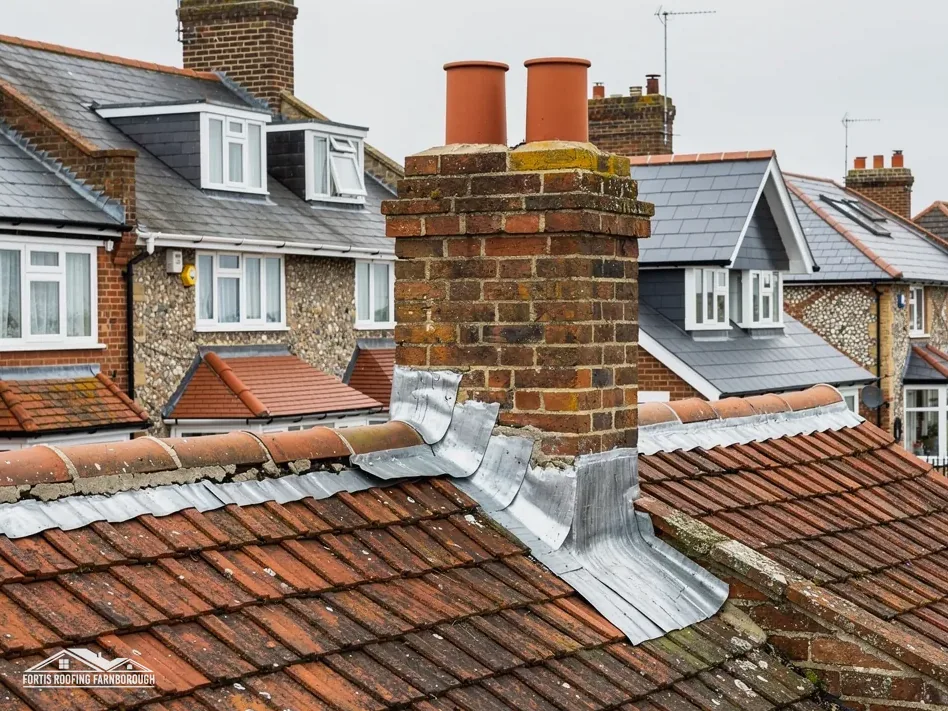
- lead flashing that has lifted away from the stack or slumped;
- a broken or missing cowl, and any nesting material around the pot.
Inside, check the chimney breast in each room and in the loft. Brown stains, flaking plaster, damp patches or a musty smell can point to a leak. In the loft, look at the brickwork where it passes through, and at the timbers beside it for dark marks.
Photograph anything you see, with the date. A series of dated photographs shows whether a crack or a stain is changing, and it saves the roofer time. Our guide to a damp chimney breast explains what the signs inside can mean.
If you see a lean, a wide crack or loose bricks, keep clear of the area below and call a roofer.
Rules that apply to owners as well
Doing the work yourself does not take you outside the rules, and a few catch DIY owners out.
Removing a chimney breast needs Building Regulations approval in every case, since it is structural. An owner who removes one without approval and without a support design risks the stack and the house. Our answer on whether chimney repairs need Building Regulations sets out where the line falls.
A shared stack brings in the Party Wall etc. Act 1996. The Act gives an owner certain rights over a party wall, such as cutting away a projecting breast or flue, and requires notice of two months to the neighbour. That applies whoever does the work.
If a scaffold or tower would stand on the pavement or the road, Highways Act 1980 section 169 makes the highway authority's licence necessary, and that applies to an owner who hires scaffold as much as to a roofer. Hampshire County Council has the scaffolding firm make the application, with a lead time of 10 clear working days.
In conservation areas, Article 4 directions in places such as Hart and Aldershot's Cargate area can control work on chimneys. Check with the council before starting anything.
Who to call, and what they will do
For repairs at the top of the stack, such as repointing, flaunching, pots, flashings and cowls, a roofer is the right person. For the flue itself, including sweeping, blockages and the liner, it is a chimney sweep or an appliance installer. Our guide to roofer or chimney sweep explains the split.
When you ring, describe what you have seen and send the photographs. The roofer starts with a survey: measuring the stack, looking at every face and the leadwork, checking the loft and photographing everything. You see the pictures and hear a plain account of what the stack needs.
Many repairs are modest. A new flaunching or a short run of repointing is a short visit, and the survey tells you whether it is a modest job or a bigger one. Where a stack is in poor condition, the survey also says whether to repair or rebuild, and which is the better buy.
You receive one written price for the work described, with access and any scaffold inside it, so you decide knowing the full amount.
If you want to look at the options before calling, the chimney repairs hub sets out the repairs we carry out.