The short answer
Yes for urgent and protective work, and often no for repairs that depend on wet mortar. A stack that is dangerous or leaking can be made safe in any season. Repointing, flaunching and rebuilding need mortar to set without freezing, so they are timed for mild, dry spells, and the chimney is protected in the meantime.
Why mortar and frost do not mix
Most chimney repairs depend on mortar: repointing the joints, re-bedding a pot in its flaunching, rebuilding the top courses of brick. Mortar sets by a chemical reaction that needs water and a reasonable temperature. If the water in fresh mortar freezes before the reaction has progressed, the mortar can be disrupted and weakened, and the joint will not perform as it should.
Exposure makes this worse for a chimney than for a wall. The stack stands clear of the roof, with wind on all four faces, and it cools quickly. Mortar freshly laid at the top of a stack can meet frost overnight even after a mild day.
The Met Office climate station at South Farnborough (1991 to 2020) records around 53 air-frost days a year, along with annual rainfall of about 715 mm spread over 118 wet days. Those averages say nothing about a given week, but they show that frost and wet weather are part of the local winter, and a roofer plans around them.
The practical rule is that mortar work goes ahead on days when the forecast is dry and clear of frost, and the new work is covered against overnight cold. That sometimes means waiting for the right window, and it is better to wait than to lay mortar that fails.
What can be done in cold weather
Not every chimney job involves wet mortar, and several can go ahead whatever the season.
Making safe is the first. A loose pot, a leaning stack or bricks about to fall are hazards, and a roofer can secure or remove the danger straight away. Where a pot is loose, it can be lifted off and the opening covered until the mortar can be laid.
Temporary weatherproofing is the second. A stack that leaks can be covered with sheeting strapped over the top, lead flashings can be tucked and held, and an open pot can be capped. These measures keep water out while the weather is poor, and they cost little against the damage they prevent.
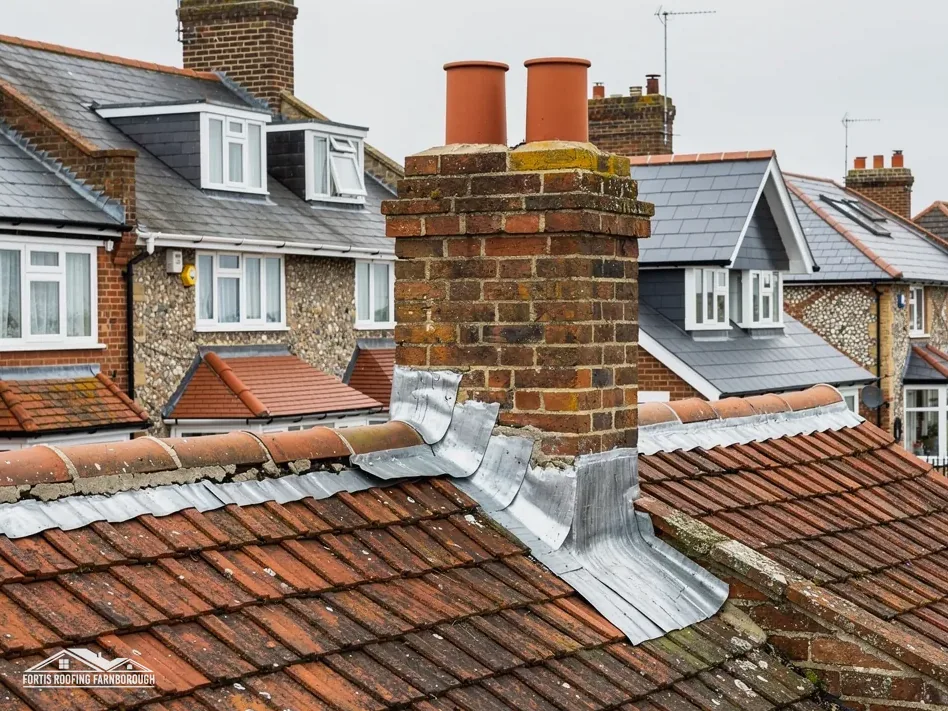
Dry work is the third. Fitting a cowl with straps, replacing lead flashings that are dressed rather than bedded, and inspecting and photographing the stack all go ahead in cold weather. Lead flashings suit this kind of work because they are dressed into place and do not rely on wet mortar to set.
The condition for all of it is safe working. High wind, ice and rain stop the work, since a stack is tall, and a roofer does not climb in conditions that make the roof or the scaffold unsafe.
Protecting a stack until the work can be done
When a repair has to wait, the aim is to hold the position and stop things getting worse. The steps are simple and quick.
A sheet or tarpaulin, tied down securely, can cover the top of the stack and stops rain entering the flue and the brickwork. A cap or cowl placed over a pot does the same job more neatly. If lead has lifted, it can be pressed back and held, so that the joint sheds water until the permanent repair.
Inside the house, a bowl under a drip and a note of the date and weather give a record of what the leak does. Keep the fire unlit if the flue is wet or blocked. Our answer on a chimney leaking in heavy rain explains how the entry point is found.
The point of a temporary cover is to keep things dry until the proper repair. It is not a cure, and it needs checking after strong wind in case it has loosened. We tell you what has been done, and you receive a written price for the permanent work, with the timing left open until a suitable dry, frost-free window appears.
This approach avoids two mistakes: rushing a repair in poor conditions, and leaving a leaking chimney exposed while waiting for spring.
Choosing the right moment
If the chimney has a minor issue, such as worn pointing with no leak, waiting for milder weather is a sensible plan. The repair will be better, and the cost of waiting is low. If the chimney is leaking, loose or cracked, acting sooner is wiser, with the permanent repair following when the weather allows.
Booking early helps in either case. A survey in autumn or early winter finds problems before the worst weather, and the mortar work can be scheduled for the first suitable spell. Our chimney repointing guide describes what the work involves.
Access has its own winter issues. A scaffold on the highway needs a licence in advance, and that lead time can run to ten working days or more, so the booking has to allow for it as well as the weather.
When we survey, we photograph the stack and give you a plain view of what is urgent and what can wait. The written price covers the full job, and the programme follows the forecast. Our chimney repairs hub lists the work we carry out, and the timing guide helps with planning.