The short answer
The work itself runs from a single visit for a cowl or a pot to several days for a rebuild, but the wait before it starts can be longer than the job. Scaffold standing on the highway is licensed, and Hampshire County Council wants 10 clear working days between applying and starting. Weather can move the dates, because mortar work needs dry, frost-free days.
Time on site, by type of job
The answer begins with the scope, and the survey settles it. These are typical patterns, and the survey confirms them for your stack.
Small, self-contained jobs are done in a single visit. Fitting a cowl or bird guard, replacing a loose pot, or renewing a short run of flashing can take a few hours once the roofer has safe access to the top of the stack.
Repointing takes longer, because the old mortar has to be raked out, the joints cleaned and the new mortar worked in and finished. A tall stack with several faces can take a day or more, and the mortar then needs time to set before the cover is taken off.
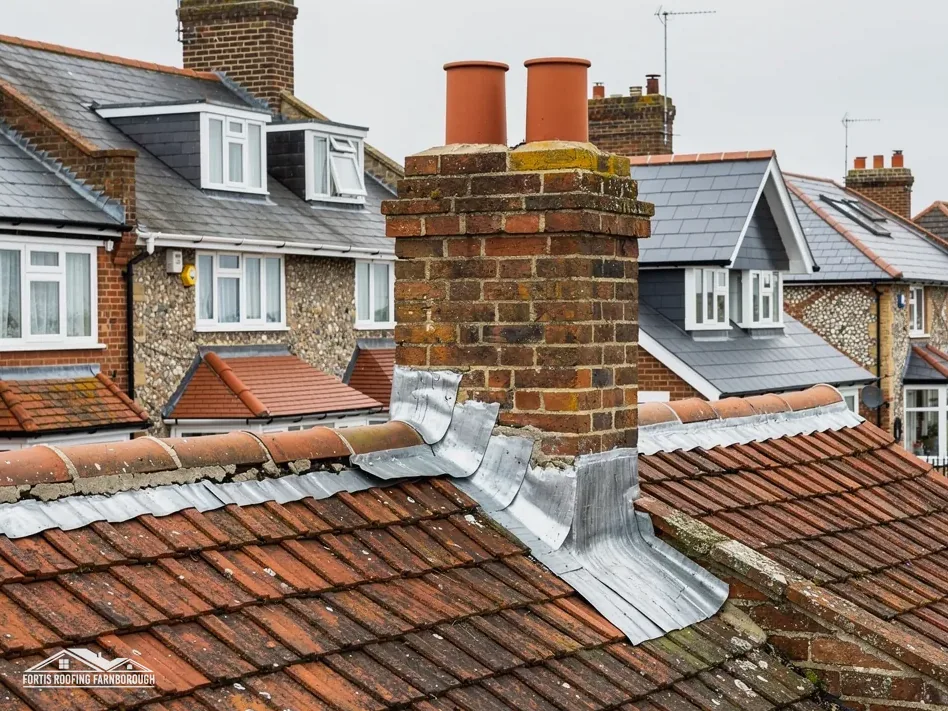
Replacing flaunching, lead flashings and the back gutter is similar. The lead is cut, dressed and fixed to the brickwork, and then the joints are pointed. These jobs are often combined with repointing in the same visit.
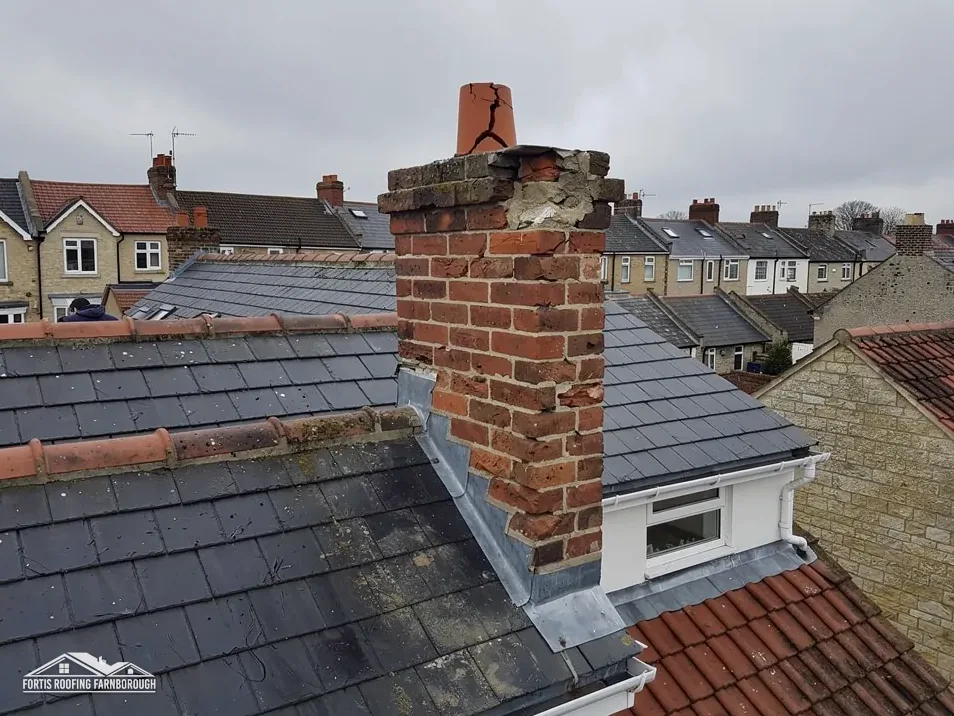
A rebuild is the largest. The upper stack is dismantled to sound brickwork, relaid course by course and finished with new flaunching and pots. It can take several days, because the mortar needs to harden between stages and the work is only done in suitable weather. Our guide to a chimney rebuild describes the stages.
The wait for a scaffold licence
For a chimney on a house that fronts the pavement, the scaffold often stands on or over the highway. Under section 169 of the Highways Act 1980 the highway authority decides, and a licence takes time to arrive.
Hampshire County Council wants 10 clear working days between the application date and the start it names. It is the authority for addresses in Basingstoke, East Hampshire, Hart and Rushmoor, and it has the scaffolding firm apply for the customer. Surrey County Council (until April 2027) wants applications 10 working days or more ahead, and Wokingham Borough Council also wants 10 working days or more. Other councils publish their own arrangements.
These periods run before any work happens. A chimney repair booked on Monday cannot start on the highway side the following week if a licence is needed, which is why a repair can seem to take a month from the first call.
The scaffold is sometimes avoidable. A low stack on a bungalow may be reached with a ladder laid on the slope, while a property well back from the road may have scaffold wholly on private land, which needs no licence. The survey records access, and our answer on scaffolding for chimney repair covers the options.
Weather and mortar
Weather is the other thing that moves dates. Repairs that depend on wet mortar need dry conditions and a spell clear of frost, and wind or rain stops work at height altogether.
The Met Office climate station at South Farnborough (1991 to 2020) records around 53 air-frost days a year and about 118 wet days. Those are averages, but they show why a programme has slack. In winter, a job planned for a specific day may slip by a few days or longer, and a roofer who promises a fixed date in January is promising something the forecast will not honour.
The way to handle this is to be told the position plainly. We agree a target window, watch the forecast and confirm the day a few days ahead. If the weather turns, the stack is covered and the work resumes when conditions allow.
Summer brings fewer delays but has its own limits. Mortar laid in strong sun can dry too fast, and a roofer will shade or dampen it. Our answer on chimney repairs in winter goes further on the cold-weather side.
None of this is a reason to delay a safety repair. A leak or a loose pot is made safe first, and the permanent repair follows.
How the programme is planned
A realistic timeline has three parts: the wait for survey and approvals, the wait for a licence and weather window, and the time on site. The first is days, the second can be a fortnight or more, and the third is as described above.
We start with a survey, and the photographs and measurements of the stack and its surroundings come to you. The survey tells us what repair is needed, what access is required and whether a licence applies. From that you receive a written price covering the entire job, plus a likely sequence of dates.
If a licence is needed, the application goes in at once, since the clock starts only when it does. The dates then follow, with a confirmation call before the crew arrives.
You can help by deciding quickly and by telling us about any fixed dates, such as a sale or a family event. A roof that is leaking should be mentioned at the first call, and then the stack can be made safe while the permanent repair waits for its slot.
For the repairs themselves, the chimney repairs hub is the place to look.