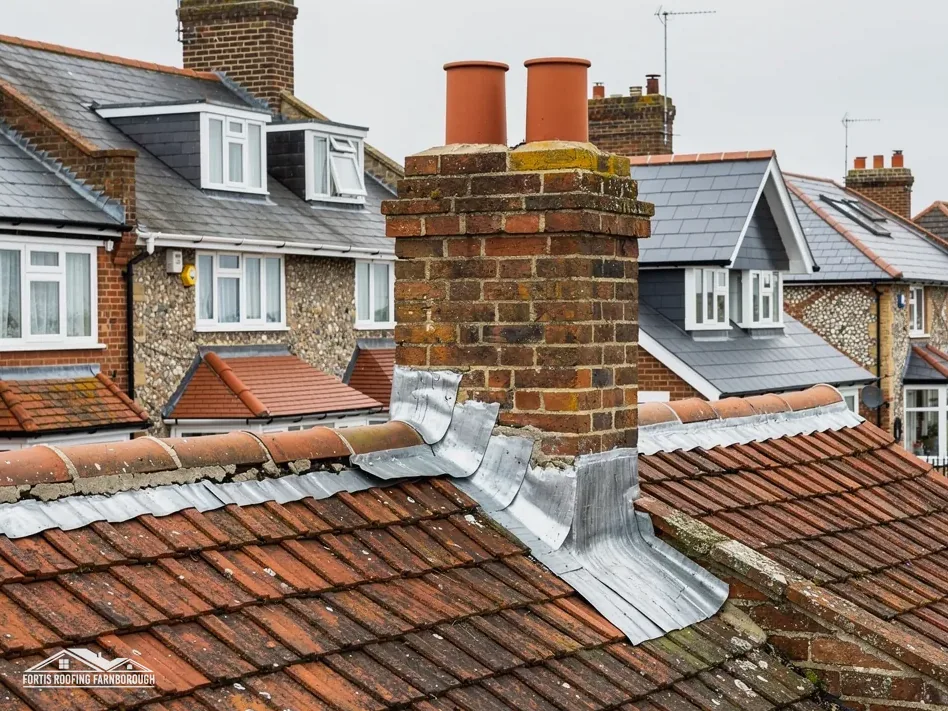
Repairing a chimney stack looks like a small job from the pavement: a few bricks, some mortar, perhaps a new flashing. Standing at the top of a roof with heavy materials, however, calls for a stable platform with edge protection, and that is why scaffold appears on so many chimney quotes. On many jobs it outweighs the repair itself.
Scaffolding also brings a legal question. Section 169 of the Highways Act 1980 covers a scaffold that obstructs a public road or pavement, whether it stands on the surface or reaches over it. The highway authority must license it, and putting one up or leaving one in place without a licence is an offence. Which council that is depends on your address, and each sets its own fees and notice.
This guide explains why a stack needs a scaffold or tower, when a licence is required, what the councils around Farnborough charge and ask, how a tower differs from a full scaffold, and where the cost of access fits inside one written price. It covers general points and facts published by each authority, and does not stand in for the council's own page, which you should check for your address before work begins.
Why a chimney needs a proper platform
The fault may be small, but the working conditions are demanding. A chimney stack stands above the ridge or the eaves, on a sloping roof, in the open.
Height and slope
Working on a pitched roof means standing on a surface that slopes away, often wet, often covered in moss, and with nothing between you and the gutter. Adding a tall stack puts the work well above the roof and the ground. A fall from that height is serious.
Materials and tools
A stack repair involves bricks, bags of sand and cement, buckets of mortar, scaffold boards for the work and often a heavy pot. These cannot be carried safely up a ladder onto a roof, and a platform keeps them at hand and stable.
Edge protection and collection
A scaffold has guard rails and toe boards, which stop tools, bricks and debris falling on people below. It also lets the area under the stack be kept clear, with a clean working zone.
Quality of the work
A stable platform lets a repointer or bricklayer work properly, with both hands free and good access to every face. Work done from an unsteady position suffers.
Roof protection
A good access set-up spreads loads and protects tiles. It also avoids the damage that comes from putting ladders against gutters or walking across slates.
Not an optional extra
For these reasons, we treat access as part of the job. Our guide to what chimney repair costs explains why the platform often matters more than the repair itself, and how grouping the work reduces the effect.
When the highway needs a licence
Many houses in Farnborough front onto a pavement or a road, and scaffold erected there can obstruct it. The Highways Act 1980 deals with that.
The rule
Section 169(1) says that nobody may erect or retain scaffolding, or any other structure that blocks the public way, unless the highway authority has issued its licence. The document is a scaffold licence issued under that section.
Private land
A scaffold standing entirely on private ground is not caught by the rule, a point that Bracknell Forest and Wokingham both make on their own pages. A house with a long drive and a stack well back from the road may therefore need no licence at all, though the neighbours should still be told. A house with a long drive and a stack well back from the road may therefore need none.
Who the authority is
The licensing body is often not the district council. For a house in Farnborough or anywhere in Rushmoor, the licensing body is Hampshire County Council, and the same council is responsible for the roads in Basingstoke and Deane, in East Hampshire and in Hart as well. Surrey Heath, Waverley, Guildford, Woking, Runnymede and Elmbridge fall to Surrey County Council until 31 March 2027, after which East Surrey Council and West Surrey Council take over. Bracknell Forest, Wokingham and Windsor and Maidenhead each license their own roads.
Why it takes time
Hampshire, Surrey and Wokingham each publish a notice period of ten working days. That affects the start date, which is why a chimney job is rarely arranged at a day's notice. Our answer on the scaffold licence in Hampshire explains the local process.
Hampshire County Council: Farnborough, Aldershot, Fleet
The four Hampshire districts named earlier all depend on Hampshire County Council for the licence, from Farnborough across to Basingstoke. Its own scaffolding page sets out the rules in full.
Who applies
Hampshire County Council's own page says the scaffolding company, not the householder, makes the application for the customer. For a house in Farnborough or Fleet, the scaffolder files it, and the owner has no form to complete.
Notice and extensions
Hampshire County Council wants 10 clear working days between application and licence start. Nothing can be extended, so if the scaffold stays up past its dates the owner starts again with a new application and another wait.
Fees
Hampshire County Council charges £211.90 on application, which covers the first 2 weeks, and £72 for each additional 2-week period.
The conditions
Hampshire County Council's page also sets standards for the scaffold itself, citing BS EN 12810, BS EN 12811 or TG20:13, and a public liability requirement for the scaffolding firm. Those are matters for the scaffolder to satisfy, though it is fair to ask the firm to confirm that it meets them before the date is fixed, and to ask for that confirmation in writing.
Private roads
The same page adds that a private road needs no licence at all.
Farnborough Airport
Farnborough Airport says the surrounding area is safeguarded so that temporary obstacles on and around the aerodrome, cranes and tall constructions among them, do not interfere with its operation. We quote no distance, height or permit from that statement. If a job involves a crane or tall plant, ask the airport's safeguarding team.
Surrey and Berkshire: other councils, other rules
Our area crosses county lines, so the licence rules change with the address. Here is what each authority publishes.
Surrey County Council (until April 2027)
For the Surrey districts, the county's fee is £208 for each 28-day period, and a renewal costs the same. Surrey wants the application in at least 10 working days before work is due to begin, and says it processes applications within 10 days. The fee cannot be refunded. Surrey's page leaves open who files the application, so the householder should ask the scaffolder and keep the answer on paper. The successor councils take over on 1 April 2027.
Bracknell Forest
A residential licence costs £350, of which £100 is a non-refundable application fee, and it runs for 6 weeks before a fresh application is required. Where the frame stays entirely within your own boundary, the scheme does not apply.
Wokingham
Wokingham Borough Council also places the application with the scaffolder, who files it for the customer. The licence costs £263 for the first 4 weeks and £163 for every further 4 weeks, with at least 10 working days between application and start.
Windsor and Maidenhead
The Royal Borough says scaffolding on the highway needs the council's permission, and it states no fee on its page. Its page names £5,000 as the maximum fine where a scaffolding licence is breached.
What this means for you
For Surrey, Bracknell Forest and the Royal Borough, ask who applies and put that in writing. Our guide to rebuilding a chimney above the roofline shows how the notice period affects the timetable.
Towers, full scaffolds and roof access
Not every chimney job needs a full scaffold around the house. The arrangement depends on the stack, the roof and the work.
Tower scaffold
A tower is a freestanding frame that can be wheeled or built beside the wall, with a platform at the top and guard rails on every side. It suits a stack at the end of a low roof, where a single tower reaches the work. It is quicker to erect than a full scaffold.
Full scaffold
A tall stack, a steep roof or work on several faces usually needs scaffold along the eaves and a lift up to the stack. It provides a continuous platform, and a safe route up. The longer the job, the more sense that makes.
Roof access and crawling boards
Where the stack sits on the roof slope, a scaffold at the eaves does not reach the top. Access then involves a scaffold lift above, a roof ladder or a system of boards to spread the weight and give a safe foothold. We choose the arrangement at survey.
Impact on neighbours
If a tower or scaffold has to stand on a shared drive, an alley or a neighbour's land, ask permission first. A neighbour's consent is separate from any council licence.
Checking the set-up
A scaffold should be erected by trained scaffolders to a recognised standard, and inspected before use. Ask the roofer who is putting it up and when it was inspected.
Taking it down
The scaffold stays until the work is complete and is struck as soon as the job allows, since longer hire adds cost and fees.
Where access sits in one total price
Access is a real cost, and it sits inside the figure you are given, not beside it.
One total, in writing
The total we write after the survey reflects the access the job needs, including any licence we arrange with the scaffolder, because the scaffold is part of doing the job safely. You see the whole figure before you agree.
What drives the access cost
- How high the stack stands above the ground, and how many lifts of scaffold that needs.
- The length of the job, since licences and hire run for fixed periods.
- Whether the scaffold stands on the highway, which brings a licence and notice.
- How easy it is to get materials to the stack.
Questions to ask any roofer
Ask what the price covers where the platform is concerned: who arranges any licence, how long the scaffold stands, who inspects it and what follows if the job overruns. Ask also whether VAT is included.
Group the work
Since access is the costly part, the sensible plan is to finish every repair the stack needs while the platform is up. Pointing, flaunching, pots, caps and flashings all share it.
Related reading
The chimney repairs page lists what we survey on a stack. The decision on scaffold type is made at the survey, with photographs of the stack and roof.