The short answer
Only if the scaffolding obstructs a public highway. Section 169 of the Highways Act 1980 makes the highway authority the body that licenses it, and across four Hampshire districts, the licensing body is Hampshire County Council. A scaffold wholly on private land needs none, and Surrey and Berkshire addresses follow different councils.
When the law asks for a licence
Under section 169 of the Highways Act 1980, a scaffold or similar structure that obstructs a highway may be neither erected nor retained there without the highway authority's licence. What matters is obstruction of public space, and public space covers the footway and the verge as well as the road itself.
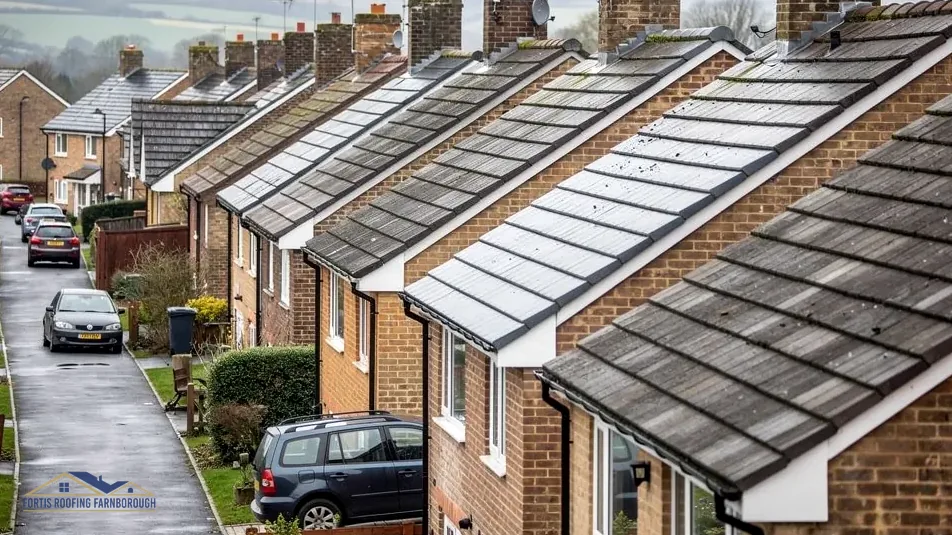
Terraced and semi-detached houses that front a pavement commonly have the scaffold standing on or over the footway, so a licence is usually needed. A detached house set well back, with the scaffold wholly inside its front garden, may need none. Hampshire County Council's page says scaffolding placed on private roads falls outside the licence.
The district councils in Hampshire do not issue these licences. The four districts concerned all sit under the county council as highway authority, so its page is where the rules are set.
The licence deals only with the space on the highway that the scaffold occupies. It is separate from planning permission and from Building Regulations, and it says nothing about the roofing work. A licence does not turn on the quality of the scaffold either, which is why the insurance and safety conditions sit alongside it.
Hampshire County Council: who applies, how long, how much
Hampshire County Council names the scaffolding contractor as the applicant, acting for the customer. The homeowner does not complete any form. The scaffolder supplies the address, the dates and the footprint of the structure.
Timing is the part that catches people out. Its rule allows 10 clear working days from application to the planned start of the licence. A roof job booked for next Monday cannot have a licensed scaffold on the road by then, so the programme has to allow for the wait.
Hampshire County Council's charges are £211.90 on application, which covers the first 2 weeks, and £72 for each additional 2-week period. Hampshire County Council allows no extension of a licence, which means a longer stay is a new application with its own lead time. Scaffolding companies must also hold public liability insurance at a minimum of £10 million.
These are charges paid to the council for the licence. For our jobs, the scaffold sits inside the one total price we put in writing, and the application is organised alongside the scaffolder so that the licence dates match the work.
Surrey and Berkshire neighbours
A short drive from Farnborough, the rules change. Each council below has its own page, fee and wording.
- Surrey County Council, the highway authority for Elmbridge, Runnymede, Woking, Guildford, Waverley and Surrey Heath, charges £208 per 28-day period. Its page asks for applications at least 10 working days before the start and does not state who applies. Local government in Surrey is reorganised on 1 April 2027, so check who issues licences for work after that date.
- Bracknell Forest Council charges £350 for a residential licence, including a non-refundable £100 application fee, and the licence covers 6 weeks. Its page also leaves out who applies.
- Wokingham Borough Council leaves the application to the scaffolding firm, and charges £263 for the first 4 weeks and £163 for each 4-week period after that.
- The Royal Borough of Windsor and Maidenhead says permission is obtained from the council, and publishes no fee.
Where a page is silent on who applies, ask whoever you book with. Our answer on roof work and neighbours covers the people next door.
What this means when you book a roof job
Build the lead time into your plans, particularly if you want the work finished before a holiday, a family event or a house sale. If the house needs a scaffold on the highway, expect the work to start no sooner than ten working days after the application, and tell neighbours when it will stand. Bad weather can then become a licence question too, since a delayed start may fall outside the dates that were applied for, because a licence runs for a fixed period.
Ask at the survey whether a licence is needed, who will apply and how the cost appears in the quote. Our survey records the access, and the single written total makes clear that scaffolding is inside it, so nobody asks you for a separate sum halfway through.
On a small job, a licence is sometimes avoidable. A low roof may be workable from a tower or ladder placed on private ground, and the survey tells you whether that is realistic for yours. Scaffold goes up only where the height, the weight of materials or safety call for it, and a licence follows only if it reaches the highway.
Our guide to scaffolding for a new roof covers the structure itself, and the CDM rules explain who is responsible for a safe set-up. All our services are listed from the homepage.