Homeowners usually ask one thing: do I need permission to take my chimney out? "Permission" is really several different things, and a chimney can touch more than one. There is the structural side, which is Building Regulations. There is the appearance side, which is planning and, for an old building, listed building consent. And where the chimney breast is built into a wall shared with a neighbour, there is the Party Wall etc. Act 1996.
This post is for people in Rushmoor and Hart: Farnborough, Aldershot and North Camp on one side, and Fleet, Hook, Odiham, Yateley and the Hart villages on the other. Those two councils work differently in one important way. Rushmoor has a specific Article 4 direction for the Cargate area of Aldershot that covers chimneys and flues. Hart made directions in 1998 for most of its conservation areas that cover chimneys on dwellings. Elsewhere in both boroughs, the planning side is something to settle with the council.
Everything here is general information from published sources, not legal advice. A chimney on a listed house in a conservation area is the most complicated case, and an unlisted one on an ordinary street is the simplest. Work out which you have, then read the section that matches.
Stack and breast are two different jobs
People say "remove the chimney" and mean either of two things. The difference decides which approvals you need.
The stack above the roof
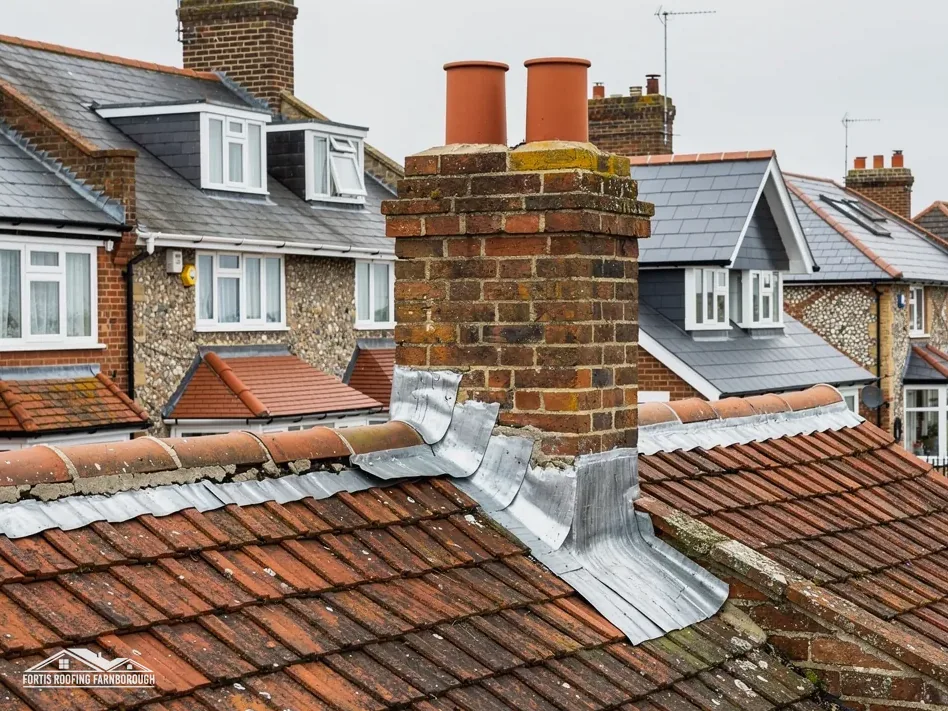
The chimney stack is the part you can see from the street: the brickwork that rises through the roof, with its pots, its mortar cap (the flaunching) and the lead flashing that seals it to the slope. Taking it down is a roofing job. The roof slope has to be made good afterwards, with new battens, underlay and covering, and with the flashings and valleys around the old stack reworked.
The breast inside the house
The chimney breast is the projection into the room below, which carries the flues. Taking a breast out is a structural job. If the wall above is carried on the breast, something else has to carry it once the breast is gone, and the stack above, if it stays, needs support.
What people often do
Some owners remove the stack and the upper breast but leave the lower breast, or take out a breast and leave the stack standing on a new support. Each combination changes what needs approval. A stack removed without work to the breast below is a roofing question. A breast removed with the stack left in place is a structural one.
Ask what is meant
When you speak to a builder, a roofer or the council, use the exact words: stack, breast, flue, pot. Our guide to chimney breast removal goes through the steps in more detail, and the sections below take each approval in turn.
Building Regulations: the breast always counts
The Planning Portal's position is that Building Regulations approval always applies to removing a chimney breast, since the breast forms part of the structure of the house. The rule is absolute, and the planning position does not change it.
What building control looks at
Building control wants to know that the structure above the removed breast is supported safely, that the load is carried to the walls and foundations, and that any flues left in the wall are dealt with properly. It also looks at whether ventilation to the room and to any appliance is affected. A structural engineer's calculation is the usual way to show the support works, though the council will say what it needs to see.
Who deals with it here
In Rushmoor and Hart the building control service is shared. The Hart and Rushmoor Building Control Partnership is based in Rushmoor's Farnborough offices and can be reached on 01252 398715. Hart does not run a separate team: its service comes from that same Rushmoor-based partnership. A registered building control approver, the regime in force since 6 April 2024, is the private alternative to the council.
Keep the paperwork
A completed job with a completion certificate is useful when you sell. A removed breast with no paperwork can hold up a sale and may force someone to open the wall to prove what was done. If you are buying a home that has lost a breast, ask for the approval and the engineer's drawings.
MyJobQuote gives a typical UK range of £1,200 to £3,500 for removing a chimney breast (updated 27 August 2026). That is a national figure and depends on the structure; your price comes after a survey.
Cargate and Rushmoor's other conservation areas
Rushmoor has nine conservation areas and several Article 4 directions in force. Only one of them reaches chimneys.
What an Article 4 direction is
An Article 4 direction withdraws specified permitted development rights across a defined area. Where one applies, work that would normally be allowed without a planning application needs permission instead.
The Cargate direction
Cargate is a conservation area in Aldershot. Rushmoor made an immediate Article 4 direction for it on 31 July 2020. The direction applies to work visible from the street or from open ground, and its list names chimneys and flues, covering fitting, altering or demolishing one, as well as windows and doors. So in Cargate, taking out a chimney that shows from a public place needs the council's permission first.
Elsewhere in Rushmoor
Rushmoor's other directions cover different things: front garden parking at Church Circle, front hard surfaces, gates, walls and antennas facing a highway at Wellesley, and the conversion of shops and employment land to homes. None of those is about chimneys. If you live in one of the other conservation areas, such as South Farnborough or Farnborough Street, your next move is a question to Rushmoor's planning team about your address.
Flats and period homes
A flat has no permitted development rights whatever, so only an identical replacement avoids a planning application. A listed house keeps its permitted development rights, yet listed building consent is also required if the work would alter its character, and a chimney frequently contributes to that.
The council's own pages explain Article 4 and list the current directions. Our guide to Rushmoor conservation areas and roof work covers the rest.
Hart's 1998 directions and who they cover
Hart District Council made Article 4 directions in 1998 for most of its conservation areas, and they matter to chimneys. In those areas the directions bring two things under control: changes to the front of a house, which takes in the roof slope facing the street, and putting up, altering or taking down a chimney.
Where the directions apply
The list of areas is long. It includes villages such as Crondall, Crookham Village, Eversley Street, Greywell, Hartley Wintney, Heckfield, Rotherwick, South Warnborough and Yateley Green, together with later additions for West Street in Odiham and parts of the Basingstoke Canal conservation area. Odiham Town Centre, designated in 1970, has a direction that reaches the whole dwelling. North Fleet is the exception, since its direction deals only with front boundaries and chimneys are outside it.
Repairs are different
Hart takes the view that repairing a building that is not listed needs no planning application when the repair copies the original details and materials in a traditional way. That is why repointing a stack, or rebuilding it to the same pattern, raises a different question from taking it away.
Counting conservation areas
Hart's own pages give two different totals for its conservation areas, so check your address on the council's map and ask the planning team if you are unsure.
If your home is in Fleet, Hook or another Hart village, check the map first and then speak to the council. For a listed house, the rule that listed building consent is needed alongside planning applies in Hart just as it does in Rushmoor.
Party wall notice for a shared breast
If your chimney breast sits on the wall between your house and your neighbour's, the Party Wall etc. Act 1996 comes in. This applies whatever the planning and building control position.
What the Act gives you
Section 2(2)(g) gives a building owner a right to cut into a party wall to remove a footing, a projecting chimney breast, a jamb or a flue. That right comes with a duty to serve notice, and section 3(2)(a) sets the lead time at no less than two months ahead of the start.
If the neighbour does not reply
Silence is not agreement. GOV.UK guidance warns against reading a lack of reply as agreement to the works. If the two of you remain at odds, surveyors are appointed to settle it between them.
Who to ask
Questions about party walls go to a party wall surveyor. They do not go to building control, which has a separate role. Building control approves the structural work; the party wall process protects the neighbour's property.
Timing
Two months' notice is a long wait if you have already booked the builder. Serve it before you fix a date. The same applies to the scaffold: if a scaffold must stand on the pavement for the stack work, it needs the highway authority's licence, and in Hampshire the application comes from the scaffold firm, with 10 clear working days needed. Plan the two waits together so they run side by side.
Making the roof good, and a checklist
Once the approvals are in place, the roof side of the job is straightforward but not trivial. Taking a stack down leaves a hole in a slope, and how it is closed decides whether the roof stays dry.
What the roof needs afterwards
The slope has to be rebuilt to match: rafters or trimmers where the opening was, battens, underlay and then the covering. Tile or slate should match what is there, and a flat patch left behind is a leak waiting to happen. Lead flashing and any valley or gutter around the old stack are reworked. If you choose to keep a stack and cap it, our post on chimney capping looks at that route. Before the work we survey the roof and photograph the stack, so the finished patch can be compared with the original.
Checklist before you start
- Decide whether you want the stack, the breast, or both removed.
- Establish whether the address lies in a conservation area, and whether the house is listed.
- Ask the council about Article 4: Cargate in Rushmoor, the 1998 directions in Hart.
- Speak to building control about the breast.
- If the breast is on a shared wall, serve party wall notice no less than two months before the work starts.
- Agree who arranges scaffold and its licence.
After the survey comes a single written price, covering the whole job. Our guide to scaffolding for chimney repair covers the access side, and the chimney repairs page explains the other jobs on a stack.