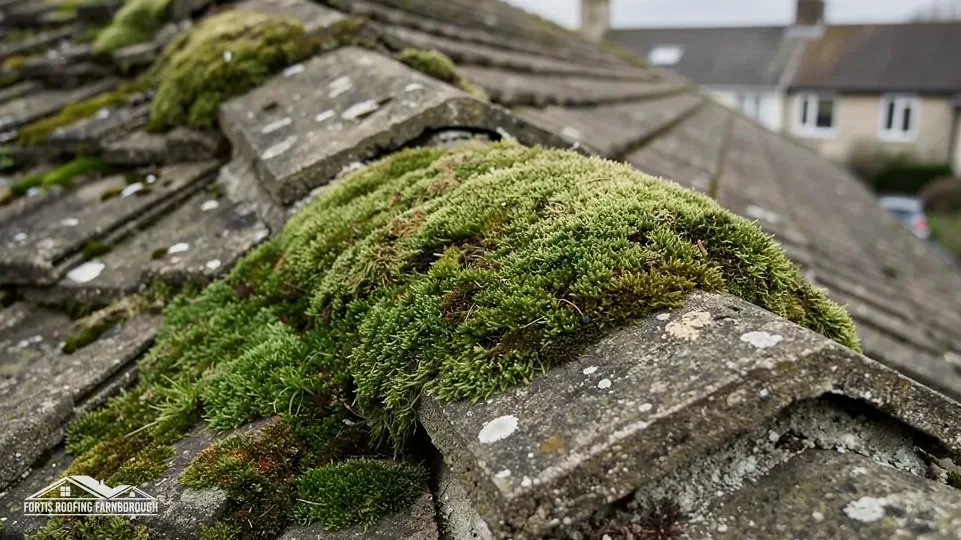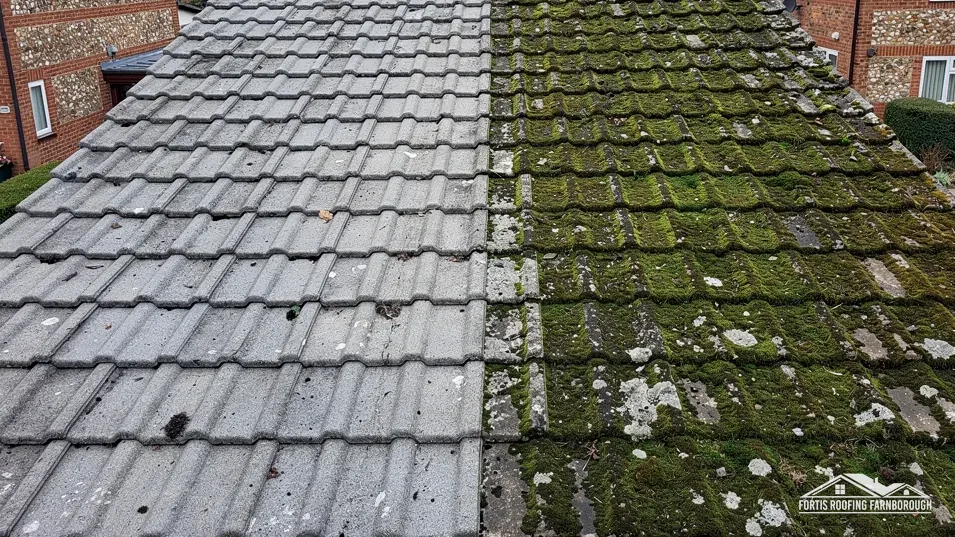
Moss removal sounds like one job, but it is a choice between methods. The right one depends on the covering, the age of the tiles, how thick the moss is, how steep the roof is and what lies beneath. A method that suits a modern concrete roof can ruin an old clay one, and a method that works on light growth struggles with a thick mat.
All of them aim at the same result: a roof that sheds water cleanly, with the laps, valleys and gutters free of growth. None of them replaces a look at the roof itself, because the moment the moss comes off is when a roofer can see what it was hiding.
This guide compares the main methods side by side: hand scraping, brushing, soft washing with treatment, and combinations. It covers what each does to the tiles, what happens in the gutters afterwards and what a roofer checks beneath the moss, for homes around Farnborough and the surrounding villages.
The methods side by side
This table sets out the main options in plain terms. It is a guide to suitability, not a price list.
| Method | How it works | Main risk | Suits |
|---|---|---|---|
| Hand lifting | Moss is lifted from laps and valleys by hand or with a soft tool | Slow; loosens weak tiles | Thick moss; delicate roofs |
| Soft brushing | A soft brush sweeps the growth downslope | Scuffs soft or old surfaces | Light to medium growth |
| Treatment then brushing | An approved biocide kills the growth, then it is brushed or rinsed away | Runoff to drains and plants; needs time | Algae and lichen; most coverings |
| Soft wash | Treatment applied and rinsed at low pressure | Water into the loft if the underlay is poor | Large areas of light growth |
| Jetting | High-pressure water blasts the surface | Strips the tile face and forces water under laps | Not recommended for tiles |
Tile maker Marley puts jetting at high power in the not recommended column, since the blast scars tile and slate faces and cuts the covering's expected life by a good margin. The rest of this guide covers the other four in turn.
How to read the table
Methods are often combined, and a good roofer picks the order for the roof in front of them. Hand work is the usual first step on anything thick. Thick moss is lifted by hand first, then the surface is treated to deal with what remains. The order matters. Treatment sprayed over a thick mat never reaches the tile, so the product is wasted and the moss stays. A light film of algae, by contrast, can go straight to treatment with no hand work at all.
Hand lifting and scraping
For thick moss, hand work is where the job starts. Moss that stands in cushions is lifted out of the laps with the hands or a plastic or wooden tool. It is slow, and it is also the gentlest way to clear the places where water gets trapped.
What it does well
- Clears moss from laps, valleys and behind chimneys where brushes do not reach.
- Lets the roofer see each tile closely as it is cleared.
- Puts no water or chemicals on the roof.
Where it goes wrong
Metal scrapers and wire brushes can gouge tile faces, and a hard scrape on old concrete or clay strips the surface skin. Lifting moss from under the edge of a tile can lever it out of line or crack it, especially if the nails have rusted. Hand work also means working on the roof, with the risks that go with it.
Access
The roofer must stand or kneel somewhere. Roof ladders and boards spread the load, and on steep or tall roofs, scaffolding gives a safe platform. Doing it yourself carries real risk, which is why this is work for people with the right access gear.
Handling debris
Lifted moss is not swept into the gutter. It is bagged as it comes off, or caught in a sheet at the eaves, and carried down. Moss left in the gutter is the start of the blockage described later in this guide.
When it is enough
On a roof with patchy moss and sound tiles, hand lifting and a soft brush may be all that is needed. It leaves the tile faces alone and costs only the roofer's time.
Soft brushing and its limits
A soft brush, such as a long-bristled broom head used with care, sweeps loose moss and debris down the slope. It is quicker than hand lifting and suits growth that is dry and loose.
Technique
Brushing is done downslope, never up under the laps, since pushing upwards drives debris and water beneath the tiles. Light, even strokes are used, and the brush is kept clean so grit is not dragged across the face of the tile. Dry weather makes it easier, because wet moss smears.
Limits
- It does not remove growth that is rooted into the surface, such as lichen.
- It can scuff soft, porous or weathered tiles, so the bristle choice matters.
- It does not stop regrowth, since it leaves spores and fragments behind.
Why not wire
A wire brush works fast and scars the surface. Concrete tiles carry a coating, and clay carries a fired skin, so a hard brush undoes the very thing that keeps water out. Once the skin is damaged, the tile soaks up more and grows moss faster. A roof that has been scrubbed hard may look clean for a season, then go green faster than before.
Brushing and treatment together
Brushing is often the second step. A treatment kills the growth and loosens it, and a soft brush a few weeks later clears what remains. That route avoids heavy scrubbing, because the growth has already let go. The product side, covering labels and approvals, is explained in the biocide guide.
The gutters are cleared at the end of every brushing pass, not left for another day.
Soft wash and treatment
Soft washing applies a liquid treatment at low pressure and lets it do the work. It is the method most associated with algae, lichen and large areas of light growth.
How it differs from jetting
The difference is in what does the cleaning. A jet uses force and the tile takes it. A soft wash uses a product, and the water is only a carrier. The treatment is left on the surface for the contact time on its label, and the dead growth loosens over days or weeks.
Rules and runoff
Roof treatments are biocides, and they must be approved for the use and used within the terms of their authorisation. HSE says householders should not use products intended for professionals only. Runoff reaches gutters, drains and the garden, so plants, ponds and water butts are protected, and the label's instructions followed.
What can go wrong
Water at any pressure can find a gap in a perished underlay or a poorly lapped tile and enter the loft. A soft wash on a roof with torn underlay is a risk, and a roofer who checks the roof first avoids it. On very old roofs, even low-pressure water can lift loose tiles.
Where it fits
Soft washing suits broad areas of algae and light moss on sound roofs. Thick moss still needs hand lifting first. Our guide to soft wash methods goes through the differences in more detail.
Timing
The treatment needs dry weather for its contact time, and results come over weeks. A roof looks patchy and darker partway through, which is normal. A roofer should tell you what to expect and when to look again.
Clearing the gutters afterwards
Whatever the method, the moss ends up near the eaves. A moss removal job that leaves the gutters full has swapped one problem for another.
What reaches the gutter
Loosened moss, grit shed from the tiles, bits of dead lichen and treatment runoff all drop into the gutter. Dry debris is light, and wet debris is heavy and sticky. A gutter that was fine before the job can be choked after it.
The sequence
- Gutters are cleared before cleaning, so there is room for what falls.
- Debris is caught or bagged as the slope is cleaned.
- Gutters and downpipe outlets are cleared again at the end.
- Water is run through the gutter to test its fall and show up any weeping joints.
Why it matters
A blocked gutter overflows, and water running down the fascia and into the soffit rots the timber. Our guide to moss in gutters follows that chain from overflow to rot. A roof that is clean and a gutter that is blocked leaves the house no better off than before.
Checks at the eaves
With the gutter clear, the fascia, soffit and brackets can be looked at. Sagging runs, loose brackets, cracked joints and soft timber behind the gutter are all recorded with photographs. Published guidance from Which? lists £75 to £350 ex VAT for a full gutter clear (Nov 2025, typical UK range), and on a roof job the clear is part of the same visit.
Disposal is the last step: moss and debris leave with the site waste.
What a roofer checks once the moss is off
The best result of moss removal is not the clean roof. It is the clear view of the roof beneath the moss, which is a reason to have the job done by someone who inspects as they go.
Tiles and fixings
A clean surface shows cracks, chips, flaked faces and tiles that have drifted out of line, and the roofer notes the pitch, the lap and the condition of every row. A tile that was held in place by the moss around it can be loose. Each defect is marked and photographed with its position on the slope.
Ridge, hips and verges
Crumbling mortar, rocking ridge tiles and loose verge tiles are common finds. Moss on a ridge often hides pointing that has already failed. Our guide to roof repairs found after moss removal sets out the usual repairs.
Flashings and abutments
Lead and other flashings at chimneys, walls and roof windows are checked for lifting and gaps. These details cause many leaks and are often hidden under moss and debris.
Valleys and outlets
Valleys are checked for blockage and wear, and outlets for flow. Water that backs up in a valley finds its way under the tiles.
What you receive
A photographic record, with each defect described in plain terms, and a written price covering what the roof needs. Repairs come before any treatment. If the roof is sound, you know it, and you have the photographs to show a buyer or surveyor later.
Our roof cleaning and moss removal service starts from this inspection, whichever method the roof needs.