The short answer
Concrete roof tiles are cleaned gently, with low pressure, a soft brush and an approved treatment left to work. Many carry a coloured surface layer that harsh washing can wear through. Marley, which makes these tiles, advises against high-powered jet washing, which can damage the surface and reduce a tile's expected life. Be cautious about any promise that a coating adds years.
The surface of a concrete tile
A concrete tile is a moulded mix of cement and sand, with a finish applied to its upper face. That finish gives the tile its colour and a smoother, denser skin that sheds rain and resists the growth of moss and algae. Over decades it weathers, and the underlying concrete becomes more porous and rougher, which is why old tiles hold growth more readily.
The surface is the part cleaning can harm. Aggressive washing strips or scours the skin, exposes the rough concrete beneath and leaves the tile paler, patchy and more absorbent. A tile that absorbs more water is more exposed to frost, and Met Office averages for South Farnborough (1991 to 2020) record around 53 air-frost days a year.
That is the reasoning behind Marley's warning, which comes from a tile maker and covers its own product: a blast of water strips the face of the tile and wears down how long it will last.
Lifespans for concrete are published as ranges. Marley puts its concrete tiles at around 60 years, with no assurance attached, while HomeBuilding gives plain concrete and Double Roman 40 to 50. The two ranges overlap only a little, and neither tells you what your roof will do.
The surface wears slowly, so a gentle approach is a sensible habit.
Gentle methods that protect it
The preferred approach has three parts: soften, treat and let the weather finish the job.
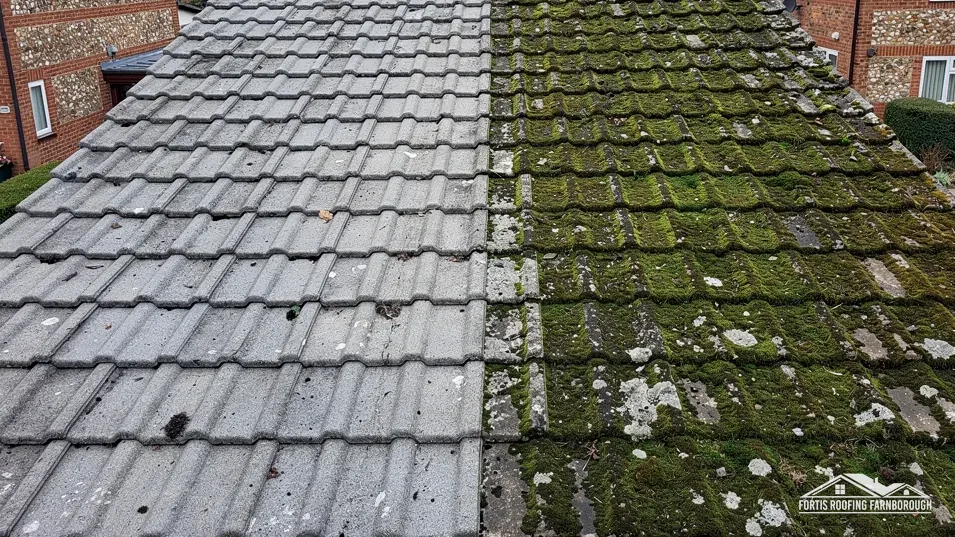
First, loose moss is removed carefully by hand or soft brush, without scraping the tile face. Thick cushions of moss can be lifted in sheets, and the roots left in the surface are treated.
Second, an approved biocide is applied at low pressure to kill what remains. The product must be used as its authorisation requires, and HSE warns that products sold to professionals only are not for householders to use. A professional can control where the runoff goes, keeping it from plants, ponds and drains.
Third, the roof is left to shed the dead growth over the following weeks, helped by rain. The tiles are not blasted to speed this up.
Soft washing is the term for the low-pressure method. Our soft wash page sets out how the method works.
Access matters too. Tiles are walked on only when unavoidable, using a roof ladder or crawl board, since concrete tiles crack under a boot as readily as clay ones.
Gutters and valleys get cleared at the same time, since moss and sediment wash down into them.
Be wary of coating claims
Some cleaning firms offer to coat a cleaned roof with a sealant or paint, usually described as protecting the tiles, making them last longer or restoring the colour. Treat such claims with caution.
The lifespans quoted above come from tile makers and cost guides, not from coating suppliers, and none of those guides credits a coating with adding years to a concrete tile roof. A claim of extra life should be backed by evidence you can check. Ask what product it is, who made it, what the maker says about it and what the warranty covers, and in whose name it is given.
A coating also has practical limits. It can hide cracks and slipped tiles beneath a uniform colour, and a thick film may trap moisture in tiles that are already porous. If it peels, the roof can look worse than before.
It may be fine as a cosmetic choice, with the limits understood. It is not a substitute for repairing damaged tiles or fixing the cause of moss, which is usually persistent damp and shade.
Our page on whether roof cleaning changes tile colour covers what to expect from the clean itself.
Checking the tiles and getting a quote
A clean roof shows the tiles' condition. Look for cracks, chips, flaking edges, slipped courses and worn ridge bedding, and photograph them. If many tiles are crumbling, cleaning will not help and the roof is better re-covered. Our page on clean or replace roof tiles sets out the decision.
When you ask for a quote, ask which method will be used, what products, how the roof will be reached and what happens if broken tiles are found. A fair answer names a low-pressure method and approved products to the label.
We inspect the roof first, identify the tile, check its condition and explain what we find. The cleaning method follows from that, and repairs are recommended only where the roof shows they are needed.
The price follows the survey, because it depends on the area, the pitch, how the roof is reached and how much growth there is. It comes as a single written total.
The roof cleaning and moss removal hub explains the wider service for homes across Farnborough, Camberley and Fleet.