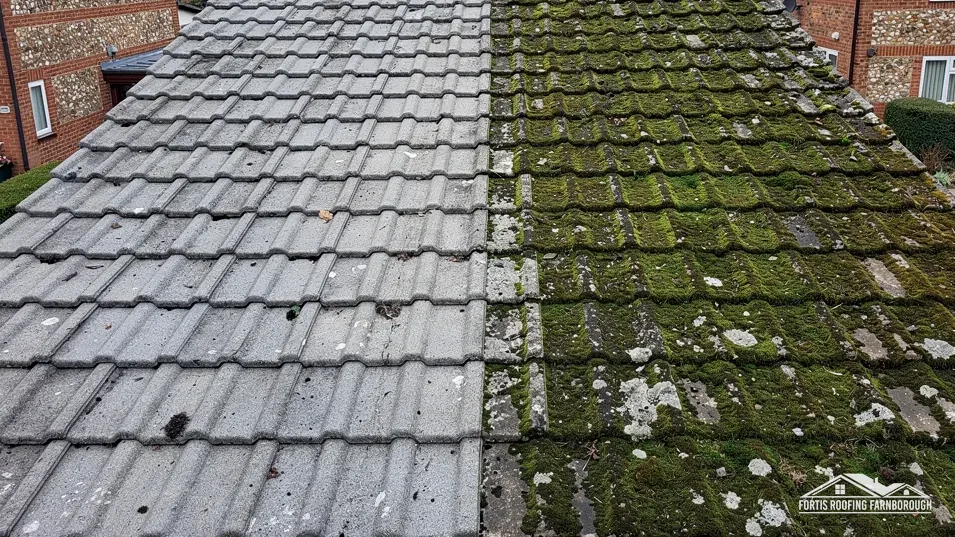
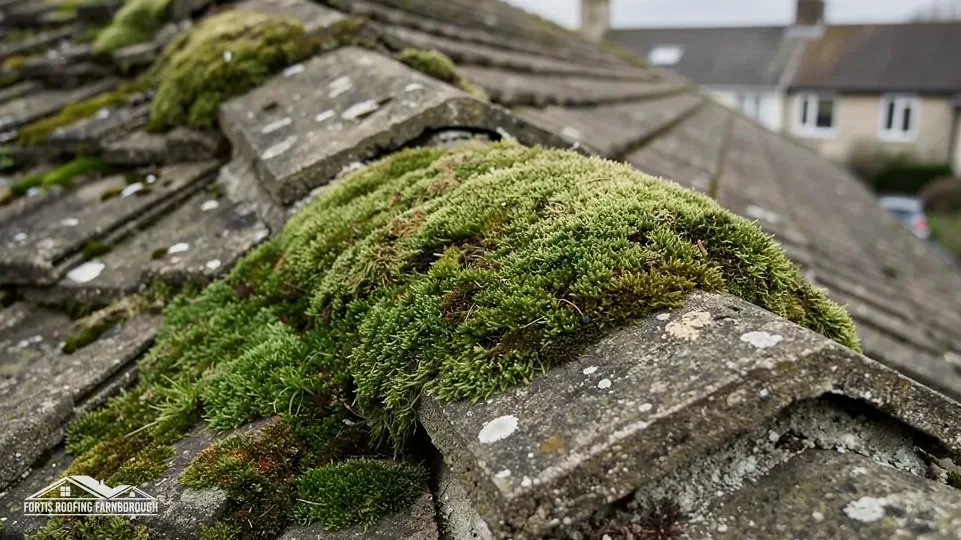
Moss grows over everything. It sits in the laps between tiles, along the ridge, round the base of a chimney and in the valleys, and while it is there it covers cracks, gaps and loose fixings that nobody can see from the ground. Once it is removed, the true state of the roof shows for the first time in years.
That is why a roof clean sometimes turns into a roof repair. The faults were there before the cleaning. The clean did not cause them, though a rough clean can make some worse, and a wet clean over a perished underlay can push water towards the loft insulation. A good roofer expects to find something and plans for it.
This guide covers what turns up most often once the moss is off, why the repair comes before any treatment, how each fault is mended, what national cost guides publish for the smaller jobs and how photographs help you decide, for roofs in Farnborough and the neighbouring villages.
Why moss removal often finds repairs
A roof is a set of overlapping parts that hold each other in place. Moss grows into the gaps between them and, over years, becomes part of the structure. Pulling it out changes the roof's behaviour, and a few things follow from that.
Moss as a hiding place
A cracked tile under a pad of moss looks like a green lump. A slipped tile that moss has glued in place looks normal. Mortar on a ridge can be crumbling underneath a skin of growth that still holds the shape. Until the growth comes off, none of it can be seen.
Moss as a bandage
In some places, moss is the only thing keeping debris out of a gap. When it is lifted, the gap is open. A tile that was wedged by the growth beside it may drop or slide. That is not damage caused by the clean, though it can feel that way to the owner standing in the garden.
The effect of the method
Rough cleaning makes things worse. A hard scrape can crack a brittle tile, lever a loose one out of line or loosen pointing. Gentle methods find faults without adding to them. Our guide to roof moss removal methods compares the choices.
An honest expectation
A roof that has gone unchecked for many years is likely to need something. A newer roof, or one looked after, may need nothing. Neither outcome is a surprise to a roofer, and neither is a reason not to look.
Slipped and cracked tiles
These are the most common finds. A tile that has slipped down its row leaves a gap above it. A cracked tile may look whole from below but let water through along the crack.
How they show up
With the moss gone, rows of tiles that waved before now show as lines that dip. Tiles with hairline cracks, chipped corners and flaked faces are easy to mark. Edge tiles at the verge are checked first, since wind finds the weakest edge.
Why they slipped
Nails rust and let go, a batten behind may have rotted, or the tile was never well fixed. Wind uplift can lift and shift a loose tile. The cause decides whether a refix will hold. Our guide to slipped roof tiles sets out how the repair differs when the batten has failed.
The repair
A slipped tile is refixed to a sound batten with a proper fixing, and a cracked or flaked one is replaced with the closest match available. Where several tiles in a run have gone, the batten behind them is checked and renewed if it is soft.
What national guides publish
Which? lists £75 to £400 ex VAT for a job of one to six standard tiles (Nov 2025), and MyJobQuote gives around £215 for five (Oct 2026). Both are typical UK ranges, and tile type, access and matching move a real quote around inside them. Large numbers of failing tiles may point to a roof nearing the end of its working life, which is a different decision.
Perished ridge and hip mortar
Mortar on a ridge is exposed to every season and takes the full weight of wind and frost. It is often the first part of a roof to fail, and moss hides it well.
What it looks like once cleaned
Cracked pointing, gaps between ridge tiles, tiles that rock under a gentle push and mortar that has crumbled into the gutter are all signs. A ridge line that has dipped or shifted can mean the timber below has been affected.
Repair options
Re-bedding the ridge on fresh mortar with mechanical fixings is one route. A dry-fix system is the other. BS 5534:2014+A2:2018 is the current standard for slating and tiling, and Marley says that since the 2014 revision of the standard, a mortar bed on its own no longer counts as enough for the ridge. BS 8612:2018 covers tested dry-fix systems. Our guide to dry ridge or mortar explains how to choose.
Costs
Which? gives £80 to £300 ex VAT to put in a new ridge tile (Nov 2025). MyJobQuote gives £225 to £550 for replacing roof ridge tiles (Oct 2026). Both are typical UK ranges for different jobs, and the length of ridge, access and the method chosen decide where a real job falls.
Timing
Ridge repairs are done before any treatment. A treatment spray on a cracked ridge soaks into the joints and is wasted, and a wet clean can wash loose mortar into the gutter.
Mortar is not banned, and BS 5534 is not the law. The standard asks for more than mortar to hold ridge tiles against wind.
Flashings, valleys and blocked gutters
Tiles and ridges get most of the attention, but the details where roofs meet walls and each other cause many of the leaks.
Flashings
Flashings are metal strips, usually lead, that seal the line between the roof and whatever it butts against, such as a chimney stack, a gable wall or a roof window frame. With moss and debris off, lifted edges, splits, gaps and failed sealant show up. Where lead has lifted from its wall chase, it is re-fixed or replaced, and sealant is not used as a long-term fix.
Valleys
Valleys are the V-shaped channels formed where one slope runs into another. It carries a lot of water and collects debris. Moss in a valley can back water up under the tiles. Once cleared, the valley lining is checked for splits and wear.
Gutters and downpipes
Moss lands in the gutter, and a blocked or sagging gutter is often the first thing a cleaned roof reveals. Our guide to moss in gutters explains how overflow turns into a damp fascia. The gutter is cleared, flushed and checked for fall and leaking joints.
Fascia and soffit
With the gutter clear, the boards behind it can be pressed and checked. Soft timber behind a gutter that has overflowed for a long time turns up often.
Why these details are worth the trouble
The joints between parts are where a roof is most likely to let water in, because the weather finds every gap between two materials. A tidy field of tiles with a failing flashing still leaks, and the leak often shows indoors some distance from its source.
Cost context
Which? gives a range of £75 to £350 ex VAT for clearing every gutter on a property (Nov 2025). Repairs to flashings and valleys vary with access and the extent of the work, and are priced after the survey.
Repair first, treat afterwards
When both repairs and treatment are needed, the order matters. Done the wrong way round, one wastes the other.
Why repair first
- A treatment sprayed over a cracked tile or failed ridge runs through the defect.
- Wet cleaning over a perished underlay can carry water to the loft and wet the insulation.
- Repair work disturbs the surface and may need cleaning again after.
- Seeing the full list of repairs lets the plan and the price cover everything at once.
The usual order
- Survey the roof and record what is there.
- Clear the heavy moss by hand and catch the debris.
- Mark and photograph every defect.
- Repair tiles, ridge, flashings and gutters.
- Apply any treatment and arrange a follow-up.
- Clear the gutters a final time.
Protecting what is below
Repairs create debris too. Broken tile, old mortar and rotten timber come off the roof and need catching, so access is set up with sheeting at the eaves and the ground below is kept clear. Mortar that lands in a gutter is cleared on the same visit, so it does not set there.
Getting a price
You receive one total in writing after the survey, and repairs that the survey finds sit in it. If the clean uncovers more than the survey could see, we tell you what has changed and explain the options before anything extra is done. VAT is stated and access is included.
When the list is long
If the repairs add up, the sensible question is whether to keep repairing or to re-cover the roof. HomeBuilding (Sep 2025) gives typical lives of 40 to 50 years for concrete tiles and 60 to 80 years for clay. Those are ranges, not promises, and a survey says where your roof sits within them.
Photographs, records and what to ask for
The most useful thing a roofer can give you after a clean is a clear record. Photographs turn a verbal report into evidence.
What the record should show
- The roof before cleaning, from the same positions as afterwards.
- Each defect, with a note of which slope and which row.
- The ridge, hips, verges and flashings.
- The gutters before and after.
- The state of the underlay and battens where tiles were lifted.
Why it helps you
A record lets you decide calmly. You can see for yourself that a ridge tile rocks or a flashing has lifted. You can show it to a second roofer for a second opinion. If you sell the house, a buyer's surveyor can see what has been done and when.
Insurance
If a defect is linked to a storm, tell your insurer first and keep photographs and receipts. Read your policy's own storm definition, since cover turns on its wording and exclusions for wear or slow deterioration are common.
What to ask a roofer
Ask whether the survey comes before the price, whether repairs are done before treatment, and whether photographs of every defect are provided. Ask what happens if more is found once work has started.
A short checklist for the day
Before the work starts, agree where the access equipment will stand, which areas of garden need protecting and who will be at home. At the end, walk round with the roofer or look through the photographs together, so you both agree on what was done and what, if anything, is still outstanding. Keep the record with your house papers.
Next step
Our roof cleaning and moss removal service is built around that order of work, and the photographs come with every job.