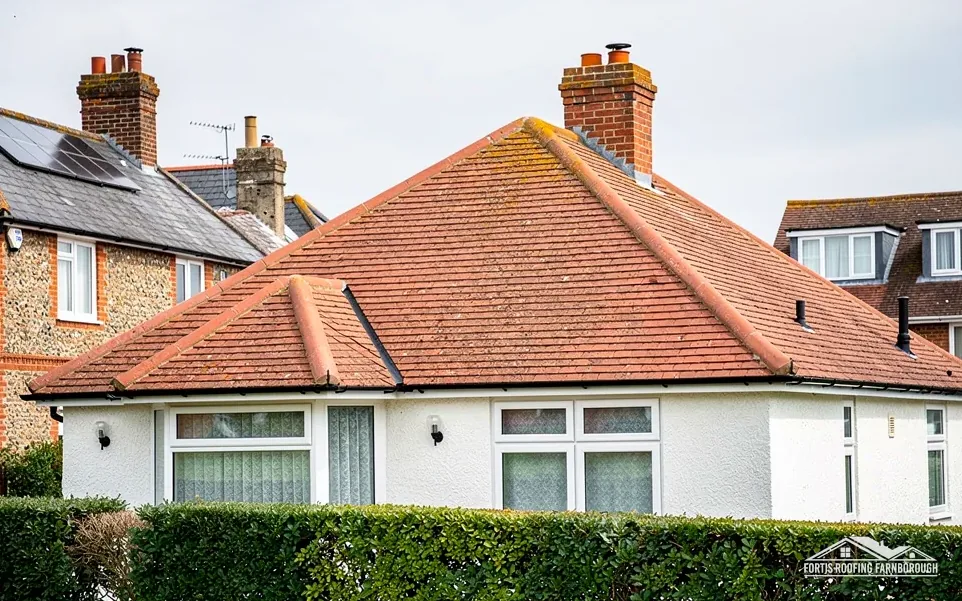
A slipped tile is one that has moved down the slope from its row, leaving a gap above it and a line that no longer runs straight. It may sit a few millimetres out of place or hang over the edge of the course below. Owners tend to spot it from the garden first, and it is easy to wave off as a small repair.
Tiles are held in place by their own weight, by the nibs on their back edge that hook over a batten (the timber strip fixed across the rafters), and by nails or clips at set intervals. When one slides, one of those three has failed. The reason matters, because a tile nudged back up on a rotten batten will slip again, and a patch on a roof that is wearing out everywhere will not hold for long.
This guide covers the causes of slipping, what you can safely check from the ground and the loft, how a proper repair is fixed to BS 5534, when slipped tiles suggest more work than a repair, and what the national guides give for the cost.
Why tiles slip in the first place
Tiles rarely slip for no reason. There are four common causes, and a roof can have more than one at work.
Nail fatigue and corrosion
Many tiles are held by nails driven through the tile into the batten. Over decades, nails rust, and a rusted nail shears or loses its grip. The tile then relies on its nibs alone, and the next hard gust or a heavy frost can tip it. On older roofs, a few slipped tiles often mean the fixings across the slope are ageing together.
Battens that have rotted
Soft timber cannot keep hold of a tile. Where water has got past the covering, or damp air has condensed on the underside, a batten can soften and split along its nail line. Our guide to battens that need replacing sets out how to tell sound timber from failing timber.
Wind uplift
Wind lifts and flutters tiles, particularly at the edges of a roof, along the ridge and at the verge. A tile that was fixed too lightly or in poor condition can be dislodged in a storm, and a few can follow. Check your policy's own storm definition before you assume anything about cover.
Frost, movement and earlier repairs
Freeze and thaw cycles work on cracked tiles. A previous repair may have used the wrong tile or fixed it only by sitting it in place. Poorly cut tiles at valleys and abutments are another frequent weak point.
What you can check without going on the roof
A great deal shows from the garden and the loft hatch. Do not climb onto the roof to look more closely, and do not lean a ladder on the guttering.
From the garden
Stand back and look along each slope in good light. Binoculars help. Look for rows that wave instead of running straight, dark gaps where a tile has slid, tiles tilted at a different angle from their neighbours and pieces of broken tile in the gutter or flower beds.
From the loft
On a dry day, torch in hand, look for daylight at the slipped spot, damp or dark battens, torn or sagging underlay and any tiles that have fallen onto the underlay. A line of daylight under one course suggests the tile has moved from its nails.
What you can note down
- How many tiles are involved and whether they sit in a line or are scattered.
- Which slope they are on, and how high up.
- Whether the same area has been repaired before.
- Whether there was a recent storm, and the date of it.
- Any stains inside the house on the ceiling below.
Photographs with the date on them help us and any insurer. If the roof has just been through a storm, tell your insurer first, take pictures and keep receipts for any temporary cover. Never promise yourself a payout, because the claim turns on your policy and the cause of the damage.
A line of slipped tiles tells us more than one on its own, which is why the pattern is worth noting before we call.
Refixing a slipped tile properly
A proper repair starts with the batten, not the tile. We look at the timber beneath the slipped area from the loft where we can, and from the roof when we have safe access.
If the batten and nails are sound
Where the batten is firm and only the tile has moved, the tile is lifted, the course above eased clear, and the tile is refixed. A tile that is clipped or nailed back in place is held by something stronger than its own weight. A small stainless clip or a new nail is used so the fix does not rust.
If the batten has failed
The failed length is cut out and replaced with timber of the right size, joined over a rafter. The underlay beneath is checked and, if torn, a fresh strip goes in under the good underlay higher up, keeping the run of water towards the gutter. The underlay type also affects how the loft breathes, which is worth asking about whenever it is renewed.
What BS 5534 expects
BS 5534:2014+A2:2018, the BSI's current slating and tiling standard, deals with how tiles and slates are fixed to their battens. Marley points out that working to it is not a legal duty. The legal hook is Approved Document C, paragraph 6.8, and the standard fills in what an appropriate fixing looks like. A tile put back by gravity alone does not meet that test.
Pushing a tile back up and leaving it is patching. Fixing it again, properly, onto a firm batten is repairing.
Patch or proper repair: how to choose
There is nothing wrong with a small repair when the roof is sound. The trouble comes when a patch is used to hide a bigger failure.
When a patch is fair
A single tile that has slipped on a firm batten, on a roof with no other signs of wear, is a good candidate for a simple refix. So is a handful of tiles knocked out by an obvious event, such as a fallen branch. Both are quick, small jobs.
When a patch is not enough
- The slipped tiles form a line, or turn up in several places across a slope.
- The battens behind them are soft or split.
- Nails across the slope are corroded.
- The underlay is torn or has perished.
- Earlier patches have already been made in the same area.
In those cases, we recommend stripping and relaying the affected area, or the whole slope, with new battens and fixings. Reusing good tiles on a new batten is common when the tiles are hard and flat.
Where the cost figures sit
Which? gives £75 to £400 for replacing one to six standard roof tiles that are broken or gone, ex VAT (Nov 2025), and MyJobQuote gives around £215 for replacing five roof tiles (Oct 2026). Both are typical UK ranges. A bigger relay costs more because more of the roof is stripped, and the survey sets the scope. Our guide to roof tile replacement cost sets out what moves a tile price up or down.
Whatever the size, the price you receive is one total in writing, VAT stated.
Slipped tiles and ridge or verge edges
Tiles at the top and sides of a roof are the most exposed, and slipping often shows first there.
Along the ridge
Ridge tiles on a mortar bed lose their grip as the mortar cracks. Marley explains that since the 2014 revision of BS 5534, mortar alone is no longer trusted with that job. A ridge that is shifting needs fixings of its own, or a dry-fix system, and our guide to dry ridge or mortar covers both.
At the verge
The verge, the sloping edge at a gable wall, meets wind head on. Mortar there cracks and falls out, loosening the last tile in each row. A dry verge system holds the edge tiles with fixings, and BS 8612:2018 sets the tests a dry-fixed verge system has to pass.
Around chimneys and valleys
Where tiles are cut to fit round a chimney or into a valley, a tile can rock if it is cut small or the fixings are poor. A slip next to a chimney also deserves a look at the lead flashing, since the tile and the flashing work as a pair.
Why location helps diagnosis
Where the slipped tiles sit tells us what to look for. Edge tiles point to wind and failed bedding. Tiles in a run beneath a gutter point to damp and rot. Tiles across a whole slope point to age. That is why the survey is done with the location in mind, not just the gap.
Each case ends with photographs of the roof, so the photographs sit on the table when you decide.
When slipping points to a re-roof
A roof that is slipping everywhere is telling you it is coming to the end of its working life. A re-roof is a large decision, and it deserves evidence.
The signs that tip the balance
Widespread slipped or cracked tiles, soft battens across several slopes, a sagging line along the roof, failed underlay and repeated leaks all add up. One of those is a repair. Several together mean that each repair is a stopgap, and the bills for stopgaps add up.
Age as a guide, not a verdict
HomeBuilding (Sep 2025) gives typical lives of 40 to 50 years for plain concrete tiles and 60 to 80 years for clay. These are ranges, not promises. A roof within them can need work earlier if it was poorly fixed, and a roof beyond them can still be sound.
What a re-roof costs, as published
Which? gives £7,000 to £21,000 ex VAT for a full replacement of a three-bedroom house roof (Nov 2025). HomeBuilding gives £10,000 to £15,000 for a 65 m² house of that kind with plain concrete tiles (Sep 2025). The gap between the two is wide, so your roof's own area, covering and access will count for more than either average.
The regulations
A re-roof can fall inside the Planning Portal's test of under 25 per cent of the building envelope and under 50 per cent of the roof, though a whole roof is likely to exceed it, so check with your building control body. A covering 15 per cent or more heavier needs Building Regulations approval. For Rushmoor and Hart addresses, building control is the Hart and Rushmoor Building Control Partnership on 01252 398715.
Our pitched roofing page lists the options from repair to re-roof.