The short answer
Sometimes. A roof can be cleaned in winter on a dry, still day when the surface is free of frost and ice, and where the product's label allows. Frost and heavy rain are the limits: they make the roof unsafe and can affect how a treatment works. Thick moss that is holding water is worth dealing with, while a light stain can wait for spring.
Frost, ice and a safe surface
The first limit is safety. A roof coated in frost or ice is treacherous, and so are the ladder, the tower boards and the ground at their feet. A roofer will not work on a surface like that, and should not. A frosty morning often lifts by late morning, and the work can start then, but it depends on the day.
Wet surfaces are the second concern. Rain makes tiles slippery, and wind makes ladders and towers harder to hold steady. Fine drizzle can be as slick as a downpour.
Winter days are also short. There is less light for a careful job, and the roofer has to leave time to tidy up and take access down before dark.
The local averages show why these are real constraints. Met Office averages for South Farnborough (1991 to 2020) record about 118 wet days a year, and around 53 air-frost days. That does not make winter cleaning impossible. It means workable days have to be picked, and a spell of settled weather is worth waiting for.
That is no excuse for taking risks. If conditions are poor on the booked day, the sensible course is to rearrange, and a good roofer will raise it unprompted.
Our page on how long roof cleaning takes covers how the weather moves the dates.
Frost and biocide labels
Chemistry is the other limit. Roof treatments are biocides, and each approved product carries conditions on its label. Those conditions can include the weather: whether rain is allowed within a set time after application, whether the surface must be dry, and whether a minimum temperature applies.
Under the Biocidal Products Regulation a product is used within the conditions of its authorisation, so the label governs whether a treatment can go on in cold or damp conditions at all. HSE guidance keeps professional-only biocides away from householders.
It follows that a firm applying treatment in the depths of winter should be able to show that the product label allows it. If the label calls for dry weather and no frost, and the forecast is wet, the treatment should wait.
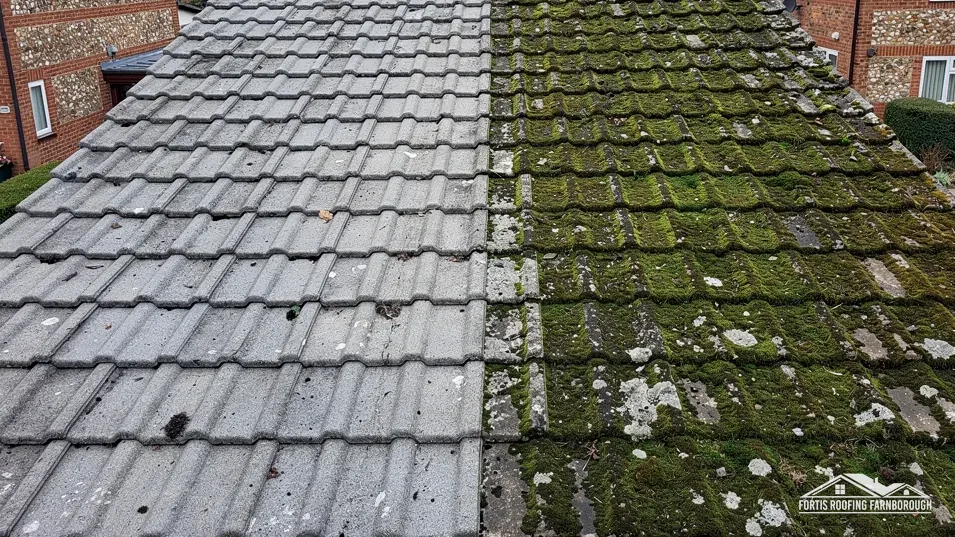
Cold also changes how the result appears. A treatment kills the growth, and the dead moss weathers off with rain over following weeks. In winter the dead moss may sit on the roof for longer, because the slope stays wet and the effect is gradual. The roof may look no better for a time, even though the treatment has worked.
Physical removal of moss, which does not depend on a product, can be done on suitable days. Heavy cushions are lifted away with a soft brush, and the tile surface is left untouched.
Weather windows and waiting
A winter clean is a matter of finding the right day. The roofer looks at the forecast for dry, still, frost-free conditions, and books work for those days, with a spare in hand.
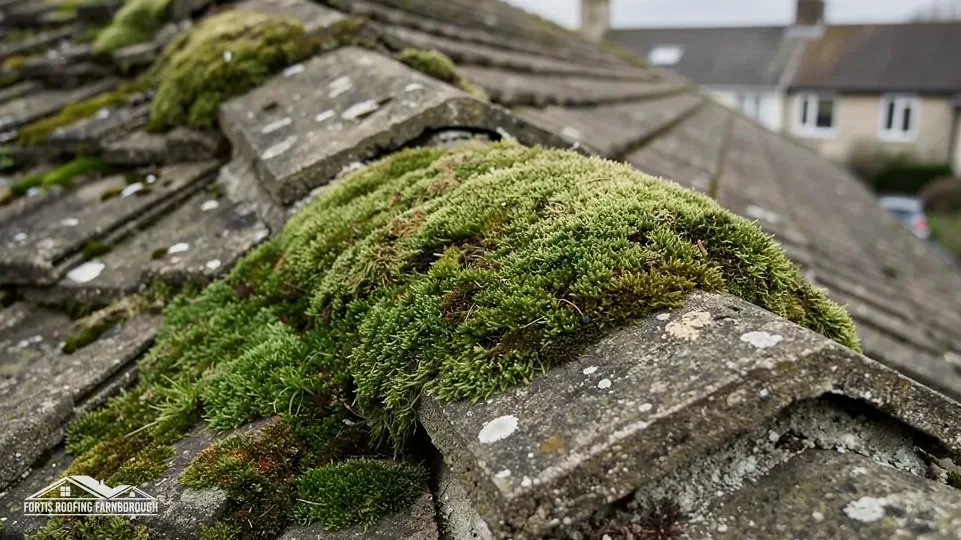
Whether to go ahead in winter or wait depends on the roof. Thick moss holding water against the tiles, blocked gutters and lifted tiles argue for acting. Moss that is thick enough to lift tiles, block valleys or send water over the fascia is doing harm all winter, and waiting costs something.
A light stain on sound tiles is a different case. It does little harm over a few months, and a spring clean is a fine plan. Our page on whether moss damages a roof helps weigh it.
Gutters can be cleared in most dry spells, and leaf litter removed from valleys, which cuts the damp that feeds growth. That job suits winter well.
Do not be tempted into jet washing to save time. Marley advises against it for the tile surface, and wet cold conditions raise the risk of water being driven under the laps.
If the roof is leaking, the answer is a temporary repair first, and cleaning waits. Our page on how often a roof should be cleaned gives a sensible routine for the year.
How we handle a winter booking
The survey comes first, on a safe day, with photographs of the roof and gutters. It shows what the growth has done and whether the roof needs action now or can wait.
If it should be done now, we plan for a dry spell, and tell you plainly that dates move with the weather. If it can wait, we say that, and suggest a time in spring or early summer.
Where a treatment is part of the plan, we name the product, check its label against the forecast and tell you what the label requires for pets, plants and runoff. If the conditions are wrong on the day, we rearrange.
The month does not change how the price is set: a single written total after the survey, based on area, pitch, access and the amount of growth.
The roof cleaning and moss removal hub sets out the service across our area.