The short answer
Yes, it is best avoided. Marley, a major tile maker, lists high-powered jet washes as "not recommended" and warns of damage to the face of tile or slate. Pressure can strip the coloured finish, drive water under the laps and leave tiles open to moss and frost. Soft washing is the gentler alternative.
What Marley says
The most useful source on this is the tile maker. In its guidance on cleaning or jet washing a roof, Marley puts high-powered jets in the "not recommended" column. The damage it has in mind is to the surface, and the result, Marley says, is "reducing its expected life considerably".
Three points stand out. The warning comes from a manufacturer that knows its own product. The word considerably describes the loss of life as large, not marginal. And the advice covers slate as well as tile.
It also fits what a tile is. Concrete and clay tiles carry a surface finish that gives them colour and sheds water. Pressure at close range acts like a sandblaster on that finish.
A manufacturer's advice is not the same as a law. There is no rule that bans a pressure washer on a roof. But if you are weighing a quote that relies on one, the maker's view is worth putting to the firm.
The figures for how long tiles last are published ranges, and none is a promise. HomeBuilding gives plain concrete 40 to 50 years and clay 60 to 80. Anything that cuts into that range is spending the roof's life for the sake of looks.
The soft wash page explains the gentler method.
Coating loss and where the water goes
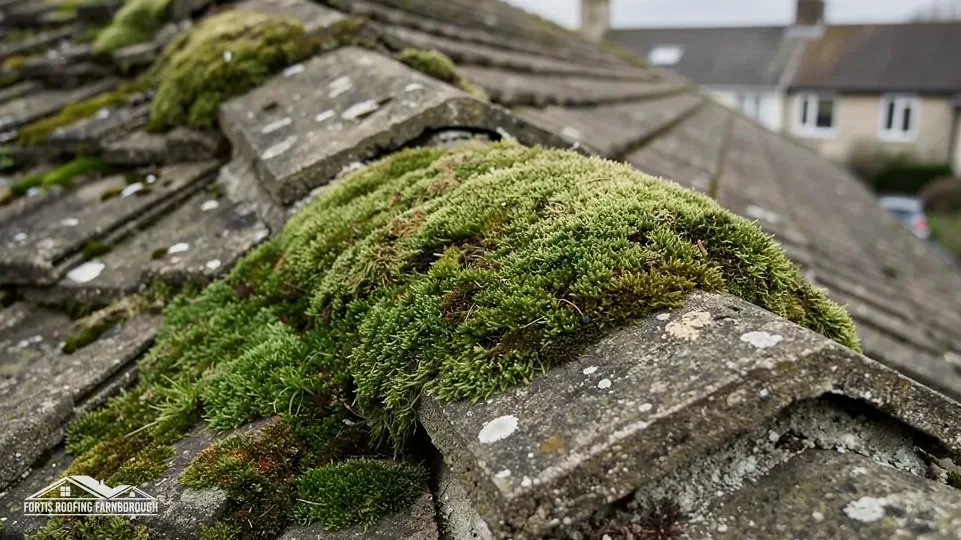
The first harm is to the surface. Pressure removes the top layer of a tile's finish, and with it much of its colour. The tile can look paler and patchy, and the bare material beneath is rougher and more absorbent. That bare surface soaks up rain, which leaves the tile more open to frost and to regrowth. Met Office averages for South Farnborough (1991 to 2020) record around 53 air-frost days a year.
The second harm is the water itself. A lance aimed along the roof can drive water up beneath the laps and through the tile joints, onto an underlay that was designed for rain falling downwards. In an older roof the underlay may be torn or tired, and a jet can produce leaks that were not there before.
The third is mechanical. Tiles can be chipped, lifted or cracked by the blast, and a loose tile can be knocked out of line. Ridge bedding and verge mortar are weak points that a jet can break up.
Finally, there is the person holding the lance. A tiled roof is already a fall risk, and wet tiles under a recoiling lance are worse.
The damage may not show for a season or two. A roof can look fine on the day, then age quickly. Our page on whether roof cleaning can cause leaks goes through the water route.
Gentler alternatives
The alternative is soft washing. It uses low pressure, which is about what a garden hose delivers, to carry a treatment onto the roof. The treatment is an approved biocide used to the label, and it kills the growth, which then weathers away over the following weeks.
Heavy cushions of moss are first eased away with a soft brush, leaving the face of the tile unscraped, and the gutters and valleys are cleared too.
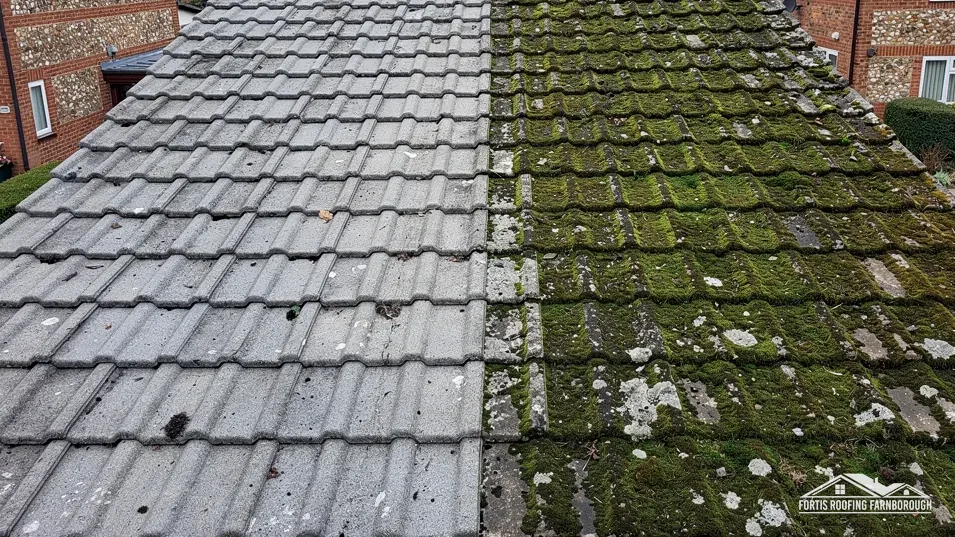
Because the roof is not blasted, the finish stays on the tile and the laps stay dry. The result arrives more slowly, and a roof may look patchy for a time as the dead growth washes off, but the tiles are left in good order.
Treatment has rules: HSE keeps professional-only biocides away from householders, and applying an unapproved product is itself an offence. Runoff must be kept from plants, ponds and drains.
For a light stain or a little moss, regular gentle attention is enough, and nothing aggressive is needed. For a roof that is too far gone for any cleaning to help, replacement is the honest answer.
Our page on clean or replace roof tiles explains how that decision is made.
When a quote leans on a high-pressure lance
Some firms still offer high-pressure cleaning, and it can look impressive in a before-and-after photograph. Treat it with caution.
Ask the firm four things. What method is proposed and at what pressure? Does it match the tile maker's advice? What will be done if tiles are damaged, and who repairs them? Will the roof and loft be photographed beforehand, underlay included?
A firm that proposes a gentle method, names the product and explains the runoff is giving you a good sign. A firm that is vague about method, or that dismisses the maker's warning, is a poorer one.
If a roof has already been blasted clean and the tiles are now pale, patchy or leaking, send photographs and the roof can be looked at. Wear cannot be undone, but what is sound and what to do next can be explained.
For a new clean, the roof is surveyed, the tile identified and its condition explained, with photographs. The price then follows as a single written sum, with access and any repairs stated.
The roof cleaning and moss removal hub lists the gentler services we offer near Farnborough.