The short answer
Yes, if the product is approved for the job and used exactly as its label says. Moss killers are biocides, and each one is tied by law to its own authorisation conditions. Products reserved for professionals are not for householders, and applying an unapproved one is a criminal offence. Runoff needs controlling, and the advice is to avoid jet washing.
What a moss killer is in law
Moss killers for roofs belong to a class of products called biocides, chemicals intended to destroy living organisms. In Great Britain, they are controlled, and each approved product carries conditions about where and how it may be used.
Under the Biocidal Products Regulation (article 17(5)), a product may only be applied as its authorisation allows. That is the legal core: the label is not advice, it is part of the permission.
For roofs, that means checking three things on any product: that it is approved for the surface you want to treat, that it is meant for the user, whether a householder or a professional, and what the dilution, method and safety instructions say. Doing something the label does not allow is outside the authorisation.
HSE spells it out for users: householders must stay away from any biocide that is made for professionals only. Some of the strongest roof treatments fall in that category.
The Control of Pesticides Regulations add that dealing in or using a product that lacks approval is itself an offence.
Home-made mixtures and products imported without UK approval fall outside this, however popular they are online.
Choosing and using a product
If you decide to treat a small area yourself, start from the label. Look for wording that names roofs, tiles or hard surfaces, and an approval number you can check. Follow the dilution to the letter, apply it in the conditions it specifies and use the protective gear it lists.
Choose a dry day with no rain forecast for the time the label states, and a calm one, so the product does not blow onto neighbours' gardens, cars or windows. Keep children and pets away while it is applied and until it is dry, as the label directs.
Applying it means getting onto the roof or reaching it from a ladder, which is a fall risk and can crack tiles. Do not walk on tiles to reach the moss. Treatments applied from the ground with a long-reach sprayer are within some labels, and not within others.
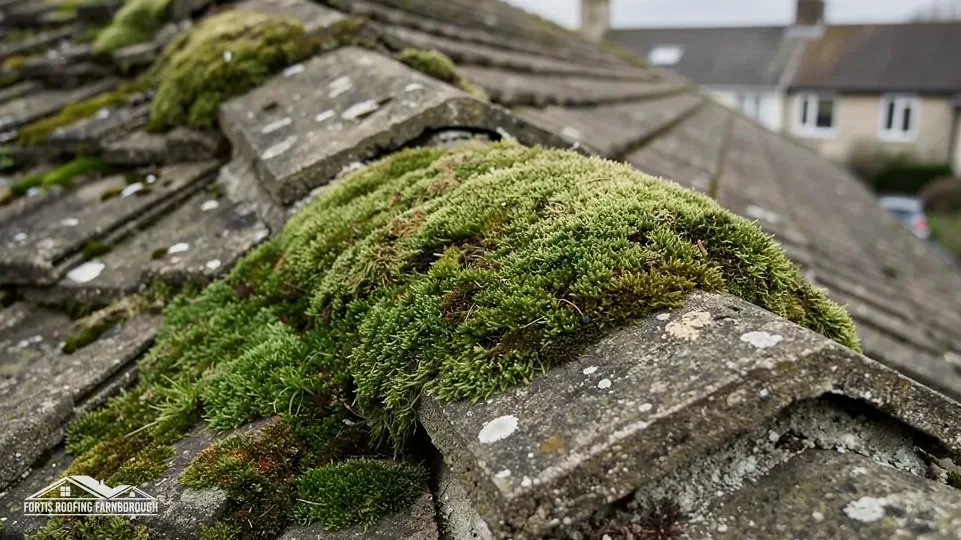
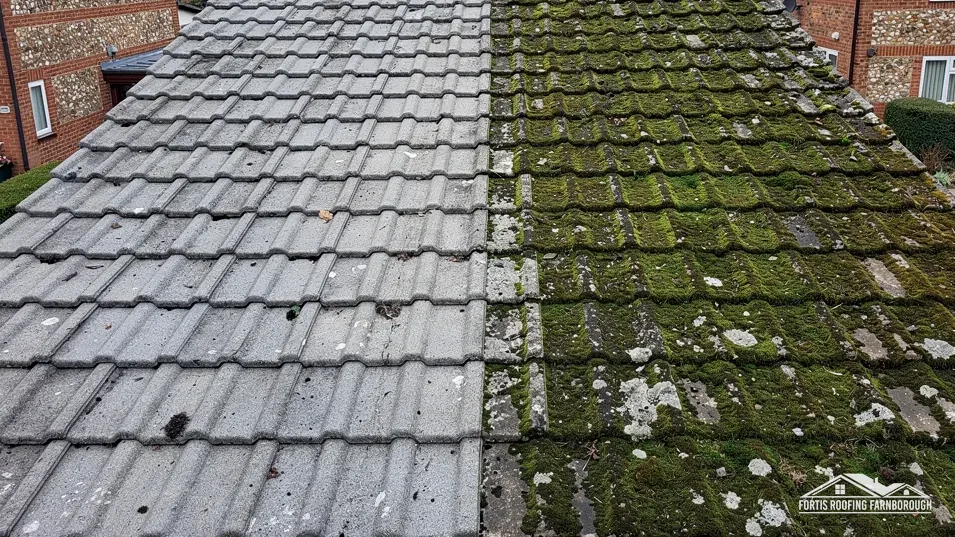
Scraping the moss off first is a common mistake: it damages the tile surface and puts fragments into the gutters. A treatment works by letting the growth die and weather away over time, so scraping adds nothing.
Marley advises against high-powered jet washing of tiles for the wear it causes, so avoid following a treatment with one.
If the product is for professional users, it is not for you. Our page on roof biocide treatment covers what a professional does.
Runoff, gutters and the garden
What the product does after it leaves the roof matters. Rain carries it down the slope, into the gutters and out through the downpipes, onto paths, beds, lawns and drains.
Plants can suffer, and so can ponds and pets. Products can mark paving and stain walls as well. Water that reaches a surface drain may eventually reach a watercourse, so the label's instructions about drains and runoff are worth reading twice.
Practical steps include covering plants or borders below the roof edge, moving garden furniture, closing windows, keeping water away from drains where the label asks and rinsing paving afterwards if it allows. Do the work when no heavy rain is forecast for the period the label specifies.
A professional manages runoff as part of the job, protecting the ground below and choosing product and timing with that in mind, which is a fair reason to hand the work to a firm.
Our page on roof cleaning runoff goes through where the water goes and how it is managed.
If you notice staining or dead plants after a treatment, stop using the product and check the label and the supplier's advice.
When to call someone in
Call a roofer if the roof is high, steep or hard to reach, if the moss is thick enough to need removing before treatment, if the product you would need is for professionals only, or if you are not sure what is growing there.
The first step is a look at the roof: the growth and the tile are identified, the tiles and gutters are checked for damage, and the question of whether treatment is worthwhile is answered with photographs.
If treatment is the right answer, an approved product goes on to its label from safe access, with the runoff managed, and the tiles are left unscraped.
Any repairs we spot, such as slipped or cracked tiles, are explained and quoted separately from the idea of treatment, so you can decide on each.
The survey leads to a single written total. Whether a quote includes scaffold and VAT is worth checking, since area, pitch, access and the weight of growth all feed into it.
The roof cleaning and moss removal hub explains the full service for roofs in Farnborough, Camberley and Fleet.