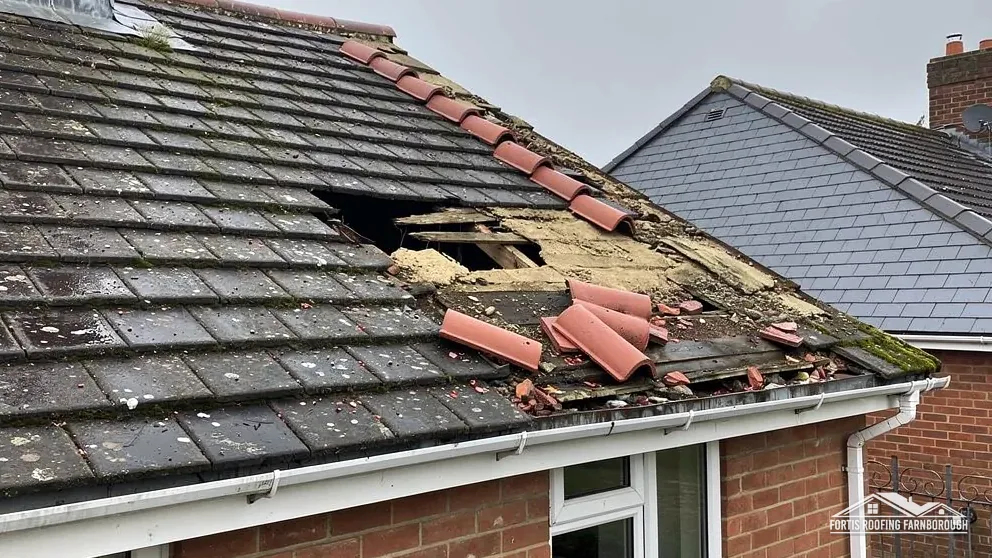
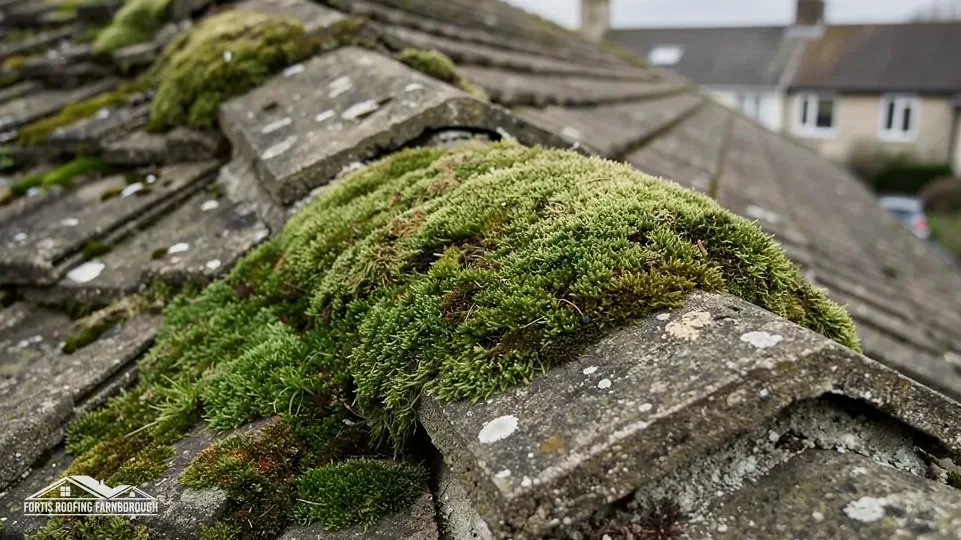
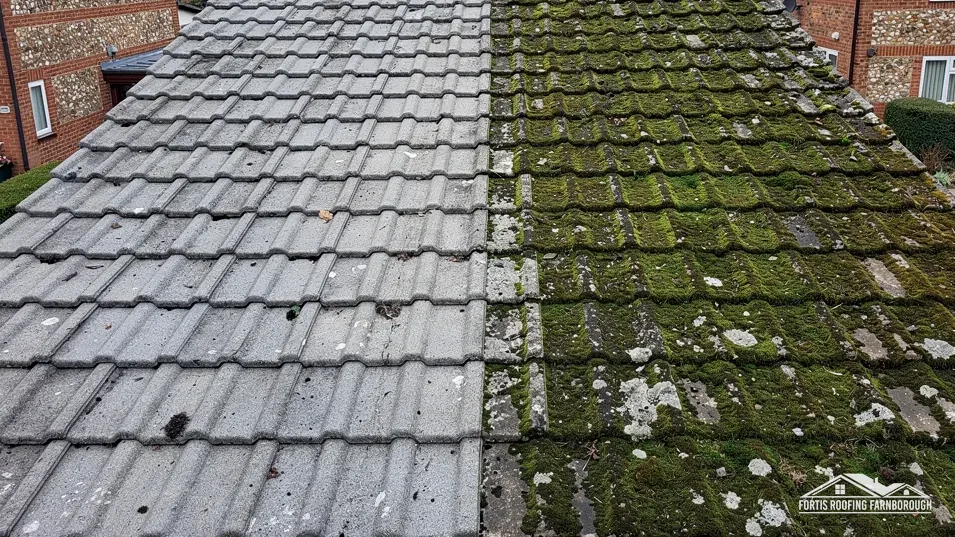
A biocide is a product that kills living organisms, and roof treatments are biocides aimed at moss, algae and lichen. Applied well, a treatment does most of its work without anyone scraping the tiles. The growth dies, loses its grip and washes or brushes off, usually over a few weeks. Applied badly, or with the wrong product, it can stain, harm plants or end up in a drain.
The rules around these products are stricter than the shelf at a garden centre suggests. Products are authorised for particular uses and particular users, and the label is part of the law, not just advice. Householders are told not to use products that are meant only for professionals.
This guide explains how a treatment works, what the rules say, how to read a label, how runoff is controlled, what results to expect and when a treatment is the wrong choice, for roofs in and around Farnborough.
How a roof treatment works
The principle is straightforward. A liquid is applied to the roof surface, soaks into the growth and kills it. The roof is then left, and the dead material loosens as the weather works on it.
Application
The product is sprayed or brushed on at low pressure, covering the whole slope evenly, including the shaded corners where growth is thickest. The roofer works from safe access, since a treated, wet roof is more slippery than a dry one. The label sets out the dilution and the amount per square metre.
Dwell time
Biocides need time on the surface. The label states how long the product must stay in contact before it is rinsed or left to rain. Rinsing too soon wastes the product and the growth survives.
Dying back
Moss turns brown or black as it dies, then dries and crumbles. Lichen is slower. It can take weeks or months for a crust to loosen. It looks worse before it looks better, which can alarm owners who expect an instant result.
Removal
Dead growth can be left to be washed off by rain, or lifted off by a soft brush at a later visit. It then has to be caught before it falls into the gutters. Our guide to roof moss removal methods covers the removal side.
The aim is to let the product do the work, so the tile face is never rubbed, and that is why treatment suits old roofs better than scraping does.
What the law says about biocides
Moss and algae killers fall under biocide law, and the main rules come from two places.
The Biocidal Products Regulation
Under Article 17(5), a biocidal product may be used only on the terms of its authorisation. The authorisation sets what the product may be used for, where, in what strength and by whom. A product authorised for one surface, or only for trained users, cannot be used outside that.
Professional-only products
HSE's biocides guidance gives householders a simple instruction: leave alone any product made solely for trained users. Some of the strongest roof treatments sit in that category. The label or the supplier tells you which kind a product is.
The Control of Pesticides Regulations
Under COPR, HSE says, supplying, storing or using a product that has no approval is an offence. Buying an unapproved product from an online seller and using it on your roof is therefore a legal risk as well as a risk to the roof.
What this means in practice
- Choose a product whose label names roofs or masonry as a use.
- Check whether it is sold for household or trained use.
- Follow every instruction on dilution, contact time and protective gear.
- Keep the product in its original container and store it as directed.
A roofer who treats roofs for a living buys and uses products suited to the job and the user. Homeowners who want a treatment done should ask which product it is and have the data sheet to hand. The risks of doing it yourself are wider than the chemistry.
Reading a label and a data sheet
The label is the legal instruction, and the data sheet adds detail. Reading both takes five minutes and prevents most mistakes.
What to find on the label
- Authorisation number or registration details, showing the product is approved for use in the UK.
- Permitted uses, which should name roofs, tiles, masonry or hard surfaces.
- User category, household or trained user.
- Dilution rate and the amount to apply to a given area.
- Contact time and whether to rinse.
- Hazard warnings and the protective equipment required.
What the data sheet adds
A safety data sheet lists the active ingredient, the hazards, first-aid measures and how to dispose of surplus. It is the document to give a neighbour or a vet if there is an accident with a pet or a pond.
Red flags
A product with no authorisation information, no named active ingredient, or a vague claim of being a miracle cleaner is one to avoid. So is a product sold in an unmarked container.
Check with the roofer
Ask for the product name, the data sheet and what happens to runoff. A roofer who has thought about the job will have all three. We name the treatment on the survey sheet when one is proposed, so the label and the plan agree.
Storage and surplus
Do not pour surplus into a drain or onto the ground, and do not decant it into a drinks bottle. The label says how to dispose of it, and a roofer takes surplus away.
Runoff, plants, pets and neighbours
A liquid sprayed onto a roof goes somewhere. Planning for that is part of any treatment job.
Where it goes
Rain runs down the slope into the gutter, along it to the downpipe and then to a drain or soakaway. On the way, it passes over anything below the eaves: paving, borders, a conservatory roof, a pond or a water butt. A treatment that is safe at the dilution on a roof may harm a plant or fish if it arrives in strength.
Precautions
- Cover or protect plants, ponds and water butts where the label advises it.
- Divert or block the downpipe into a drain if the label requires it, and rinse as directed.
- Keep pets and children out of the area until the product has dried or the label permits access.
- Close windows and tell neighbours who share a boundary.
Timing and weather
Treatments are applied in dry weather with no rain forecast for the contact time, so the product stays on the tile. Strong wind blows spray where it should not go. Frost can stop a product working. The label sets out the conditions it needs.
Gutters
The gutters take the first flush of dead growth and treatment. They are cleared afterwards so that dead moss does not turn into a blockage, which is the damage route described in our guide to moss in gutters.
When the work is done, the area below the eaves is checked and left clean, and any surplus is taken away with the roofer.
What results to expect
A treated roof does not look finished the day the product goes on. Setting expectations early avoids disappointment.
The timeline
Moss often darkens within days and begins to crumble within weeks. Algae streaks fade over a few weeks as rain breaks them down. Lichen can take a season or more. Rain and wind do the clearing, and a second visit with a soft brush finishes the job where it is needed.
What treatment will not do
It cannot mend a cracked tile, re-seat a slipped one or stop a leak. It will not remove a stain from a tile whose surface has aged. On an old, weathered roof the tile colour beneath may be paler or darker than the owner remembers.
Regrowth
A treatment slows the return of growth, and may hold it off for a good while, but it does not stop it for good. Shade, trees and damp bring it back. Some products leave a residual effect, which the data sheet describes. A roof open to sun and wind needs treating less often than one sitting under a tree.
Comparison with other methods
Treatment and soft washing together are gentler than jets and scrapers. Our guide to soft wash methods sets the options side by side, and tile maker Marley's own advice on jets is that they are not recommended for tiles.
Price
Treatment is priced once the roof has been seen, because its size, slope, access and how thickly it is covered all change the work. A fixed price per roof would be guesswork.
Expect to see the roof improve over weeks, and ask the roofer to say what the next visit, if any, would be.
When treatment is the wrong choice
A biocide is one tool among several, and some roofs need a different one, or none.
Asbestos cement sheets
An asbestos cement roof is not an ordinary tiled roof. Spraying, rinsing and brushing can all disturb weathered sheets, so the material has to be identified before anyone treats it. Asbestos cement is a separate subject with its own safe route, and it starts with identification.
Roofs with problems beneath
If tiles are cracked, battens are soft or the underlay has failed, treatment will not fix any of it, and the wet may find its way into the loft. Repair first, then treat. A roofer who treats a roof without looking at its condition is selling a surface effect.
Other metals and finishes
Some roofs include lead flashings, zinc, copper or painted surfaces that can react to a strong product. The label and the data sheet say what a product is safe on. If the answer is not stated, ask the maker, or choose another method.
Wildlife
Birds nesting in or on a roof are protected. Section 1 of the Wildlife and Countryside Act 1981 makes it an offence to intentionally harm a wild bird's nest, by damaging or destroying it, while the nest is in use or going up, and all bat species and their roosts have full protection. Work near either has to wait, or be planned with proper advice.
Very light growth
A light film of algae on a sound roof may not be worth treating at all. If it is only a question of appearance, leaving it alone is a fair choice, and a survey will say whether anything under the film needs attention.
If treatment is not suitable, the roofer says why and proposes something else, with one written total to follow. Our roof cleaning and moss removal page lists the full range of work, from gutter clearing to treatment and repair.