Ask three people what roof cleaning costs and you may hear three very different numbers. That is not because someone is wrong. It is because a roof clean is not one job. A bungalow with a gentle slope and light algae is a different task from a four-bedroom house with a steep, shaded slope under oak trees and moss thick in every lap.
Published cost guides for roof cleaning also disagree with one another, so a single national figure would mislead more than it helps. What helps is knowing what moves the price, what a quote should state and how to compare two of them sensibly.
This guide sets out those drivers one at a time: the roof itself, the access, the method, the repairs that cleaning tends to uncover and the gutters. It then explains how to read a quote and how to keep later bills down, for homes in Farnborough, Aldershot, Fleet, Camberley and the villages around them.
The roof itself sets the starting point
Every cleaning quote begins with the surface to be cleaned. More roof means more time, more product and more hands, and the shape of that roof changes how hard the work is.
Area and number of slopes
A small terrace roof with two slopes is quicker than a detached house with four slopes, a porch, a bay and an extension. Each extra slope means moving access equipment, and each small roof is its own job within the job.
Pitch
A steep slope is harder to work on safely than a shallow one. The roofer needs more equipment, works more slowly and takes more care about where debris falls. A flat or low-pitched area behaves differently again.
Covering
Concrete tiles, clay tiles, natural slate and fibre cement all clean differently. A fragile or brittle covering needs gentler handling, and an old clay roof with a worn face needs a different method from a newer concrete one. Some coverings, notably asbestos cement, cannot be cleaned by the usual methods at all, and need identifying first.
Depth of growth
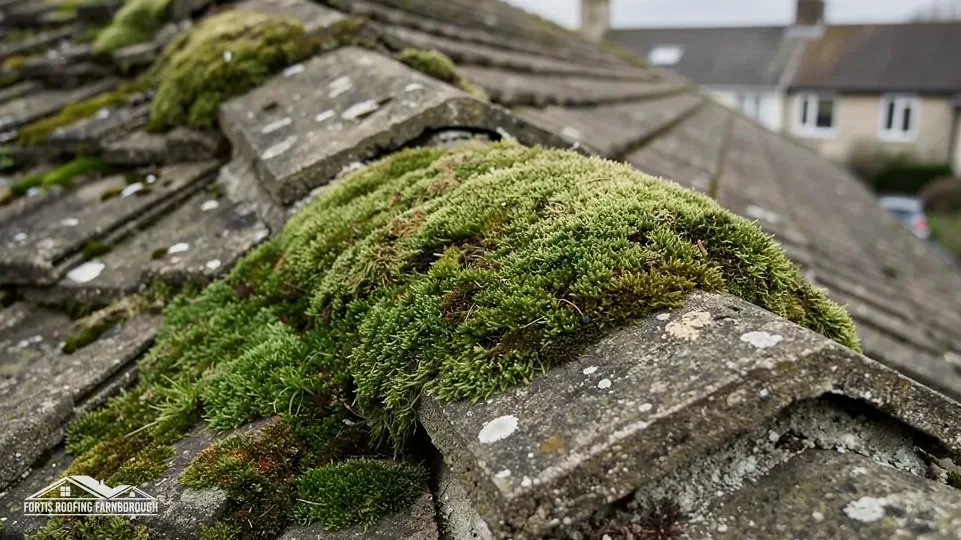
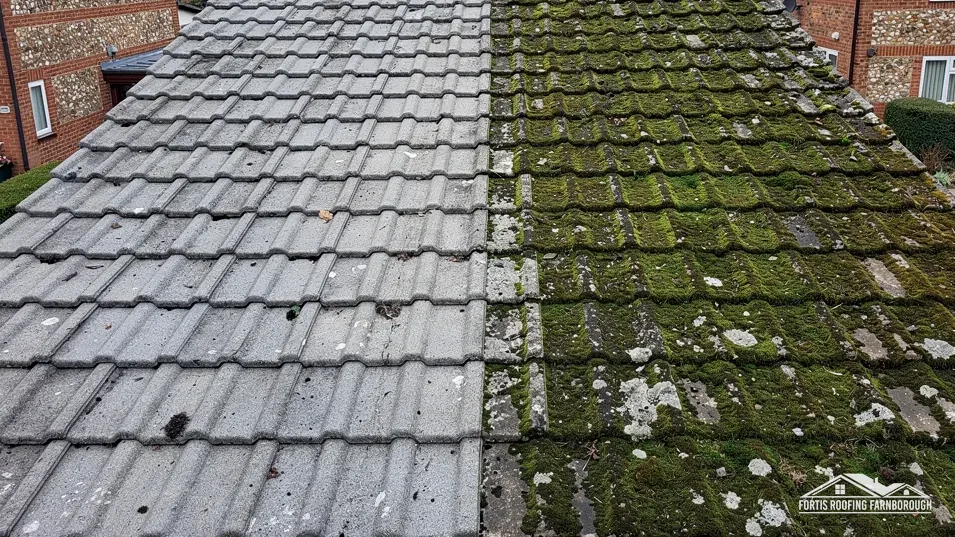
A light film of algae is a short job. Moss that has built into thick cushions in every lap needs lifting by hand before any treatment can reach the tile. The thicker the growth, the longer the visit and the more debris to clear.
Features on the roof
Chimneys, valleys, roof windows, solar panels and dormers all add cutting-in and care. Our guide to whether roof cleaning is worth it helps you judge whether the job is needed at all before you ask for a price.
Access: ladders, towers and scaffolding
Reaching the roof safely is often the largest single factor after the roof itself. A cheap quote usually means less access than the job needs.
Ladders and platforms
On a low roof, a ladder with a stabiliser and a roof ladder may be enough for the roofer to work properly. On a taller house, a mobile tower or a platform allows a stable working position, and it often costs more to bring and set up than the cleaning takes.
Scaffolding
Where the work is high, or a roof is steep or has a lot of repairs to do, scaffolding is the safe answer. It protects the roofer, catches debris and gives a working edge for the gutters. If a scaffold stands on the road or pavement, the Highways Act 1980 (section 169) makes a licence from the highway authority a condition, and that licence takes working days to arrange. Scaffolding that stays entirely on your own land is not caught by it.
What access does to the quote
The cost of access sits inside the written total. If one quote leaves out scaffolding, towers or the licence and another includes them, the lower figure is not lower at all. Ask each roofer what access is proposed and whether it is in the price.
Why we do not cut corners here
A job done from an unsecured ladder, or by walking on tiles, may save money and put a person at risk. It also breaks tiles. Our guide to cleaning your own roof explains the dangers in detail.
Check whether a quote includes access equipment and VAT before comparing two prices. They are the two items that most often explain a gap.
How the method changes the price
Cleaning methods differ in time, skill and equipment, and the price follows. The method with the lowest labour is not always the one that protects your roof.
Hand removal and brushing
A roofer lifting moss by hand and brushing the surface works slowly but gently. It suits delicate tiles and light growth, and it costs labour hours.
Soft washing and treatment
Soft washing applies an approved treatment at low pressure and rinses away loosened growth. It needs product, a plan for runoff and sometimes a second visit to finish, since lichen and thick moss die back over weeks. Our guide to soft wash methods sets out the gentler options.
Jets
High-powered jets can look fast and inexpensive, yet tile maker Marley lists them as not recommended for roofs, since they scar the tile face and shorten its expected life a long way. A low price for a method that harms the tiles is a false saving.
Follow-up visits
Treatments work over time. A fair quote says whether a second visit is part of the price, and what it covers. If a roofer offers a once-only clean of thick lichen with no follow-up, ask how the result will be reached.
Why the method belongs on the quote
The method decides how the roof is treated, how long the job takes and what is left behind. A quote that says only roof clean tells you nothing about any of those. Ask for the method, the product and what happens to the debris.
Repairs and gutters found along the way
Cleaning is often the first close look at a roof in years. What it uncovers can change the job, and it should be in the plan from the start.
Typical finds
- Tiles that are cracked, slipped or have lost their faces.
- Ridge or verge mortar that has crumbled.
- Flashings that have lifted or split.
- Blocked valleys and outlets.
- Damaged or sagging gutters.
Our guide to roof repairs found after moss removal sets out the usual order of work.
Repair before cleaning
A repair done first is cheaper than a repair done after a treatment has been sprayed over a leak. Cracked tiles can fall apart when cleaned, and a wet clean over failed underlay can send water into the loft. For that reason, a survey comes before any cleaning price, and repairs found sit in the same one written total.
Gutters
Moss that comes off the roof lands in the gutter, so a proper clean ends with the gutters cleared. Which? puts gutter clearing for a whole property, front and back, at £75 to £350 ex VAT (Nov 2025, typical UK range). On a roof job, gutter clearing happens on the same visit.
What that means for comparing
One roofer may leave the gutters to you, another may include them. If the lower quote skips the gutters, you will either pay for them separately or find them blocked within a season. Ask which quote includes them.
Reading and comparing quotes
A written quote is a document, and the details decide whether two of them can be compared. A few items are worth checking each time.
What the quote should state
- The address, the roof area to be cleaned and the covering.
- The method and the product, if a treatment is used.
- Whether access equipment or scaffolding is included.
- Whether gutters are cleared.
- Whether VAT is included, and the rate.
- What happens to waste and debris.
- Whether a follow-up visit is part of the price.
Our approach
After a visit to your roof we give a single written price, with photographs. Our prices are good and fair, and the figure covers the access, the method and the clear-up that the survey says the job needs.
Getting more than one
Citizens Advice points out that at least 3 written quotes make a sound basis for choosing. Compare like with like: same roof, same scope, same method. If one comes in far below the others, ask what has been left out.
Your cancellation rights
If you sign at home after a visit, that is an off-premises contract, and the usual cancellation period is 14 days, starting the day after you agree. A repair where you called the trader out as urgent follows different rules, so ask what applies before you sign.
Deposits and payment
Be careful about large payments before work starts. If you are unsure about a trader or a contract, the Citizens Advice consumer helpline on 0808 223 1133 gives general advice.
Keeping future cleaning costs down
The best way to spend less on roof cleaning is to deal with growth when it is light and to remove the conditions that feed it.
Deal with causes
Moss grows where a roof stays damp and shaded. Trimming overhanging branches lets in light and air. Clearing leaves from the roof edge and valleys stops them forming a wet mat. Fixing a leaking gutter dries the roof edge. These are small jobs that make a large difference to how fast the growth returns.
Light and regular beats heavy and rare
A roof cleaned lightly every few years costs less each time than a roof left for a decade, because thick growth takes longer to lift and may hide damage. A treatment slows regrowth without stopping it, so the interval depends on the shade.
Keep a record
Photographs of each slope from the garden, taken at the same time each year, show how fast growth returns. They also give a roofer something to refer to when you ask for a price. Our guide to roof cleaning and moss removal sets out the full range of work.
Do not clean a roof that needs repair
If the survey says the tiles are failing, money spent on cleaning is spent on the surface of a roof that is wearing out. HomeBuilding (Sep 2025) gives typical lives of 40 to 50 years for concrete tiles and 60 to 80 years for clay, as ranges rather than promises. Where a roof is near them and showing signs of wear, ask about repair or replacement first.
What next
Send photographs of the roof and the gutter line, and tell us the type of house. A survey follows, and the price comes out of what it shows.