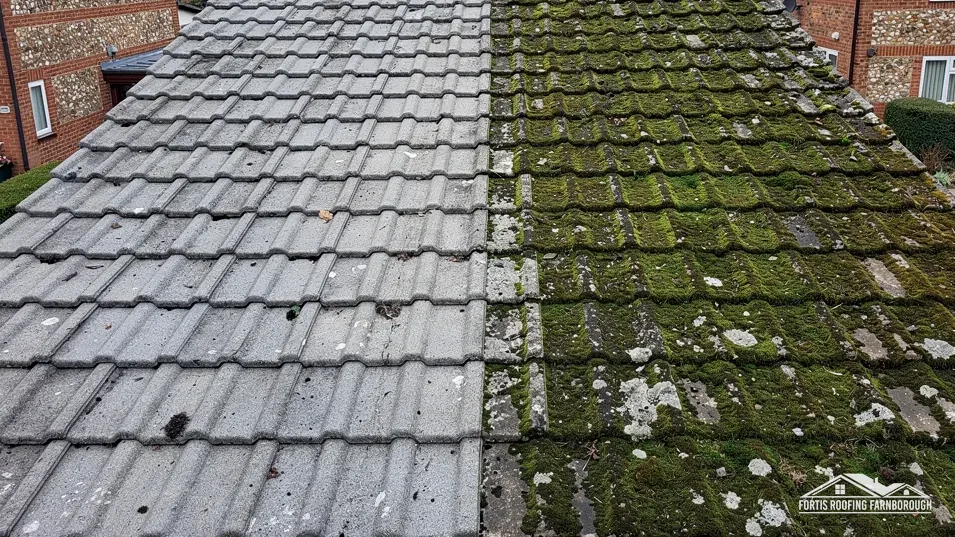
Roof cleaning has a reputation as either a vital maintenance job or an unnecessary extra, depending on who you ask. The truth sits between. A roof with a light dusting of lichen and a few patches of moss is a roof with a weathered look. A roof with thick moss in every lap, blocked valleys and a green gutter line below is a roof with a drainage problem.
The value of cleaning therefore depends on three things: what the growth is doing, the material under the growth and how the cleaning is done. A gentle clean on sound tiles can be money well spent. A hard clean on old, brittle tiles can shorten their life, and a clean that is done without a look at the roof beneath can hide faults that then go unrepaired.
This guide sets out when moss causes harm, when it is mostly appearance, what the wrong method risks, what a roofer checks while on the roof, and how to decide whether to pay for it on a house near Farnborough.
When growth is harmless and when it is not
Moss, algae and lichen are all common on roofs, and they are not equal. Telling them apart helps you decide whether cleaning is a priority.
Mostly appearance
Algae shows as dark streaks and stains. It spoils the colour of a roof, and it does little else. Lichen, the crusty grey, green or orange patches, grows slowly and clings tight. It makes a roof look old and, on its own, is not usually the first thing to put a roof at risk.
Where moss matters
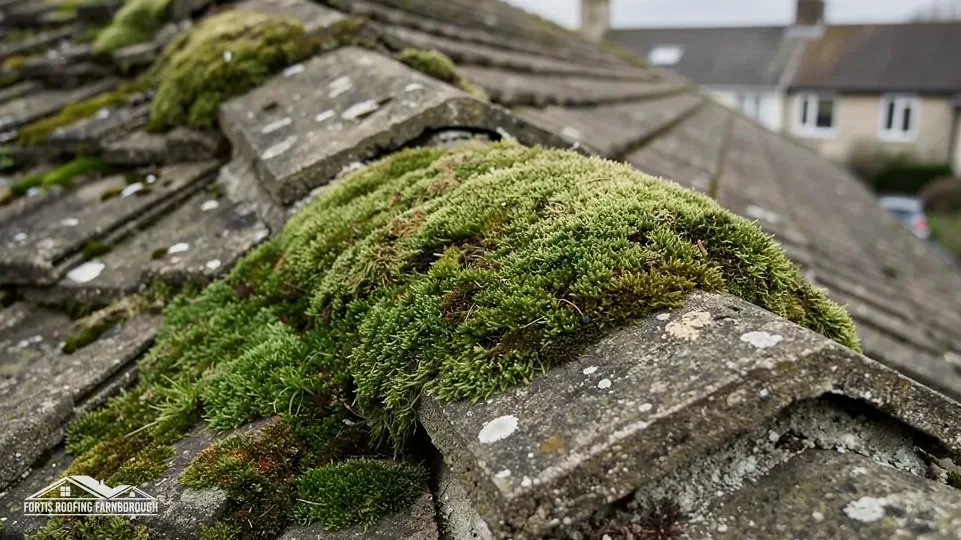
Moss grows in thick cushions that hold water like a sponge. On a roof, that matters in four places. Between overlapping tiles, where a pad of moss can hold water against the laps and push it sideways under the tile. In valleys, where a mat of moss can slow the flow and send water over the edge. At the eaves, where lumps fall into the gutter. And around the ridge and verge, where it sits on mortar and keeps it damp.
Why shade and damp matter
Growth thrives where a roof stays wet: under trees, on north-facing slopes and near gutters that overflow. A roof that gets sun and wind dries out between showers and grows little. If one slope is mossy and the other is clean, the cause is the place, not the roof.
The sensible question
Ask what the growth is touching. If it sits on clear tile faces, it is cosmetic. If it blocks a valley, fills laps or clogs the gutters, it is working against the roof, and the case for cleaning is stronger. Our guide to lichen on a roof goes further on the difference.
What cleaning does, and what it does not
Cleaning takes growth off the surface. That is all. It is easy to expect more, and the gap between expectation and result is where dissatisfaction starts.
What you get
- A cleaner, more even colour once stains are removed.
- Clear laps, valleys and gutters, so water drains as designed.
- A chance for the roofer to look closely at every tile, ridge and hip.
What you do not get
Cleaning does not repair a cracked tile, replace a failing batten or stop a leak from a bad flashing. It does not give a roof a new life. A roof at the end of its working life will still be at the end of its working life when it is clean, and it may look better while it fails.
Regrowth
Growth comes back where a roof stays damp. Treatment slows it, and a treated roof can stay cleaner for some time, but no method stops it for good. A homeowner who knows regrowth is normal can plan for a light clean every few years, with a lower bill each time than a roof left alone for a decade.
Roofs you should not clean
Some roofs are better left alone. Asbestos cement sheets must not be scrubbed or jetted, and the asbestos cement guidance elsewhere on this site explains why. Roofs with failing tiles, rotten battens or perished underlay are better repaired first, since cleaning loosens weak tiles and a wet clean can send water into a loft with a torn membrane.
Cleaning a roof that needs repair is paying to polish a problem. Check the roof beneath before paying for the surface.
How the wrong method does damage
Methods differ greatly in what they do to a tile. The harsher ones can undo the benefit of cleaning.
Jets and high pressure
Tile maker Marley lists jet washing at high power as not recommended: it harms the face of slate and tile, with a large cut in the covering's expected life. A jet can strip the coating from a concrete tile, scar clay, and drive water up beneath the laps toward the loft, scattering debris and runoff as it goes.
Scraping and wire brushes
A scraper on moss can gouge a tile face. Metal brushes leave scratches that catch dirt and grow moss faster. Moss is better lifted gently, with a soft brush or by hand, and caught before it falls into the gutter.
Treatments
Moss and algae killers are regulated biocides. Householders should never use professional-only products, and a non-approved product cannot lawfully be used. Runoff reaches gutters, drains and gardens, so the plan has to cover where it goes. The rules sit in the biocide treatment guide.
Walking on the roof
The roofer's own weight cracks tiles unless it is spread, and moss makes the slope slippery. A trained roofer uses boards and access equipment to move over a roof without damaging it. A cheap quote from someone who walks directly on the tiles can cost more in broken tiles than it saves.
The question to ask any cleaner is how the roof will be cleaned, what will be used and how the debris and runoff will be controlled.
What a roofer checks while cleaning
One real advantage of a proper roof clean is that someone examines the whole roof, closely, on foot or from a platform. That look is often worth as much as the clean itself.
Tiles and slates
With the moss off, hairline cracks, chipped corners, spalled faces and slipped tiles show up. A tile that sounded fine under a pad of growth can turn out to be loose. We mark each one and photograph it so you can see where it sits on the slope.
Ridge, hips and verges
Mortar that has crumbled and ridge tiles that rock are easy to miss from the ground. Cleaning exposes them. Our guide to roof repairs found after moss removal covers what turns up most often and in what order the work is done.
Flashings and abutments
Where the roof meets a chimney, a wall or a roof window, the lead or other flashing is checked for lifting, splits and gaps. Many leaks start there, not in the field of the roof.
Gutters and outlets
The gutters under the eaves are cleared and checked for sagging, joints that weep and outlets that are blocked.
Why it matters when you decide
If the check finds only a few small things, the clean has paid for itself by telling you the true condition of the roof. If it finds a lot, the real question turns out to be repair or a new covering, and you learned that before paying for treatment. Either way, you receive photographs.
Where repairs are found, they are priced in the same one total, and the cleaning is done after the repairs, not before.
When cleaning is the wrong spend
Sometimes the sensible answer is not to clean. These are the common cases.
The roof is close to worn out
HomeBuilding (Sep 2025) gives typical lives of 40 to 50 years for concrete tiles and 60 to 80 years for clay. A roof close to or beyond those ranges, with cracked tiles and soft battens, is better served by a survey that weighs repair against a new covering. Spend on cleaning is best held back for the work the roof really needs, and a clean can follow a repair when it is wanted. If the survey says the covering has years in it, a clean becomes a fair question again.
There is a leak
If water is already coming in, cleaning does not address it. Finding and stopping the leak comes first. A wet clean on a roof with a failing underlay may push water into the loft.
The tiles are fragile or frost-damaged
Tiles that flake or crumble will not survive cleaning intact. They are better replaced first. Our guide to cleaning clay roof tiles shows how spalling looks.
The roof is only slightly marked
A light green tinge on a north slope that drains well is something many owners decide to live with. A clean for appearance alone is a choice, not a need.
Buying or selling
A mossy roof can put off a buyer, though it is the underlying condition that a surveyor will report. If you are selling, a roof survey with photographs can give more confidence than a clean on its own.
Weigh these cases carefully, and with the roof's actual age to hand. A roof that is sound, with growth in the laps and the gutters, is the one that gains most from cleaning, and a roof that is failing is the one that gains least.
How cleaning is priced and how to decide
A fixed price per roof would mislead you, since size, shape and growth differ so much between houses. What moves the cost is more useful to know than a number.
What sets the price
- Size of the roof and the number of slopes.
- Pitch and access, since a steep roof or a tall house needs more equipment.
- Depth of growth, because thick moss takes longer to lift than a light film.
- Repairs found once the surface is clear.
- Gutters and downpipes that need clearing at the same visit.
One total after the survey
After the survey we give one written price, VAT shown. Check any other quote you hold for the same two points, and ask what method is proposed. Citizens Advice advises getting written quotes from at least 3 traders before you choose.
A short list for deciding
- What is the growth sitting on, and what is it blocking?
- What is the roof made of, and how old is it?
- Is the roof sound enough to be cleaned?
- Which method is proposed, and why?
- What happens to the debris and the runoff?
If the answers are good, cleaning is worth it. If they are vague, ask again.
Our roof cleaning and moss removal work is arranged around those questions, and the answers go onto the survey sheet with photographs.