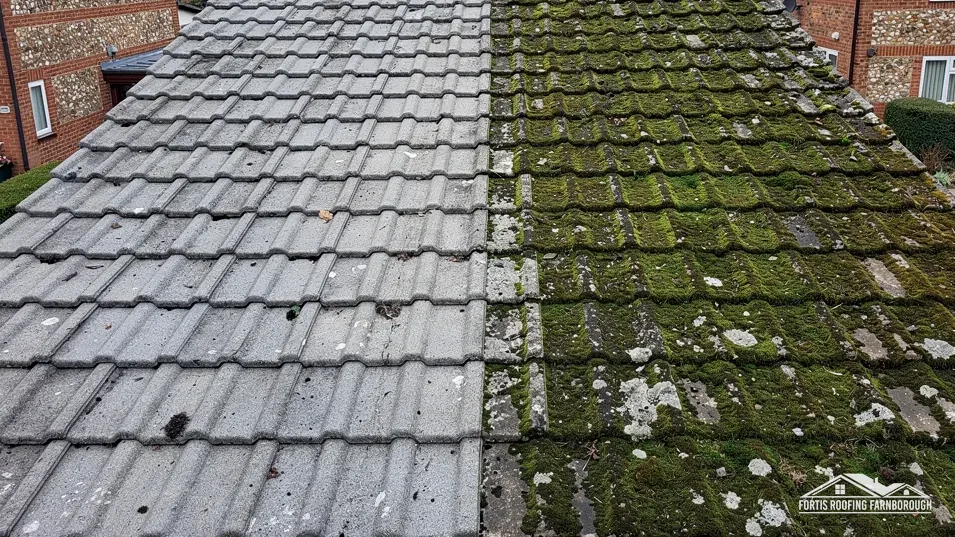
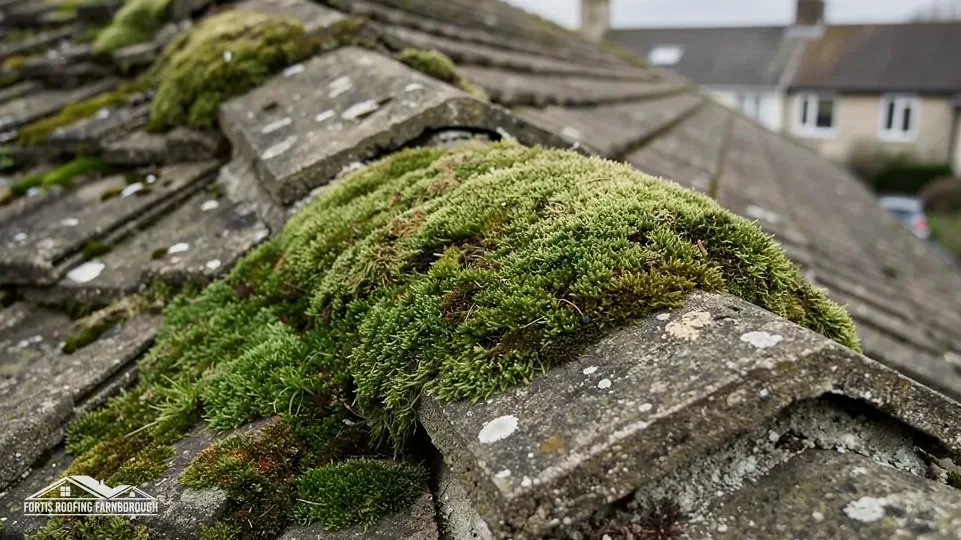
Lichen is neither a plant nor a simple mould. It is a partnership between a fungus and an alga, living together as a flat crust, a leafy rosette or a fine fringe on the surface of a tile, slate or stone. It is common on roofs that are old, unshaded and rarely cleaned, and many owners notice it as a yellow, orange or grey speckle on the slope facing the road.
People often use moss and lichen as if they meant the same thing. They do not. Moss is a soft green cushion that holds water and lodges between tiles. Lichen is a hard, thin crust that clings to the face of the tile. They need different treatment, they present different risks, and in some cases the right answer is to leave lichen alone.
This guide explains how to tell the two apart, what harm lichen does, when removal is worth doing, what methods suit it, and how to avoid damaging the tiles in the process, for roofs around Farnborough and the neighbouring villages.
Telling lichen from moss
A quick look from the ground, ideally with binoculars, usually settles it. The differences are in texture, colour and where the growth sits.
Moss
Moss forms soft, raised cushions, usually green and sometimes brown when dry. It grows in the gaps between tiles, in valleys, along the ridge and on the shaded, damp parts of a slope. Pulled gently, it comes away in a clump with fine threads. It holds a lot of water.
Lichen
Lichen forms flat crusts or leafy patches that are grey, pale green, yellow or orange. It sits on the face of the tile and seems to be part of it. Rubbing it with a fingernail will not lift it off, and a scraper will take the tile surface with it. It tends to grow in a scatter of rings and patches, and it is slow, adding a few millimetres a year at best.
Algae
Algae looks like dark or green streaks that run down the slope, often below a ridge or chimney where rain collects. It stains rather than builds. It is often mistaken for lichen, but it wipes away more easily.
Why it matters which you have
Moss is the one that blocks laps and gutters, so it tends to be the priority. Lichen is a longer-term resident and usually calls for patience. Treatments that suit one do not always suit the other.
If you cannot tell, a photograph is enough for a roofer to say, and it spares you from going up for a closer look.
Does lichen harm a roof
The honest answer is that it depends on the covering and the amount, and that the evidence for serious harm on a sound roof is thin.
On sound tiles and slates
A thin lichen crust on hard, well-fired clay or good slate is mostly cosmetic. It does not hold large amounts of water, and it does not form a mat that blocks the laps. Many old roofs carry lichen for decades with no sign of trouble.
On softer or older surfaces
Where the face of a tile is already porous, lichen can hold moisture against it and, over many winters, add to the wear of the surface. Frost then has more water to work on. We would not call it the cause of a failing tile, but it can be a contributor on a roof that is already tired.
The point where it becomes a problem
Dense lichen, together with moss, over a whole slope tells you the roof stays damp, which is a reason to look at the shade, the gutters and the ventilation of the loft. Lichen next to a leak or a blocked gutter is a sign of excess damp, and the damp is the problem.
Appearance
Some owners like the aged look of lichen on slate or old clay, especially on a period house. Others dislike the speckle. Both are fair views. How the roof looks, and whether any local rule limits changes to it, belong in the decision too. If the house is in a conservation area, ask your local planning authority whether any rules affect how the roof is treated.
Remove it or leave it
There is no single right answer. These are the questions that decide it.
Reasons to remove
- The growth is dense and covers most of a slope.
- It sits alongside moss in the laps, valleys or gutters.
- The tiles are porous and look worn beneath it.
- You are selling, and the look matters.
- The roof is due a survey anyway and the surface needs to be clear to inspect it.
Reasons to leave it
- The crust is thin and sits on sound, hard tiles.
- The roof is old and brittle, and cleaning risks more than the lichen does.
- The house is period or listed, and the owner values the aged finish.
- The access is awkward, and the cost of safe access outweighs the benefit.
A middle course
Some owners remove moss and leave lichen. Moss is the part that causes drainage trouble, and the lichen can remain as a slow-growing finish. A roofer can clear laps, valleys and gutters and leave the face of the tiles as they are.
Why force is the wrong tool
Lichen is attached to the tile by threads that grow into the surface pores. Pulling the crust off takes those pores with it, and a rougher tile holds more water, which feeds the next round of growth. That is the reason a patient, chemical-free or lightly treated approach often leaves a roof in better shape than a thorough scrape.
What not to do
Do not scrape lichen off with a wire brush or scraper, because it strips the tile face. Do not use a jet. Our guide to soft wash and pressure washing compared explains the risk, and Marley's view is that high-powered jetting is not recommended.
Treatment methods that suit lichen
Because lichen grips, it is not removed by brushing. The methods that work are slow and gentle.
Approved treatment and time
A biocide approved for the job is applied to the roof and left to work. The lichen dies back, loosens and then falls away over weeks or months with the rain. A single application may not clear heavy growth, and a repeat is sometimes needed. The label's instructions set the contact time, the dilution and the precautions for runoff.
Soft washing
Soft washing applies a treatment at gentle pressure and rinses away what has loosened. It is a different thing from jetting, because the pressure does the minimum and the product does the work. It still has to be done by someone who knows the tile.
Hand work where needed
A roofer may lift loose edges of growth by hand and leave the rest to die back. For delicate surfaces, such as old clay and slate on a heritage roof, this slow route avoids any abrasion.
Rules on products
Moss and lichen killers are biocidal products. They have to be used in line with their authorisation, and HSE's biocides pages say the public should not use ones meant for trained users. Our guide to roof biocide treatment sets out what that means.
Patience
Treatment is a slow process, and results come over a season, not a day. That is an advantage as well as a delay, because the tile face is not rubbed in the process. A roofer who promises an instantly clean roof of old lichen is either using a method that harms the tile or has not looked closely at the growth.
Looking after the roof while you decide
Whether or not you remove lichen, there are low-risk steps that help the roof stay dry and sound.
Keep the roof drying out
Trim overhanging branches so that light and air reach the slope. Clear leaves from gutters, valleys and the roof edge, using safe access. Fix overflowing gutters and leaking joints, since they keep the roof edge wet. Our guide to roof moss removal methods covers the clearing side.
Check from the ground each season
Take a photograph of each slope from the same spot every spring and autumn. Changes are easier to see against last year's picture. Note any tiles that sit differently, any rough or flaking faces and any new green in the laps.
Watch for signs the tile is suffering
- Bits of tile in the gutter or on the paving below.
- A rough, sandy texture under the lichen.
- Cracks running across a tile.
- A tile that has slipped from its row.
Those are reasons for a roofer to look, and they matter more than the lichen itself.
Costs
The price for cleaning follows a survey, since roof size, pitch, access and how thick the growth is all count. The written total is one price, with VAT stated. A survey also tells you whether the roof will bear cleaning at all, which is the sensible first step for an old roof.
If cleaning is not suitable, the roofer says what is, and gives the reason in plain terms.
Special cases: slate, old clay and listed roofs
On the oldest and most valued roofs, lichen can be part of the character. The rules for what you can do depend on the building as well as the roof.
Slate
Natural slate holds lichen well, and a lichen-covered slate roof can look fine for generations. Slate is also easy to damage if it is walked on or scraped, because it is thin and can crack. HomeBuilding (Sep 2025) gives Welsh slate 100+ years, Spanish natural slate 75 to 100 years and reclaimed Welsh slate 50 to 80 years, typical ranges only. Our work on slate roofing starts from how the slates are fixed, since a loose slate under lichen is a bigger risk than the lichen.
Old clay
Hand-made clay tiles have uneven faces that catch lichen and hold it. They are also prone to spalling. A roofer treats them with the mildest method and checks each tile before and after.
Listed and conservation-area homes
Cleaning is normally maintenance, but changing materials is not. Under section 7 of the Planning (Listed Buildings and Conservation Areas) Act 1990, a listed house needs listed building consent for work that alters its character. If you are unsure whether a treatment counts, ask your local planning authority before work starts. For Rushmoor addresses that means Rushmoor's planning team.
Outbuildings and porches
Small roofs, such as a porch, a bay or a lean-to, collect lichen too and are easy to reach, which makes them tempting to scrub. They are often covered in the same old tiles as the main roof, and they break the same way.
On any of these roofs, the survey records what is there before any decision is made, and our roof cleaning and moss removal work follows from that record.