Clay tiles are made by firing moulded clay in a kiln, and the fired surface is what gives them their colour and much of their resistance to weather. That surface can be scarred by harsh cleaning, and once it is gone the tile soaks up more water and grows moss faster. The best approach is to start by asking what the moss is doing, and then to choose the mildest method that works.
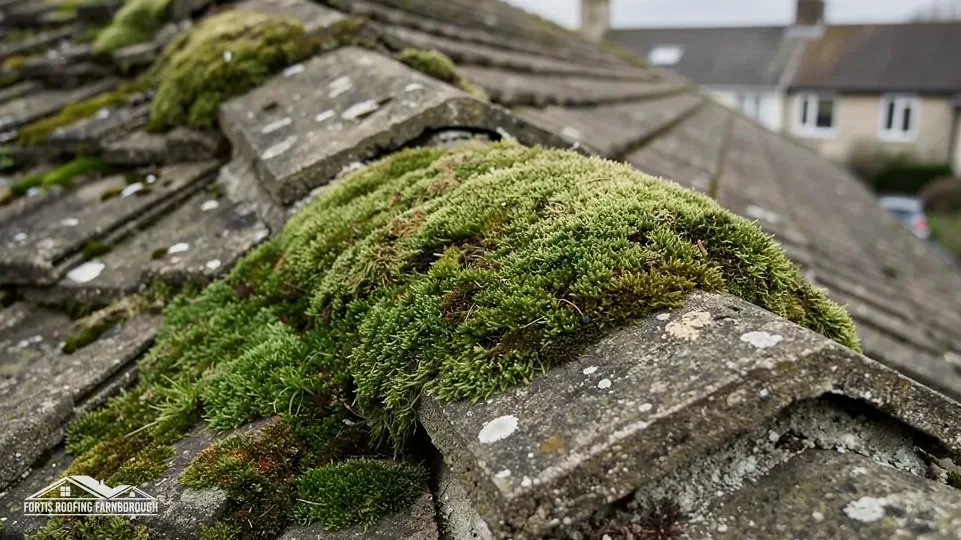
Moss, algae and lichen can stain clay and hold moisture against it. They are not always harmful in themselves, but a thick growth in the laps between tiles can send water the wrong way, and in a frost, trapped moisture can split a weak tile.
This guide sets out gentle cleaning methods for clay tiles, what to avoid, how frost-spalling looks, how long clay tiles are expected to last according to published sources, and when it makes more sense to replace tiles than to clean them, for roofs in Farnborough and the surrounding area.
What makes clay different from other tiles
A clay tile is fired through its full thickness. Its colour is in the body of the tile and in the surface skin formed during firing, so a lightly scuffed tile is not a ruined tile. That does not make clay indestructible. The surface skin is what resists water, and it is thinner and more brittle than people expect.
Plain tiles and pantiles
Plain clay tiles are small and each course overlaps the last, which gives moss a great many laps to lodge in. Pantiles are S-shaped and interlock, with a different pattern of gutters and ridges to clear. Both sit on battens and underlay that cleaning can disturb if it is rough.
Why method matters more than the product
Concrete tiles carry a surface coating, and clay carries its fired face. Either can be harmed by harsh treatment. On clay, what is lost cannot be recoated in the same way, so the damage lasts. Marley, a tile maker, says high-powered jet washing is not recommended because it can scar the tile face and cut the expected life of the roof considerably.
Look before you choose
Before any method is chosen, the roof is checked for cracked, loose and frost-damaged tiles, since cleaning will dislodge those. We also note the pitch, the access, the state of the gutters beneath and whether any lead or mortar details need care. Photographs of the roof sit alongside the quote, so the plan rests on what we saw.
Gentle cleaning methods for clay
The aim is to take off growth without taking the face off the tile. The gentler the method, the longer the tile lasts.
Hand removal and brushing
Moss that stands proud of the tiles can be lifted by hand or with a soft brush, working down the slope so that debris falls toward the gutter and not under the laps. A stiff wire brush is not suitable, because it scratches the face. Debris is caught before it blocks gutters and outlets.
Soft washing
Soft washing uses low pressure with an approved treatment that kills the growth and lets it die back on its own. The treatment is applied to the tile surface and left to work, and the dead growth is later brushed or rinsed away. Our guide to soft wash methods sets the gentler options beside the harsher ones.
Treatment products
A roof biocide has to carry an approval that fits both the surface and the person applying it. HSE's guidance is that householders should leave professional-only products alone. Our guide to roof biocide treatment explains how it works and how runoff is managed.
What to avoid
- High-powered jets, which scar the surface and force water under the tiles.
- Stiff wire brushes and scrapers.
- Standing or kneeling on tiles that are cracked or loose.
- Letting debris wash into gutters and downpipes.
Cleaning clay is slow work done well, and a quick job is usually a rough one. We say what the method is before work starts, and clear the gutters afterwards.
Frost-spalled tiles: what they look like
Spalling is when the surface of a tile flakes or peels away, leaving a rough, pitted or layered patch beneath. On clay, it is usually caused by water that has soaked into the tile and frozen, pushing the surface off.
How to recognise it
- Flakes or fragments of tile on the ground under the eaves or in the gutter.
- A rough, sandy or lighter patch where the colour has gone.
- A tile with an edge that has crumbled.
- A pattern that clusters on the cold north slope or low down near the eaves.
Why cleaning cannot fix it
Cleaning removes growth on the surface. It cannot restore a lost fired face. A spalled tile will go on absorbing water, and each freeze takes off a little more. Met Office averages for South Farnborough show around 53 air-frost days a year in the 1991 to 2020 period, so frost is part of the ordinary pattern here, not a rare event.
Telling spalling from staining
Lichen and algae stain a tile and leave its surface intact when removed. A spalled tile feels rough, and the damage is visible as texture. If a patch of what looks like lichen has a gritty, flaking texture underneath, the tile is probably spalled.
What to do
One or two spalled tiles can be replaced. A slope covered in them suggests the tiles are reaching the end of their life, which is a different decision. Our guide to roof tile replacement cost covers the smaller jobs.
Before cleaning any roof with spalling, ask for the tiles to be sorted first, since cleaning will dislodge the weakest ones.
How long clay tiles last
Published figures give a range, and none of them is a promise. They are useful for judging whether a roof is young, middle-aged or old.
| Source | Statement |
|---|---|
| HomeBuilding (Sep 2025) | Clay tile: 60 to 80 years |
| BRE, as reported by Marley | A minimum life expectancy of 60 years, for clay tiles only |
How to read the figures
The BRE figure belongs to clay alone and says nothing about other coverings. A clay roof of fifty years is not necessarily failing, and one of seventy is not necessarily sound. Condition matters more than age: whether tiles ring or thud when tapped, whether the battens are firm, whether the underlay has perished.
What cleaning does to life expectancy
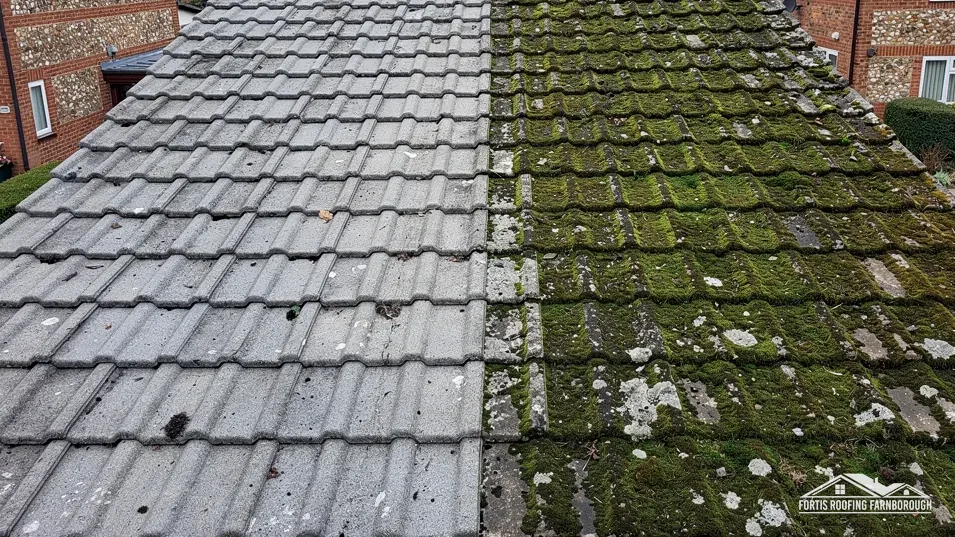
Gentle cleaning removes growth that traps water and costs the tile nothing. Harsh cleaning can cost years. That is the reason the method comes before the price. A roof blasted with a jet may look new for a season and then wear faster, which is damage, not a clean.
Pitch and the tile
Each clay tile has a minimum pitch. Marley lists 40 degrees for its Canterbury clay tile, 35 for Ashdowne, 30 for Hawkins and Acme Single Camber, and 15 for its Lincoln pantile. A tile used below its minimum pitch will let water in whatever its condition, and cleaning will not alter that.
If your roof is a Victorian or Edwardian terrace, ask for the tile maker and age to be noted on the survey. Basingstoke and Deane's Article 4 advice for its four town-centre areas says original roof materials such as clay tiles should be kept, which is a reminder that a conservation-area house needs a check before tiles are swapped for something else.
When replacing beats cleaning
Cleaning is the right choice when the tiles are sound and the growth is the problem. Replacement is the right choice when the tile itself is failing. The two jobs are often confused.
Replace when
- Tiles are spalled or crumbling across a slope.
- Many tiles are cracked, or have lost corners and edges.
- Battens beneath are soft, so that tiles cannot be held.
- The underlay has perished, so cleaning would be above a leak waiting to happen.
Clean when
- Tiles are hard, flat and ring when tapped.
- Growth sits on the surface and in the laps.
- The roof lines are straight and the ridge and verge are sound.
Individual tiles
Replacing a few tiles is a small job. Which? gives £75 to £400 ex VAT for putting right up to six standard tiles (Nov 2025), and MyJobQuote gives about £215 for five (Oct 2026). Both are typical UK ranges. Matching an old clay tile can take time, and reclaimed tiles are one option.
When the whole slope is tired
If the tiles are tired, a relay on new battens and underlay with the good tiles reused is often better value than repeated repairs. Which? gives £7,000 to £21,000 ex VAT for an average three-bedroom house re-roof (Nov 2025), and HomeBuilding gives £10,000 to £15,000 for plain concrete tiles on a 65 m² semi (Sep 2025). The sources differ widely, so a survey matters.
Our roof cleaning and moss removal work starts with the tiles, since cleaning a roof that needs repair only moves the bill.
Gutters, runoff and what happens after cleaning
Cleaning moves growth off the roof, and it has to go somewhere. How it is handled decides whether a clean roof causes a blocked gutter.
Catching the debris
Moss that is lifted off a slope falls to the eaves and into the gutters. Clear the gutters before and after, and keep downpipe outlets open. A gutter full of wet moss overflows and can soak the fascia and soffit, which is the real damage route for moss. Our guide to moss in gutters explains the chain of events.
Treatment runoff
If a treatment has been used, runoff carries it to the drains and the garden. Plants, ponds and vegetable beds should be kept clear, and the label's instructions followed. Rainwater goods and paving can be rinsed once the product has done its work, as the label directs.
Regrowth
Moss comes back where the roof is damp and shaded. Light, airflow and trimmed branches slow it down. A clean roof starts regrowing within a season or two in the worst spots, and a treatment slows it rather than stopping it. Regrowth on one slope does not mean the work failed.
The check that follows
Once the tiles are clean, they can be checked properly, which is when slipped tiles, perished mortar and hairline cracks show. Photographs before and after go into the record. If repairs are needed, they are priced as part of the one total after the survey, and the tiles are dealt with before any treatment goes on.
Maintenance of this kind is cheaper than the repairs that follow when it is neglected, and a roof looked at once a year rarely arrives at a big bill by surprise.