The short answer
Moss often grows along the ridge, and when it is cleared the mortar beneath can turn out to be crumbling, cracked or gone. Perished bedding no longer holds the ridge tiles or keeps water out. The fix is to re-bed the tiles with mechanical fixings, or to fit a dry-fix ridge system. Cleaning did not cause the fault, it only showed it.
What cleaning reveals at the ridge
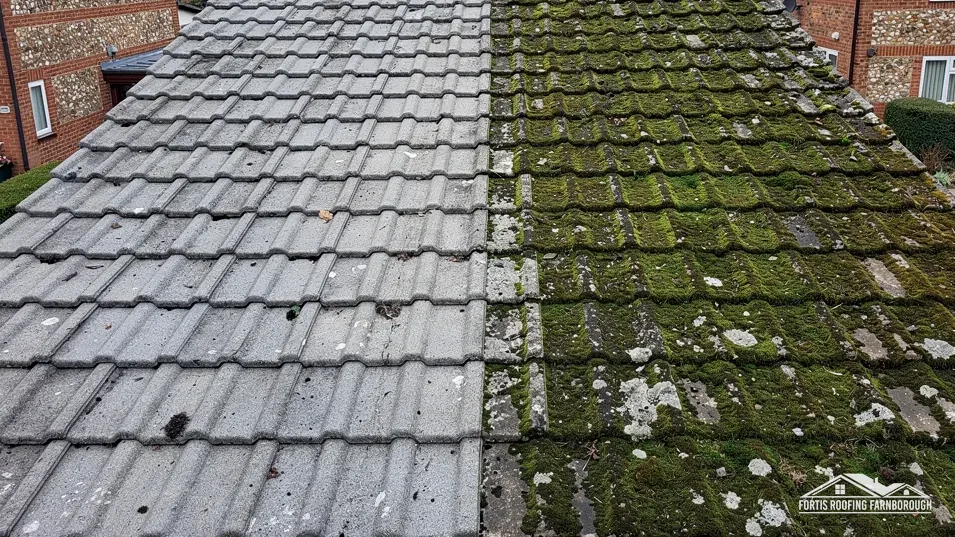
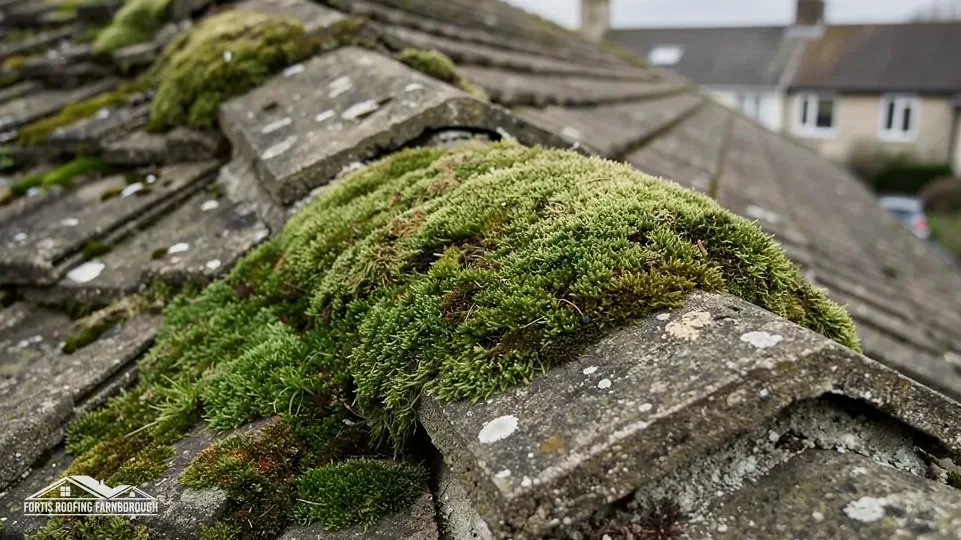
Mortar and moss are often partners. Moss grows readily on a rough, damp mortar bed, and it can also grow in cracks and along the joint between ridge tile and slope. A thick green line along the ridge may be covering a bed that has failed.
Once the moss is lifted, the evidence appears. The mortar may be powdery and soft, split along its length, shrunk away from the tiles or missing in places, with daylight showing beneath the ridge tiles. Some ridge tiles may rock when touched. Fragments of mortar often turn up in the gutters, which is a clue seen from the ground.
The fault was there before the clean. Mortar perishes with age, frost and the long cycle of heating and cooling, and moss does not help it, because it holds water against the bed. Cleaning exposes the condition, and a roofer who inspects the ridge before cleaning can warn you what to expect.
A perished bed lets water into the roof space under the ridge, and it leaves tiles loose in the wind. Neither is a matter to put off. Our page on repairs after moss removal covers the wider set of things a clean can show.
It is worth checking the hips and verges too, since they share the same kind of bedding.
What BS 5534 and Marley say
The standard that governs how roof tiles are fixed is BS 5534, currently BS 5534:2014+A2:2018. Marley points out that installing to it is not required by law, though it is the benchmark for careful work.
The 2014 revision matters here. Marley reads that revision as ending the old assumption that mortar strength by itself would hold ridge and hip tiles. It marks a real change from the days when a ridge was simply bedded in mortar and left to it.
The practical meaning is simple. A ridge tile should be held by more than its mortar bed. Mortar is not banned, and it still seals and fills the joint, but a mechanical fixing, such as a screw, a clip or a bracket, should carry the load.
So a ridge that has only ever had mortar may never have been fixed to the current standard, even before the bed perished. Finding that out is another reason to look closely when the moss comes off.
BS 8612:2018 is the specification that tests dry systems at the ridge, hip and verge, and those systems are the alternative to a wet bed. Our page on dry ridge versus mortar compares the two approaches in general, while this page deals with what you do after the bed has failed.
Re-bed or dry-fix
With the old bed gone, there are two routes.
Re-bedding keeps the traditional look. The ridge tiles are lifted, the old mortar is cleared, and the tiles are re-laid on fresh mortar, with mechanical fixings added so the bed is no longer the only thing holding them. It suits a short run, or a roof where the look matters, such as a listed or conservation-area house.
A dry-fix ridge replaces the wet bed with clips, screws and a vented trim. There is no mortar to crack, and the system lets the roof space breathe at the ridge. It suits a long ridge that has failed along its length, or a roof where the owner wants to avoid doing the job again. The system must be made for the tile and pitch in question, so the data sheet matters.
Both are sound if done properly. The choice turns on the length of ridge, the tile, the look and the budget. In the Which? guide (Nov 2025), a new ridge tile is £80 to £300, ex VAT, and MyJobQuote (Oct 2026) puts ridge work at £225 to £550. Both are national guide ranges rather than our prices, and access moves them.
Our page on ridge tile repair cost goes through the figures.
If a ridge tile is loose and might fall, it should be secured first, and the lasting repair follows.
What we do
We inspect the ridge from a ladder or by camera, before cleaning if we can. You see photographs of the mortar, the tiles and the joint, so you can see what has perished and how far it goes.
If the bed has failed along a short length, we re-bed that and fix the tiles mechanically. If it has failed along the whole ridge, we put both options to you, with the reasons, and recommend the one that suits the roof.
The cleaning and the ridge repair can be arranged together, which saves setting up access twice. We clean gently, with an approved product to its label and no jet washing, since Marley advises against it.
If the tiles beneath are sound, the repair stays small. If the ridge board or battens have rotted, that is found and priced before work starts, not discovered halfway through.
Our quote is a single written sum. The roof cleaning and moss removal hub explains the service for nearby roofs.