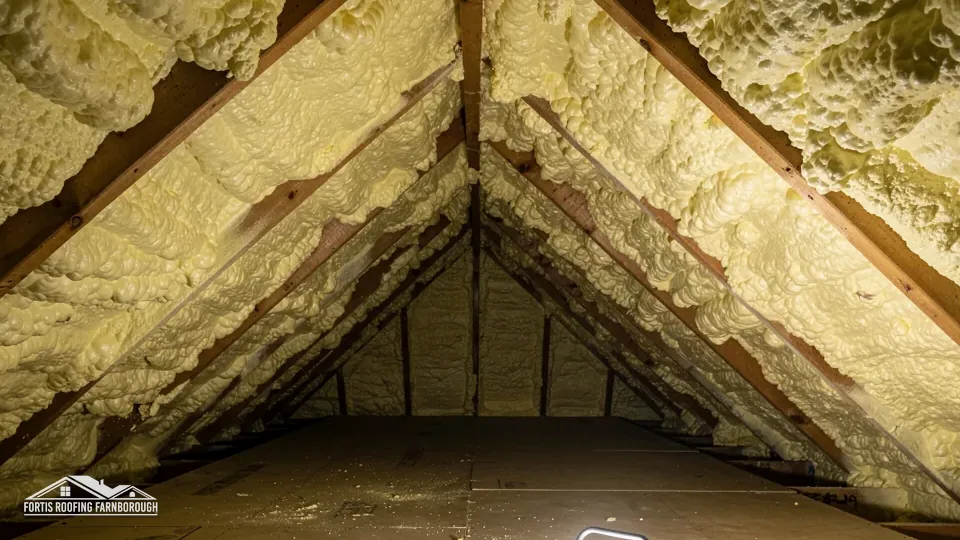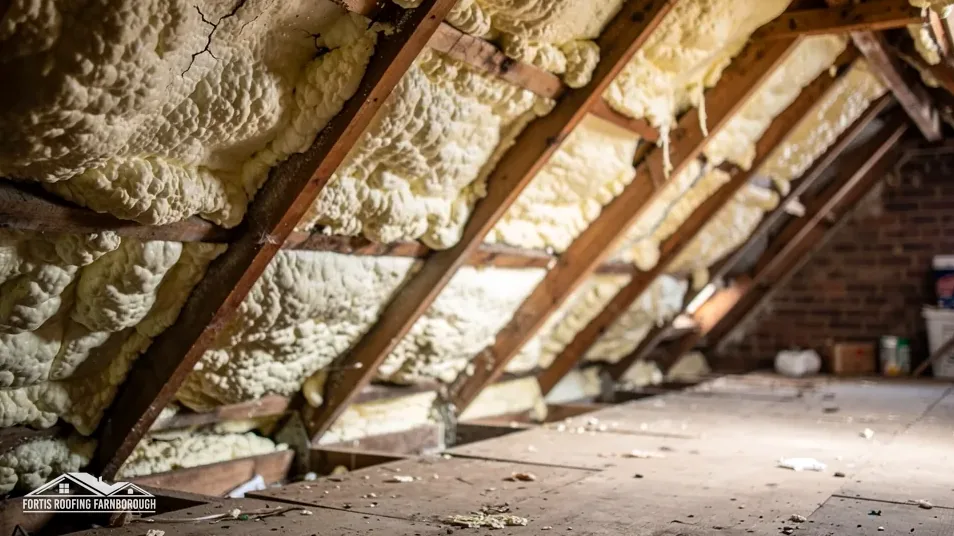
Spray foam was sold for years as a quick, effective way to insulate a roof from below. It fills gaps, stops draughts and goes on in a day. Over time, a different set of questions has come to the fore. Surveyors cannot see what is behind it. Some lenders have raised concerns. Buyers ask what is under it. And where roofs have developed leaks or damp, the foam has made them harder to diagnose.
Those questions, not any single failure, explain why a growing number of owners are asking about removal. The reasons differ from house to house. A person remortgaging has one concern, a seller facing a survey has another and an owner with a damp patch on a ceiling has a third.
Below: the main reasons people remove spray foam, what RICS said and when, how each reason plays out, who may do better leaving it, what removal involves and how to decide for your own roof.
Reason one: the timbers cannot be seen
The reason surveyors raise most often is simple: they cannot inspect what is covered.
What RICS says
In its March 2023 consumer guide on spray foam, RICS makes the point that a roof structure under foam escapes full inspection. A surveyor reporting on a house is paid to judge its condition, and a roof they cannot examine leaves a gap in the report.
What that means in practice
The survey may say the roof structure could not be inspected, and recommend further investigation. A buyer reading that wants reassurance. A lender reading it may want a specialist report. The foam has made the roof an unknown.
Why people respond by removing it
Taking the foam off is the only way to see every timber. Owners who want certainty, for a sale or for themselves, may decide to do it. Our guide to spray foam surveys explains what a survey can and cannot reveal first.
Not everyone needs to
A roof can be sampled and inferred about. If the visible timbers are dry and the roof is ventilated, many owners leave the foam and carry on. Removal is a response to an unanswered question, and not every owner has that question.
An example
A buyer instructs a surveyor on a three-bedroom house. In the loft, the surveyor finds foam on every rafter and no way of seeing the wood. The report notes that the roof structure could not be inspected. The buyer asks the seller what is under the foam. Nobody knows, because nobody has looked. That chain of events, repeated across many sales, is what has turned a technical point into a practical one.
Reason two: moisture and ventilation worries
The same guide cautions that insulation installed wrongly can upset a roof's ventilation and cause moisture damage. That is the second driver.
How it arises
Roof timbers last when they stay dry. Foam that blocks the eaves, covers a leak or seals damp timber can interfere with how a roof dries out. Our guide to whether spray foam can damage roof timbers goes through the mechanisms.
Signs that prompt action
- A musty smell in the loft or the rooms below.
- Stains on ceilings that appear after rain or cold spells.
- Condensation on roof windows or the loft hatch.
- Dark or damp patches on the foam.
- Slipped tiles or gutter problems that suggest water entering.
Caution
These signs have other causes. Moisture problems in lofts are common with or without foam. What foam adds is difficulty: it can hide the evidence and slow diagnosis. An owner who sees signs may choose removal to find out.
Leaks
If the roof leaks, spraying more foam over it is not the answer. On spraying foam over a leaking roof, the Energy Saving Trust (page last updated 8 May 2026) says: "We don't recommend doing this." Our guide to spray foam on a leaking roof explains what to do instead.
Weighing the risk
The risk is not the same for every roof. A foam layer laid on a sound, dry roof with good ventilation behaves very differently from one laid over a leak. Without inspection you cannot tell which you have, and for some owners that uncertainty is enough reason to look.
Monitoring as an alternative
Where there are no signs, an owner can watch the loft and rooms below each season, keep dated photographs and have moisture readings taken occasionally. That does not remove the question, but it can keep it in proportion.
Reason three: lenders, buyers and sales
Money matters drive many removals. The concern is less about the roof than about who will lend or buy.
The press release
RICS announced its guide in a press release of 3 March 2023, with the guide itself dated 31 March 2023. The release reported unease in some lending sectors, equity release first, which by then was affecting lenders more broadly.
The advice
Owners are advised to ask their own mortgage provider what its policy says about such products. Anyone with foam, or thinking of fitting it, therefore has a question for their lender.
What it does not say
Nowhere does it claim that lenders refuse, or that foam has to come out. Policies differ, and some lenders will lend. But an owner who wants to remortgage, release equity or sell to a buyer with a cautious lender may find removal the simplest way to take the issue off the table.
Buyers
Buyers whose surveyor flags foam may ask for a price reduction, a specialist report or removal before exchange. A seller who has already dealt with it can move faster. Our guide to selling a house with spray foam covers the choices.
Nobody can promise
Removal improves your position with lenders and buyers, though it cannot guarantee a particular mortgage or sale.
Equity release and later life
Because the RICS release named equity release as the first area of concern, owners considering that route should ask their provider early. Finding out after an application has started can delay it, and finding out before gives time to survey or remove.
Other reasons owners give
Beyond the three main drivers, several practical reasons come up.
Roof repairs
A roof that needs re-tiling, a new underlay or timber repairs is hard to work on with foam bonded to the back of the covering. Removing it first, or at the same time, lets the work be done properly. Our guide to repairing or re-roofing after spray foam removal explains how the decision is made.
A foam installation that went wrong
Some foam was applied unevenly, too thick, onto damp timber or without regard to ventilation. Owners who discover this later may want it taken out and redone.
Loft conversions and extensions
Plans for a loft room or an extension can be complicated by foam in the roof, which has to be dealt with to meet fire, structural and thermal requirements. Removal can simplify the design.
Solar panels and other fixings
Fixings through a roof need to bond to sound timber, and foam may complicate access to rafters. Some installers ask for a clear view of the structure.
Changing the insulation approach
An owner may prefer a conventional build-up with known performance and standard ventilation, and choose to replace foam on principle.
Wanting to know
Some owners simply want certainty that the roof is sound. That is a fair reason, though it carries a cost.
None of these makes removal necessary for everyone. They explain why the question keeps arising.
Insurance and warranties
Some owners find that an insurer or an installer's warranty has conditions that touch on the roof. It is worth reading the paperwork and asking questions, since a surprise at claim stage is hard to fix.
When leaving it in place is reasonable
Removal is a significant job, and not every owner needs it. The balance of evidence and circumstances decides.
Signs it may be fine to leave
- No signs of moisture, leaks or damp in the loft or rooms below.
- A sound roof covering, with no slipped tiles or failed flashings.
- Ventilation that is not blocked by the foam.
- Foam installed in line with the roof's design, with paperwork.
- A lender who has confirmed in writing that it is content.
- No plans to sell or remortgage soon.
A middle course
Commission a survey and sample moisture readings, keep records and monitor the loft and rooms below each season. If anything changes, revisit the decision. Partial removal, in an area of concern, is another option.
What to keep
The installer's paperwork, any survey, dated photographs and notes of what you checked. They support a calm conversation with a buyer or lender later.
Cost
What removal costs turns on the foam, the area and the access, so a survey comes before any price. Our guide to what decides the cost of spray foam removal sets out the drivers.
What partial removal looks like
Some owners remove foam from one area only, such as the section over a stained ceiling or the eaves. It gives a direct look at the most likely trouble spots at lower cost, and it tests the roof's overall state. If the exposed timbers are sound, the rest of the foam may stay. If they are not, the case for full removal grows.
Making the decision
Weigh the evidence, your lender and your plans. Our spray foam removal service starts with a survey, so the choice is made on facts.
A short checklist for deciding
If you are still unsure, these questions help to focus the decision. Answer them honestly, and add up where the weight falls.
About the roof
- Have I seen any signs of damp, leaks or condensation?
- Does the roof covering look sound from outside?
- Do I know what type of foam I have, who fitted it and when?
About money and plans
- Am I planning to sell, remortgage or release equity soon?
- Has my lender or a buyer asked about the foam?
- Am I planning roof repairs, a loft conversion or solar panels?
About information
- Do I have the installer's paperwork and any building control record?
- Has anyone inspected the timbers, and what did they say?
Reading your answers
If you have no signs, no plans and good paperwork, leaving the foam and monitoring is reasonable. If you have signs, plans that involve a lender or buyer, or missing paperwork, a survey is the sensible next step, and removal may follow. If the survey finds problems, repair and re-insulation become part of the plan.
Whichever way you lean, write down your reasons and keep the answers with the records for the house.