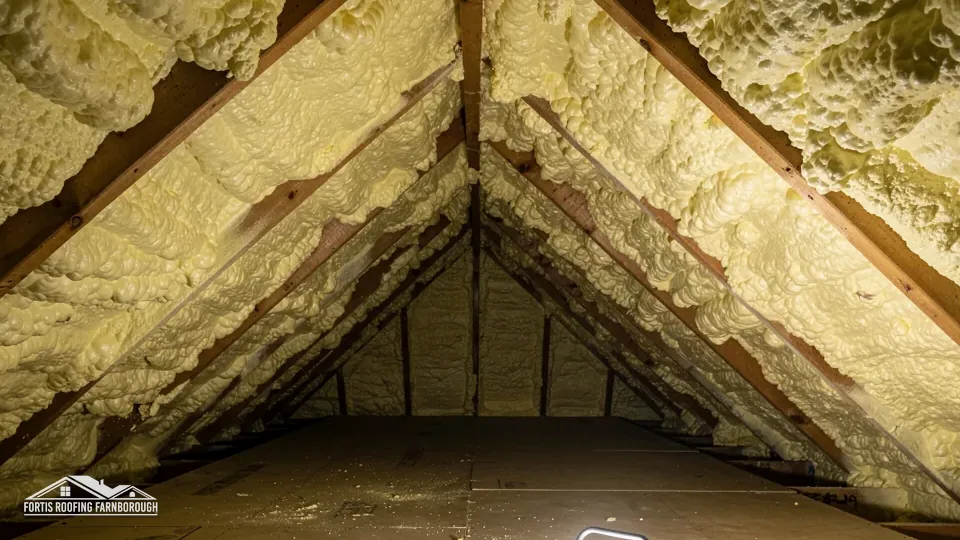
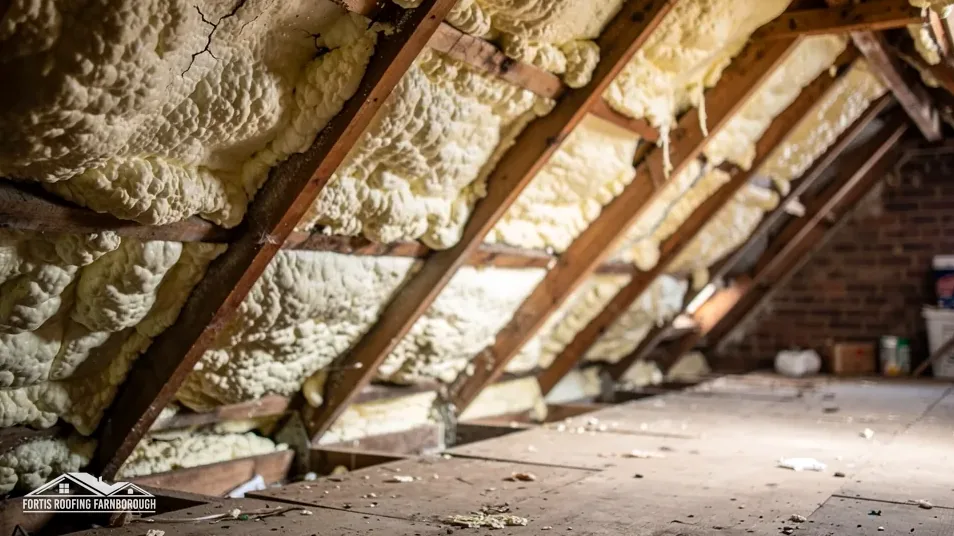
The short answer
A flat roof is built differently from a pitched one, and foam can upset it. Cold deck flat roofs rely on a ventilated void above the ceiling, and foam that fills it ends that airflow while the timber deck above stays cold. Any hidden moisture then has nowhere to go. An inspection of the deck underside is the way to find out.
Cold deck roofs and why foam is a risk
Many older flat roofs are cold deck designs. From the bottom up come the ceiling, then insulation, then an air void with vents at the edges, then the roof deck with its waterproof covering on top. The moving air in that void carries off moist air that has risen from the house.
Approved Document C expects a roof to resist rain and avoid harm from condensation within its structure, and paragraph 6.11 says that ventilation of cold deck roofs meets the requirement. If foam fills that void, the airflow stops. The deck above is now cold, and any warm moist air that reaches it condenses on the timber with no way to escape.
The risk rises if the foam has gaps, if the ceiling below is leaky, or if the roof covering already lets in water. Moisture builds up unseen and the timber deck can rot. A flat roof's joists, being horizontal, also hold water for longer than a sloping rafter does.
RICS makes a general point that fits here: insulation installed incorrectly can harm ventilation and bring on moisture damage. A flat roof is a case where the detail counts for more than usual, and the Energy Saving Trust (updated May 2026) takes the same cautious line on roofs already letting water in.
Warm deck designs, with insulation above the deck, behave differently, and the roof's construction decides which applies.
Finding out what you have
First identify the construction. Check the roof edges and fascia for vents, ask whether a loft-like void sits above the ceiling, and look for plans or paperwork. A roofer can often tell from a small inspection opening.
Then check the signs. Stains or soft patches on the ceiling, mould in the corners of the rooms below, a musty smell, and dark patches at the ceiling edges all point to damp. On the outside, ponding water, blistering or splits in the covering and a roof that feels spongy underfoot show the covering is failing. BS 6229:2025, the current code for flexible-membrane flat roofs up to 10 degrees, keeps a minimum finished fall of 1:80, and a roof that holds water has lost its fall.
An inspection is the answer. A small section of the ceiling or of the foam is opened so the deck underside, the joists and the insulation can be seen. Moisture readings and photographs record the condition. Where access is poor, more than one opening may be needed.
Our answer on spray foam and condensation explains the moisture mechanism in more detail.
Flat roofs also need regular care outside: clear outlets, sound upstands and an intact covering.
Removal from a flat roof
Removing foam from a flat roof is harder than in a loft. The space is shallow, often only the depth of the joists, and the foam is packed between them with little room to work. Access may be through the ceiling, which has to be opened up and made good afterward, or from above if the covering is to be renewed.
That points to the question of the covering. If the deck is sound but the covering is tired, taking the foam out and laying a new roof together can be sensible, as one operation. EPDM has a typical life of 25-30 years per HomeBuilding and 30 to 50 years per Less, and sources differ, so the age of the roof is worth weighing.
If the deck has rotted, boards or joists must be replaced, and the structure restored before it is insulated again. Part L treats a new flat-roof waterproof layer as renovation, which brings the insulation back into question, with 0.16 W/(m²·K) the improved figure in Table 4.3.
The replacement design needs thought. A warm deck, with rigid insulation above the deck, removes the ventilation problem, and a cold deck needs its void and vents restored. Our answer on whether spray foam can be removed sets out the general method.
What we do and what to ask your lender
We survey the roof from inside and out, find the construction, photograph the foam, the deck and the covering, and take moisture readings where we can open the structure. You then see what is happening, with pictures, and decide.
The options run from monitoring a roof that proves dry, through partial removal and repair, to full removal and a new roof build-up. The right one depends on the findings. A flat roof with foam and a failing covering is a stronger candidate for replacement than one in good order.
If a mortgage is involved, ask your provider early. Lender caution over foam began in equity release, RICS reported in March 2023, and valuers elsewhere may ask the same questions. A flat roof with foam is likely to attract a closer look from a valuer, because the risk of hidden damp is higher.
We keep the records. A report with photographs of the exposed deck is useful evidence for a lender, a buyer or an insurer. We cannot say what any of them will decide.
See spray foam insulation removal and our flat roofing service for the wider work. A written total follows the survey.