The short answer
It can, if the foam is badly installed or fitted where the roof needs to breathe. Foam that seals off the eaves and ventilation path, or traps damp air against cold timber, can leave moisture with nowhere to go. RICS cautions that badly fitted foam can interfere with airflow and bring on moisture damage. A loft inspection shows whether yours is affected.
How foam can change the moisture picture
A traditional cold roof is insulated at ceiling level and left cold above it. Air flows in at the eaves, passes through the loft and leaves near the ridge, carrying off the water vapour that rises from the house. Approved Document C, paragraph 6.2, wants roofs to keep rain out and to avoid damage from interstitial condensation, which is condensation forming inside the build-up.
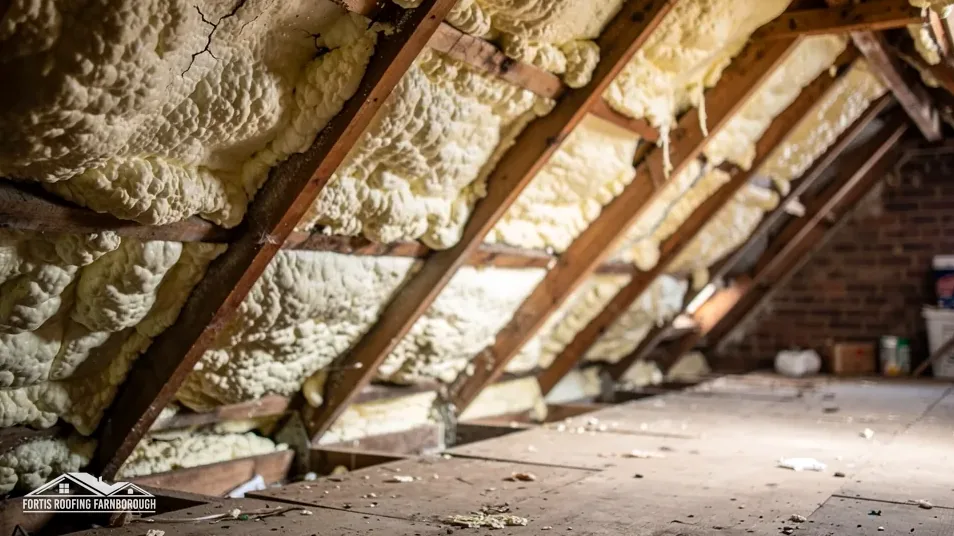
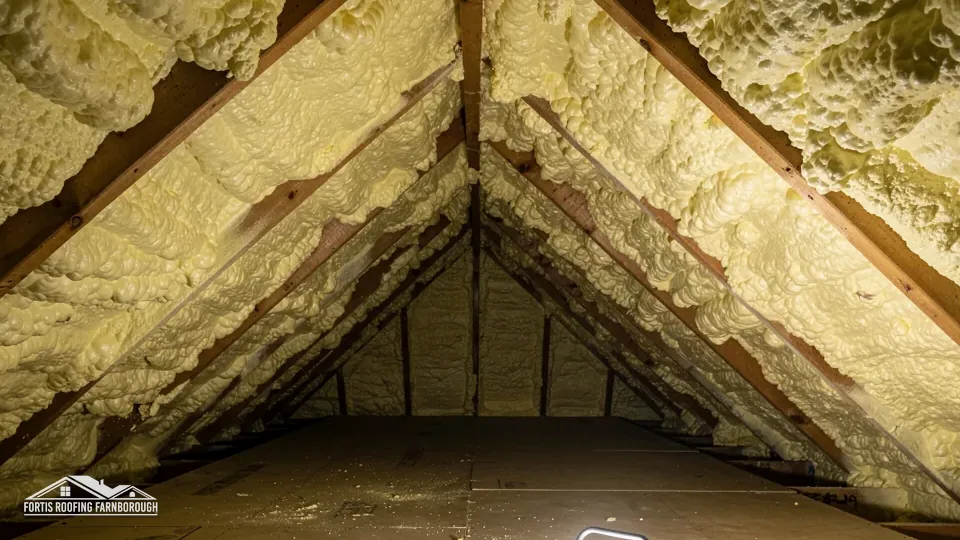
Foam sprayed beneath the covering and between the rafters changes this. It turns a cold, ventilated roof into a sealed, insulated one, and it often blocks the eaves and ridge vents that used to do the work. If the foam is complete and airtight, little moist air reaches the timbers. If it has gaps, or stops short of the eaves, warm air can reach cold surfaces and condense behind it where nobody can see.
RICS states the risk in its consumer guide: insulation that is wrongly installed can hurt ventilation and lead to moisture damage. In plain words, the airflow suffers and damp stays in.
Not every foamed roof has a problem. The Energy Saving Trust says the risk of timber rot should be much lower with open-cell foam, and a well-detailed job may perform well. Our guide to open and closed cell spray foam explains the difference. The issue is hidden damp where the detail is wrong.
Hidden damp and how it shows
The difficulty is that foam hides what is happening to the timber. Rafters buried in foam cannot be seen, and damp behind them may run for years. When signs appear, they are often indirect.
Indoors, look for damp or mould on the ceiling or the upper walls, stains that follow the line of the rafters, a musty smell in the upstairs rooms, and condensation on windows that does not clear. In the loft, if the foam is exposed, look for water marks on the foam surface, discolouration at the edges, timber ends that are dark and damp where the foam stops, and rusting nails showing through the covering.
Outside, slipped or damaged tiles, algae in patches and staining below the eaves can all point to moisture, though they have other causes too.
Condensation is easily confused with a leak. A leak follows rain and shows in one spot. Condensation appears on cold mornings and in damp conditions, and it can spread widely. Our answer on ventilating a slate roof explains how the two differ, and the principle is the same for other coverings.
The Energy Saving Trust (updated May 2026) advises against foam on a roof that leaks, because water held beneath it cannot escape and can rot the structure.
What Marley's figures tell us about airflow
Manufacturers give ventilation figures for traditional roofs that show what foam can displace. Marley's BS 5250 figures show the scale. Over HR (non-breathable) underlay, a cold roof needs 25mm of eaves gap up to 15 degrees of pitch and 10mm above. Breathable LR underlay over a tight ceiling can manage on 3mm of incidental gap, if the product is third-party certified.
Foam often fills those gaps. A roof designed for a 10mm eaves vent that is now packed solid has lost its air path, and any underlay beneath the covering is no longer doing what it was chosen to do. The current moisture code, BS 5250:2021, is under review, and it sits behind these practical figures.
That is why a foamed roof should be assessed as a system. Is the foam continuous? Is the covering dry? Is there an underlay, and what type? What happened at the eaves and at the ridge? Is the ceiling below airtight, or does warm air leak into the roof?
The answers decide whether the foam is working or storing trouble. Without a survey, no one can say, and the roof may look perfectly fine from the garden.
Checks, and what to do next
Start with the signs. If you see mould, staining or a musty smell upstairs, or if the roof is leaking, tell a surveyor or roofer. A damp roof structure gets worse with time, and early checks are cheap.
A loft survey photographs the foam and its edges, studies the covering from inside, notes the underlay and eaves, and uses a moisture meter where timber can be reached. Where it cannot, a small opening or a section of foam taken out may be proposed, so the timbers can be examined.
The result can be reassuring. Dry timber and a sound covering mean the roof is coping. Where damp is found, the options run from repairing the cause to partial or full removal, and our answer on whether spray foam can be removed covers what that involves.
If you are selling or remortgaging, raise it with your lender early, and keep the survey and photographs for them.
You get facts and photographs, not alarm, and any work is priced as a single written total. See spray foam insulation removal for the service.