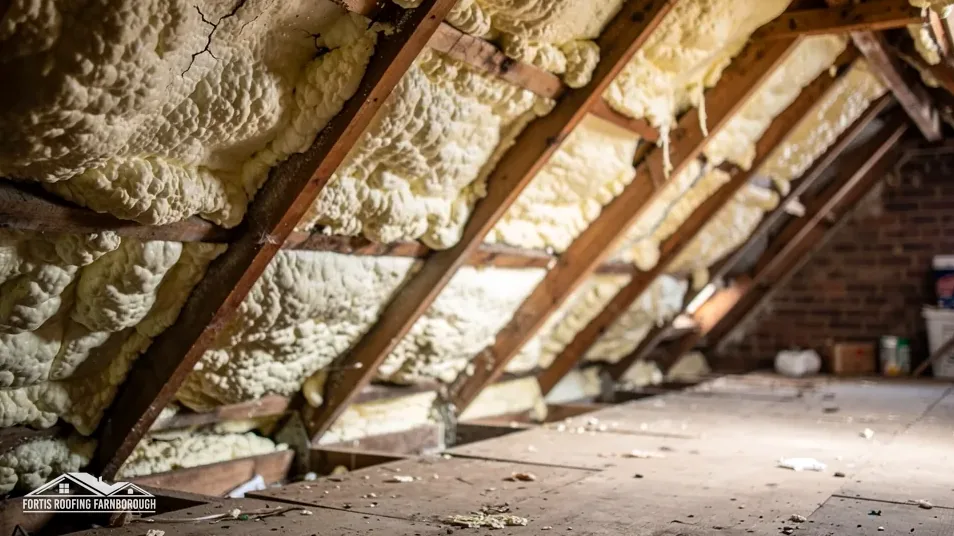
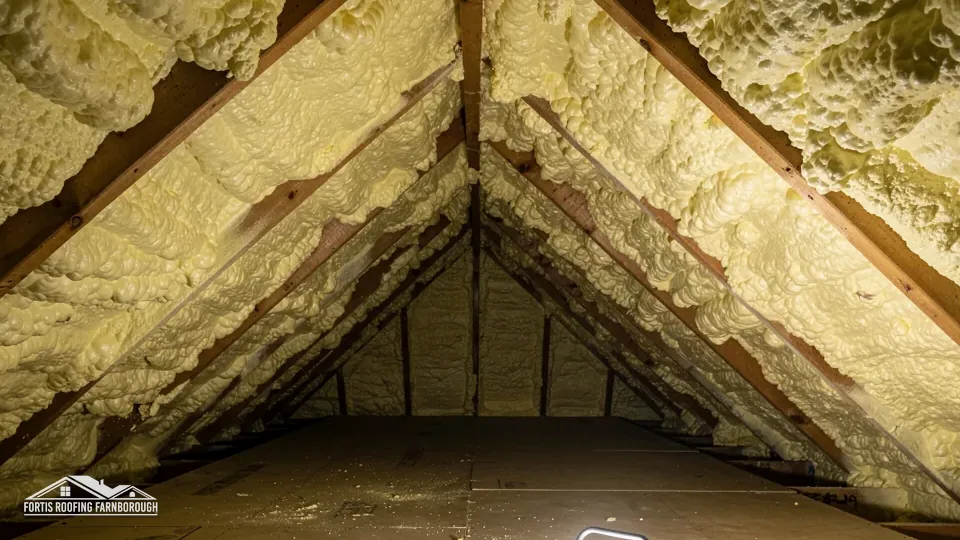
Spray foam insulation is applied as a liquid that expands and sets, bonding to whatever it is sprayed on. In a roof, that is usually the underside of the tiles or the underlay and the rafters. The result is a continuous layer that fills gaps and stops draughts, which is why it became popular for roofs that are awkward to insulate any other way.
There are two broad types. Open-cell foam has tiny cells that are not sealed, so it is soft and spongy and lets air and vapour move through it more freely. Closed-cell foam has sealed cells, so it is firmer, denser and less permeable. The difference shows up in how the foam behaves in a roof and in how hard it is to take out.
Below: the two types in general terms, what RICS says about spray foam in roofs, how each bears on moisture and ventilation, what the type means for inspection and removal, and what to check before deciding, for homes around Farnborough.
The two types in general terms
The descriptions below are general, and individual products vary. The product's data sheet gives the exact properties, and the installer's paperwork, if you have it, says which was used.
Open-cell foam
Open-cell foam is light and soft, rather like a firm sponge. It expands a great deal when sprayed, so a thin application fills a deep space. It is relatively permeable, which means water vapour can pass through it. It is less rigid, and it can be cut with a knife or scraped away more easily than the dense type.
Closed-cell foam
Closed-cell foam is denser and harder. Its cells are sealed, so it resists the passage of air and vapour, and it adds some stiffness to what it is bonded to. It insulates well for its thickness. It sets hard, and it adheres firmly to timber, tiles and underlay.
Why people chose each
Closed-cell foam was often chosen where a thin layer was needed or where moisture resistance was wanted. Open-cell was chosen for its expansion and lower cost per volume. In practice, installers sometimes used one or the other without explaining the consequences to the owner.
How to find out which you have
Look at the paperwork from the installation, if any, for the product name and data sheet. Failing that, a surveyor or roofer can usually tell by pressing it: a soft, springy surface suggests open-cell, a hard, rigid one suggests closed-cell. Photographs help.
Neither type is wrong in every roof. What matters is how it was installed and what it covers.
Where the foam sits
In a roof, foam may be sprayed to the underside of the tiles, to the rafters or to the underlay. Its position decides how far timbers are covered and how hard removal will be. A thin coat on the underlay is a different job from a deep layer encasing every rafter.
What RICS says that applies to both
The RICS consumer guide dates from March 2023: the press release is dated 3 March 2023 and the guide shows 31 March 2023. It deals with spray foam as a whole, so its main points hold for either type.
Hidden timbers
The guide's point on timbers is that a roof structure buried in foam cannot be fully seen. Whichever type is bonded to the rafters, the surveyor is left judging wood they cannot look at.
Ventilation and moisture
It adds a warning about installation: done badly, insulation can disturb ventilation and lead to moisture damage. That risk comes from how the job was done and how the roof is built, more than from the foam type.
Lenders
On lending, RICS reported unease in some sectors, with equity release the first example, and the guide points owners to their own mortgage provider for its policy. Our guide to selling a house with spray foam covers what that means for a sale.
Reading the guide in practice
For most owners the useful lesson is practical. Find out what is under your roof, find out whether anyone has been able to inspect the timbers since it went in, and ask your lender what it needs. Those three answers shape what happens next, whichever type of foam you have, and they cost far less than guessing.
What the guide does not say
It stops short of any blanket instruction to strip foam out, and it makes no claim that lenders turn homes down. Its message is that surveyors cannot see under the foam and that you should ask your lender, which is a sound basis for any decision.
Treat the RICS guide as the starting point, and a survey of your own roof as the next step.
Why the paperwork matters
Surveyors, buyers and lenders ask what foam was used, where and by whom. A product name and data sheet answer most of those questions in a line. Without them, the foam has to be identified from the roof side, and the report will say what could not be confirmed.
Moisture and ventilation: how the types behave
The foam type matters through its effect on moisture, and the details of the roof matter equally.
Permeability
A permeable foam lets some vapour pass, and a sealed one blocks it. In a roof, vapour from the house tries to rise and escape. If it is blocked in the wrong place, it can condense on a cold surface. If it is allowed through, it can reach timber and settle there. Neither is automatically safe.
Ventilation
Traditional cold roofs rely on air moving through the roof space, with eaves ventilation set by the underlay type. Marley's BS 5250 guidance for an HR (non-breathable) underlay sets eaves openings of 25 mm up to a 15° pitch and 10 mm above it. Foam sprayed to the underside of the roof covering can close those paths, whichever type it is.
Cold surfaces
Where foam is applied to the underside of a roof, it moves the cold face to the outside of the foam. The timbers behind it may then be colder than before, or isolated from room heat. Whether that matters depends on the build-up and whether moisture can get in from above.
Leaks hidden by foam
A small leak above foam can soak into the layer or run along it and out of sight. The timbers may be wet for a long time before anyone knows. That risk exists with either type.
What this means
Moisture problems come from the combination of foam, roof design and installation. Our guide to whether spray foam can damage roof timbers goes further into the risk.
Heat and the roof covering
Foam bonded to the back of tiles or slates can also affect how the covering is inspected and repaired. A tile that needs replacing may have to be freed from the foam first. That is a practical cost of leaving it in place that is easy to overlook.
What the type means for removal
Removal is mostly a matter of how firmly the foam is bonded to what is behind it, and the two types differ.
Open-cell removal
Soft foam can be cut away with knives and scrapers, pulled off in pieces and cleaned from timber with hand tools. The work is slow and dusty, and it needs careful protection of the surfaces, but it tends to be less destructive. Fibres and fragments need to be collected as they fall.
Closed-cell removal
Dense foam bonds hard. It may need to be cut, chiselled, scraped or ground away, and it can take part of the surface with it. It is the more laborious of the two, and the greater effort risks scarring timber or lifting the underlay.
Re-roofing and repairs
If the roof is also due a repair or a re-cover, foam bonded to the underside of the tiles can make that harder. Stripping tiles with foam stuck to them takes longer, and some tiles break. Planning removal and re-roofing together can save a second set of access costs. Our guide to repairing or re-roofing after spray foam removal explains how the decision is made.
Residue
Either may leave residue on timber and tiles. Cleaning back to a sound surface takes time. A roofer or specialist will say how clean a finish is possible.
Waste
Removed foam is waste that has to go to a suitable disposal route. The contractor should say how it is handled.
Cost
The cost of removal rests on the type, the area, the access, the bond and what is found underneath. Removal is priced on type, area, access, bond and what lies beneath, so the survey and one written total settle the figure. Our guide to how spray foam removal works goes through the steps.
Can it be left?
Not every roof needs the foam taken out. That decision rests on the survey, the roof's condition, the lender and your plans, not on the type alone.
Safety and dust
Cutting and scraping foam makes dust and fragments. Protective equipment, dust control and careful collection are part of the job, and the loft is cleared of belongings first. The contractor should say how the work will be protected and how the waste leaves site.
What to do before you decide
A sensible route has a few steps, whichever type of foam you have.
Find the paperwork
Look for the installer's invoice, data sheet, warranty paperwork and any building control record. Note the date, the product and the area covered. If you are buying, ask the seller for these.
Get a specialist survey
Our guide to spray foam surveys explains what is checked: the type, the extent, the condition of accessible timbers and the ventilation. A survey of the visible parts is possible, and the limits are stated in the report.
Talk to your lender
RICS advises owners to check with their mortgage provider about its policy. If you are remortgaging, selling or using equity release, the answer may affect your plans.
Weigh the options
- Leave the foam and monitor, if the survey finds no problem and your lender is content.
- Remove it partly, in places where timbers need inspection.
- Remove it fully and re-insulate to current standards.
Price and paperwork
A survey leads to a written total with VAT stated. Re-insulating after removal brings Part L into play, as our guide to re-insulating after spray foam removal explains. Our spray foam removal service starts with an inspection.
Timing
Do not rush. A sale or remortgage may set a deadline, but removing foam without a plan for re-insulation and repairs leaves a cold roof and an open question. Work out the order, and allow time for the building control and survey steps that may follow.