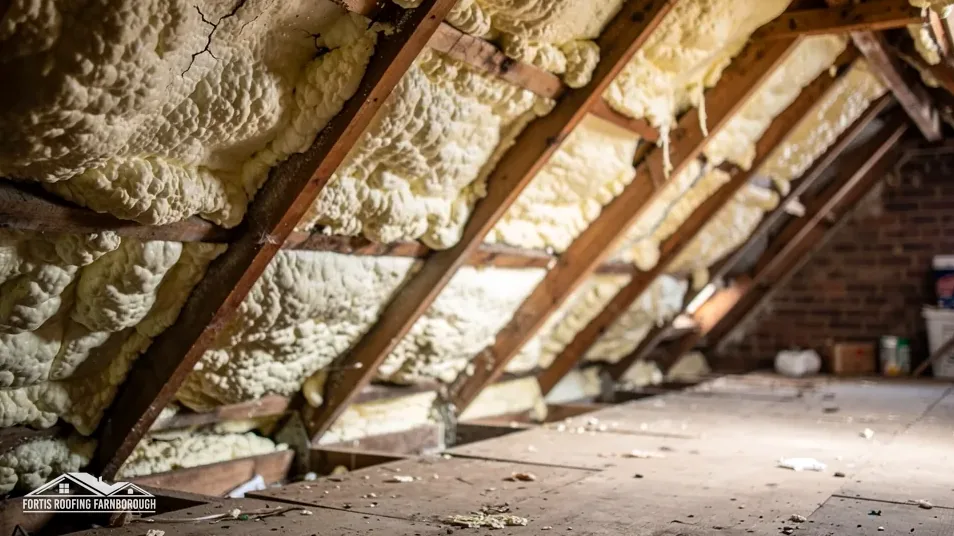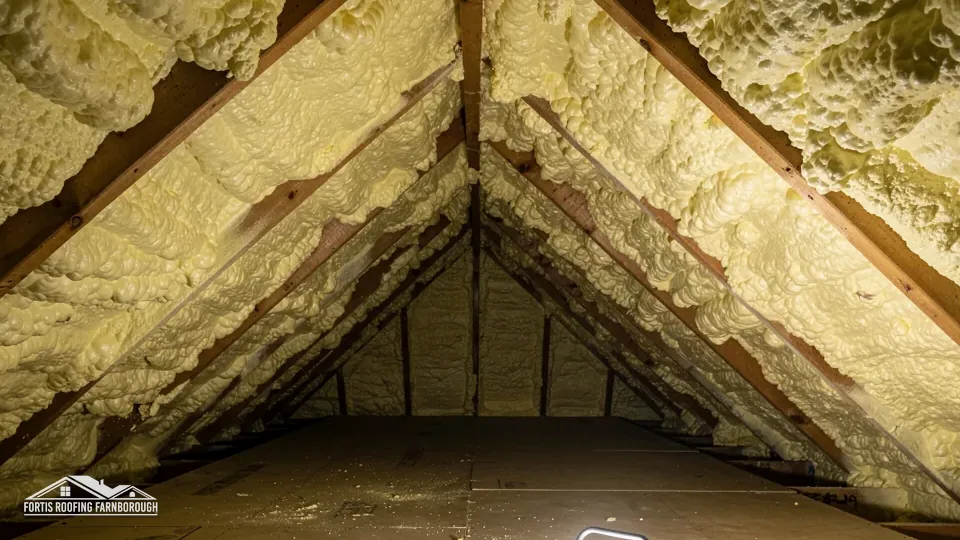
Roof timbers last for centuries when they stay dry. Rot needs sustained dampness, and so do many wood-boring insects. So the question about spray foam is really a question about moisture: does the foam make a roof wetter, or does it stop a damp roof from drying?
The answer depends on the roof and on how the foam was put in. In a sound, well-ventilated roof, with foam correctly designed and installed, there may be no problem at all. In a roof with a leak, a blocked eaves gap or a rooms-below humidity problem, foam can change where moisture goes and how long it stays, and the timber behind it can pay the price quietly.
Below: how moisture reaches roof timbers, what RICS says about hidden timber, what Approved Document C expects of a roof, when foam is most likely to cause trouble, the warning signs, how timbers are inspected after removal and what can be done.
How moisture reaches roof timbers
Understanding the routes helps show where foam can matter. Moisture gets into a roof from three directions.
From above
Rain and melting snow can pass cracked tiles, failed flashings, worn valleys and blocked gutters. Underlay should catch it, but old or torn underlay does not. A small leak can wet timbers for a long time before anyone notices.
From below
Steam from kitchens, bathrooms and living rooms drifts up through the ceiling, and where it hits a cold surface it turns to water. That is interstitial condensation, which forms inside the layers of a roof, and Approved Document C (paragraph 6.2) wants roofs built so that it does no harm to their structure or thermal performance.
From the building
Damp in walls, a chimney that leaks or a gutter that soaks the eaves can all pass moisture into the timber where it meets masonry, such as at wall plates and rafter feet.
The usual defences
A sound covering and underlay keep water out. A well-sealed ceiling limits moist air rising. Ventilation lets any moisture that does get in escape. Foam changes the balance of these defences, and sometimes it removes one.
Why timber suffers
Timber at high moisture content for long enough is at risk of rot and attack by insects. Dry timber is safe. The question to ask of any roof is whether its timbers can dry out.
Moisture content in practice
Timber in a healthy roof dries and wets with the seasons and settles at a modest level. It is persistent wetness that matters, which is why one high reading proves little and a pattern of high readings means more.
What RICS and the regulations say
Two sources frame the question: the surveyors' professional body and the Building Regulations guidance.
RICS
The RICS consumer guide on spray foam, from March 2023, makes two points that bear on this. Foam laid over rafters prevents a full look at them, and insulation fitted incorrectly can interfere with ventilation and lead to moisture damage. Together they explain why surveyors are careful: a risk exists, and the foam conceals it.
Limits of the guide
Nowhere does it say that every spray foam harms timbers, and it does not predict how many roofs are affected. It identifies a mechanism and a visibility problem. A particular roof may be fine.
Approved Document C
On roofs, the document asks that they resist the penetration of rain and snow and that interstitial condensation does not harm them. Paragraph 6.11 treats ventilating a cold deck roof as meeting the requirement and allows that a tiny roof, over a porch for example, may escape the need. Loft hatches should be draught-sealed under paragraph 6.12.
Ventilation figures
Under an HR (non-breathable) underlay, Marley's BS 5250 guidance puts the eaves opening at 25 mm up to a 15° pitch and 10 mm above that. Foam that fills the eaves can close those openings. Our guide to breathable roof membranes explains the underlay side.
Reading these together
A roof can meet Approved Document C when built and still go wrong later if its ventilation is blocked or its covering fails. The regulations set a standard for the design, and they cannot tell you the state of one particular roof today. Only a look at the timbers does that.
When foam is most likely to cause trouble
Certain combinations of roof and foam carry more risk than others. They are worth knowing because they point to where to look.
Foam over an existing leak
Water entering through a defect meets the foam. It can soak in, run along the surface or collect behind it. Timbers can stay wet for months, and the leak gets harder to trace. The Energy Saving Trust advises against foam on a leaking roof, and our guide to spray foam on a leaking roof explains why.
Foam that blocks ventilation
Foam sprayed into the eaves, or against the underside of the covering in a roof that depended on a through-flow of air, can shut the air path. Moisture that got in then cannot leave.
Foam on damp timber
Foam sprayed onto timber that is already damp may not bond properly and can seal moisture in against the wood.
A humid house
Where the rooms below make a lot of moisture, from poor extraction, drying laundry or an unsealed ceiling, the roof has more to deal with. Foam that is less permeable can concentrate condensation on the cold side.
A foam layer that is thin or patchy
Gaps and thin areas leave cold spots where condensation forms, even though most of the roof looks insulated.
Older roofs
Roofs built without underlay, or with old felt, rely on air movement through the roof space to stay dry. Foam changes that behaviour.
None of these makes damage certain. Together they define the roofs that deserve a closer look.
Warning signs you can check
Because timbers behind foam cannot be seen, owners look for indirect signs. Some can be checked safely from the loft and the rooms below.
In the loft
- A musty or damp smell, especially in winter.
- Damp or dark patches on the foam surface or on the visible edges of timber.
- Foam that has pulled away from timber, leaving gaps.
- Rust on nails or fixings that poke through.
- Frass, a fine sawdust, below timbers, which can indicate wood-boring insects.
- Foam that feels wet or has crumbled in places.
In the rooms below
- Stains on ceilings, especially near the eaves or around chimneys.
- Peeling paint or mould on upper walls and ceilings.
- Condensation on roof windows.
Outside
- Slipped or cracked tiles, which suggest water may be entering.
- Overflowing gutters, damp fascia boards or stained walls under the eaves.
What the signs mean
Any of these may have an innocent cause. Together, or repeated, they justify an inspection. Tap or probe only what is safe to reach, and do not cut into foam yourself. Photograph what you see, with the date.
Insects and fungi
Two kinds of attack matter in roof timber. Fungal rot needs sustained moisture and softens wood, often showing as cracking along the grain or a spongy feel. Wood-boring beetles lay eggs in timber that is damp enough for larvae, leaving small round exit holes. A survey looks for both, and treatment, if needed, depends on which is present and how far it has spread.
Next step
A specialist survey is the proper way to find out. Our guide to spray foam surveys explains what is checked and what cannot be.
How long signs take to appear
Rot develops slowly. Damp that started a few years ago may have done little yet, while damp that has run for a decade can have done a lot. Signs may therefore not match the age of the foam, and a clear loft today is not a guarantee about the timber behind it.
Inspecting the timbers, and what removal shows
The reliable way to know the state of the timbers is to look at them, and with foam in place that usually means taking some or all of it off.
Limited investigation
A surveyor can check accessible areas, use a moisture meter on exposed timber and sometimes take a small section of foam away at selected points. This gives a sample, not a full picture, and the report says so.
Removal and inspection
When the foam is removed, the timbers are cleaned and checked, from rafters to wall plates, for rot, beetle, splits, staining and corroded fixings, and the back of the underlay is inspected. Moisture readings and photographs are taken at many points. The record that results is described in our guide to what your surveyor needs after spray foam removal.
What is commonly found
A good number of roofs turn out dry and sound. Some show staining or local damp that is historic. A few reveal rot or insect attack that needs repair. The result is not known until the foam is off.
What can be done
Sound timbers are cleaned and left. Damp timbers are dried and the cause fixed. Rotten sections are cut out and replaced with treated timber, sometimes by bolting a new length alongside a weakened rafter, and new battens go in as needed. Failed underlay is renewed.
Costs
Typical UK averages from MyJobQuote put a roof repair at about £650 in 2026 (Oct 2026), while timber repair costs follow extent and access, and one written total after the survey fixes yours.
Deciding what to do about your roof
You do not have to remove foam because it exists. The decision rests on evidence and your circumstances.
Questions to ask
- Is the roof dry? Do any signs suggest moisture?
- Was the foam installed over a leak, damp timber or a blocked eaves?
- Does the loft ventilate, and is the ceiling sealed?
- Do my lender and my plans, such as selling, make inspection necessary?
Options
- Leave it and monitor, with periodic checks of the loft and rooms below.
- Commission a survey with limited investigation.
- Remove the foam from selected areas to inspect the timbers.
- Remove it fully, inspect, repair and re-insulate.
The role of lenders and buyers
On lending, RICS sends owners to their mortgage provider. If you plan to sell or remortgage, the question of what is under the foam may be asked by others. The reasons owners give are covered elsewhere on this site.
If you decide to remove
Plan removal, inspection, repair and re-insulation as a sequence, with Part L and ventilation designed together. Our spray foam removal work opens with an inspection and closes with a written record, priced as one total, VAT shown.
If you decide to wait
Keep records of what you know, and revisit the decision if any sign appears.