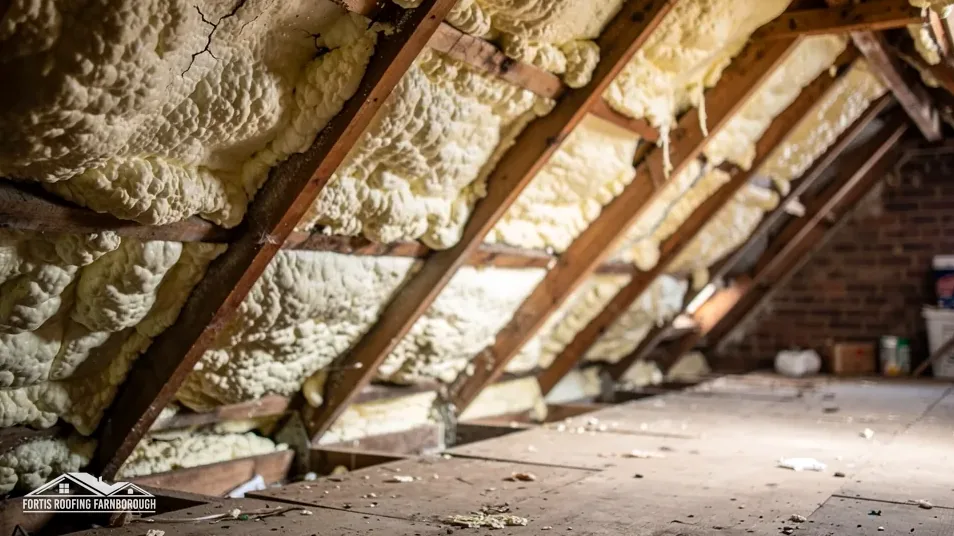
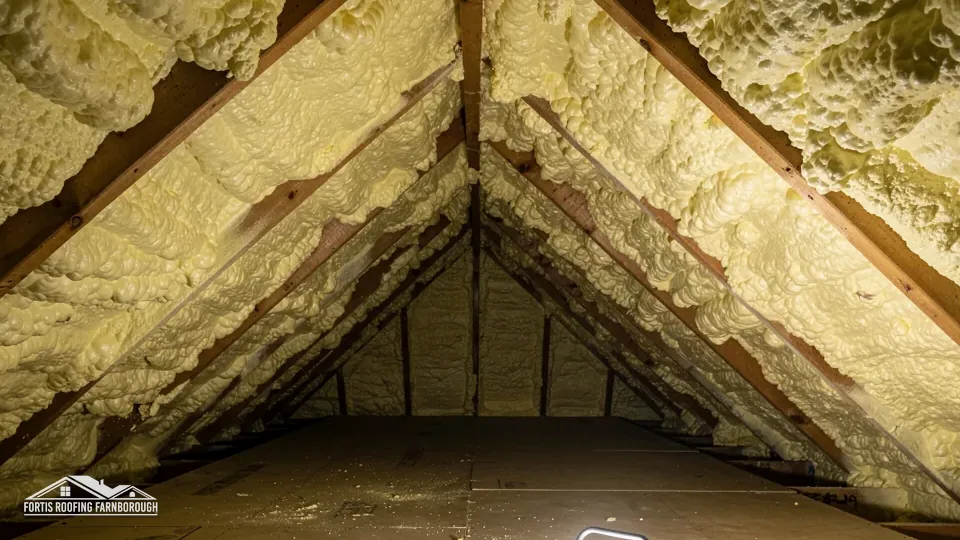
A damp patch on a ceiling or a drip in the loft sends owners looking for a fast answer, and spray foam can look like one. It sticks to almost anything and sets quickly, and sprayed over a gap it seems to close it.
The trouble is that a leak is a path for water, and foam does not remove the cause. The water enters at the source, whether that is a cracked tile, a failed flashing or a blocked valley, and foam only changes where it goes after that. It can soak into the foam, run along it or collect behind it, out of sight, and the timbers it touches can stay wet for a long time.
Below: what the Energy Saving Trust says, how foam hides a leak, why that matters for the timbers, what a leaking roof needs, what to do meanwhile, published repair costs and how foam already over a leak is handled.
What the Energy Saving Trust says
The Energy Saving Trust, an independent source of energy advice, covers roof and loft insulation on its website, with a page last updated on 8 May 2026. Among the questions it answers is whether you can spray foam onto a roof that leaks.
The answer
The Trust's answer is short: "We don't recommend doing this." It is a plain statement from a body with no product to sell, and it matches common sense about how roofs work.
What it implies
A leaking roof has a defect, and the right response is to find and fix it. Insulation, of any kind, is for keeping heat in. It is not a waterproofing layer, and it cannot take the place of a sound covering or a sound flashing.
Why people try it
Foam is sold on the idea that it seals gaps. In a roof that is partly true for air leaks, and entirely untrue for water that is entering at the covering. A bead of foam round a pipe or a chimney, or a layer under a leaking slope, deals with a draught and leaves rain free to enter.
Further reading
The wider concerns about foam under roofs have led many owners to take it out, which is covered elsewhere on this site.
Put plainly, the water has to be stopped where it enters, and foam cannot do that.
A fair test
Ask of any proposed fix whether it removes the entry point for water. A new tile does. A reset flashing does. A layer of foam on the inside does not, so it fails the test, however neat it looks from the loft.
How foam hides a leak
A leak shows itself through stains, drips and damp. Foam can hide all three, and that is its main danger.
It covers the evidence
A damp patch on the underside of the roof or a stain on rafters is the clue that leads a roofer to the source. Sprayed over, the patch disappears. The evidence that was pointing to the fault is gone, and the next leak is harder to trace.
It can trap and move water
Water that gets past the covering meets the foam. Some foams absorb it, others shed it along the surface. Either way, water ends up in the timbers or at low points, such as the wall plate, without a clear drip to show for it.
It bonds to wet surfaces
Foam sprayed onto damp timber or underlay may not bond well, and it can seal moisture against the wood. A timber kept wet for a long time can rot.
It stops inspection
The RICS consumer guide notes that foam over the roof timbers blocks a full inspection. A leaking roof with foam over its timbers is where inspection matters most and is hardest to carry out.
The leak continues
The covering is still defective. Every storm adds water, and over time the damage spreads beyond the first spot. Our guide to whether spray foam can damage roof timbers goes into the risk.
The ceiling below
Water that is hidden in the roof can still show in the house. A stain that appears after foam has been applied is a sign that water is finding a way round it. By then the damage in the roof may be well advanced.
What a leaking roof needs instead
The right response to a leak is a sequence, and it starts with finding where the water comes in.
Find the source
Leaks rarely appear below the point of entry. Water runs along rafters and underlay, so a stain on a ceiling can be a metre from the hole. A roofer works from the stain back, using the loft, a hose test where appropriate and a close look at the likely culprits. Our guide to finding a roof leak explains how it is done.
Common sources
- Cracked, slipped or missing tiles and slates.
- Failed or lifted flashings at chimneys, walls and roof windows.
- Worn or blocked valleys.
- Cracked ridge and verge mortar.
- Blocked or leaking gutters, overflowing onto the eaves.
- A perished underlay.
Fix the cause
Each source has a proper repair: refixing or replacing tiles, resetting or renewing flashings, relining a valley, rebedding or dry-fixing a ridge, clearing or mending gutters and renewing the underlay. The repair addresses the entry point.
Dry out
Wet timbers and insulation need to dry. Opening up the area, ventilating it and, if necessary, replacing wet insulation prevents rot.
Then insulate if you wish
Once the roof is sound and dry, insulation can be fitted to suit the build-up, with the eaves opening matched to the underlay. Re-insulating after removal follows the same logic, with ventilation matched to the underlay.
Typical outcomes
Most leak repairs, once the source is found, are modest jobs: a few tiles, a flashing, a section of valley. The survey and photographs let you see the cause for yourself and judge whether the proposed repair addresses it.
What to do while the roof is leaking
A leaking roof needs action, and most of the first steps are simple. Making the roof safe comes first.
Limit the damage
Put buckets under drips and move furniture and belongings. Lay towels or plastic sheeting. If water is gathering above a ceiling that is bulging, make a small hole at the lowest point to let it drain into a bucket, since a ceiling can fall without warning, and keep clear of it.
Protect electrics
If water is near light fittings, sockets or wiring, switch off at the consumer unit and call an electrician. Do not touch wet fittings.
Record it
Photograph the stains, drips and damaged contents, with the date, and note the weather. Photographs help a roofer find the source and help an insurer assess a claim.
Tell your insurer
If you may claim, speak to your insurer before anything permanent, make a temporary repair only if it is safe and keep the photographs and receipts. Your policy's own storm definition and its exclusions decide what is covered. Our guide to temporary roof repair covers the options.
Do not go on the roof
A wet roof is dangerous. Leave access to a roofer with the right equipment.
Call a roofer
A survey finds the source and tells you what is needed. We photograph the cause and the repair, so you see what was wrong.
Check the roof afterwards
After a repair, check the area after the next heavy rain, both from the loft and the room below. A repair that holds through a wet spell is one you can trust, and a roofer should be happy to look again if it does not.
Repair costs, as published
Repairing a leak costs far less than the damage it causes if left, and national guides give a sense of scale.
| Source | Job | Figure |
|---|---|---|
| MyJobQuote (Oct 2026) | Average roof repair | around £650 in 2026 |
| MyJobQuote (Oct 2026) | Emergency roofer call-out | typically £150 to £300 |
| MyJobQuote (Oct 2026) | Extensive storm repairs | £1,200 or more |
| Which? (Nov 2025) | One to six standard tiles | £75 to £400, ex VAT |
Reading the table
A small repair is a modest sum, and a storm repair or a failed covering is larger. A repair that stops a leak early costs a fraction of replacing rotted timbers and ceilings, which is the sensible way to compare.
What sets the price
The source and extent of the leak, access, the covering and whether timbers or underlay need renewing all count. A leak that has been running for a while costs more to put right.
Foam adds cost
Foam sprayed over a leaking area has to be removed before the real repair can be done, so it adds a step and a cost. Our guide to what decides the cost of spray foam removal explains what sets that price.
Our price follows the survey as a single written figure.
If foam has already gone on over a leak
If a leaking roof has already been sprayed, the sensible course is to treat the foam as part of the problem.
Stop and assess
Do not add more foam. Have the roof looked at to find whether the leak continues and what the foam is covering. Signs include fresh stains on the foam, damp patches that appear after rain and a musty smell.
Survey
A survey looks at the foam from inside and the covering from outside, checks the likely entry points and tests accessible timbers for moisture. Our guide to spray foam surveys explains what is covered.
Options
- Repair the entry point from outside and monitor, if the survey finds the timbers dry.
- Remove foam from the affected area to inspect and dry the timbers, then repair and re-insulate.
- Remove all the foam, if its extent or the damage warrants it, and re-roof or re-insulate.
Why speed matters
A leak that has run for months costs more to repair than one caught early. If foam has been sprayed over it, the wet may be sitting out of sight. Inspect soon, since timber that stays wet through winter is timber at risk of rot.
Records
Photographs of the foam, the entry point and any exposed timbers form a record for a future buyer or lender. On lending, RICS points owners to their own mortgage provider, so keep the paperwork.
Next steps
Our spray foam removal service starts with an inspection and finishes with one written total.