The short answer
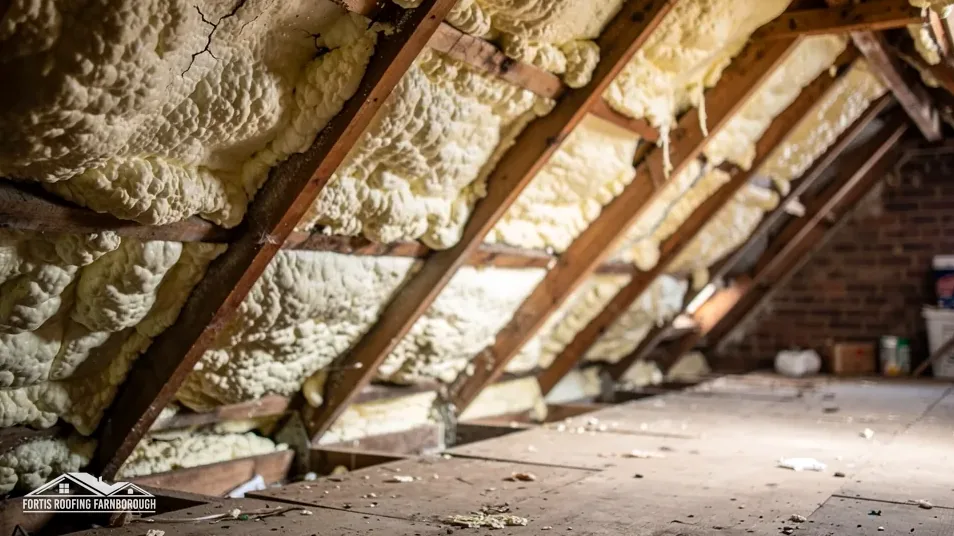
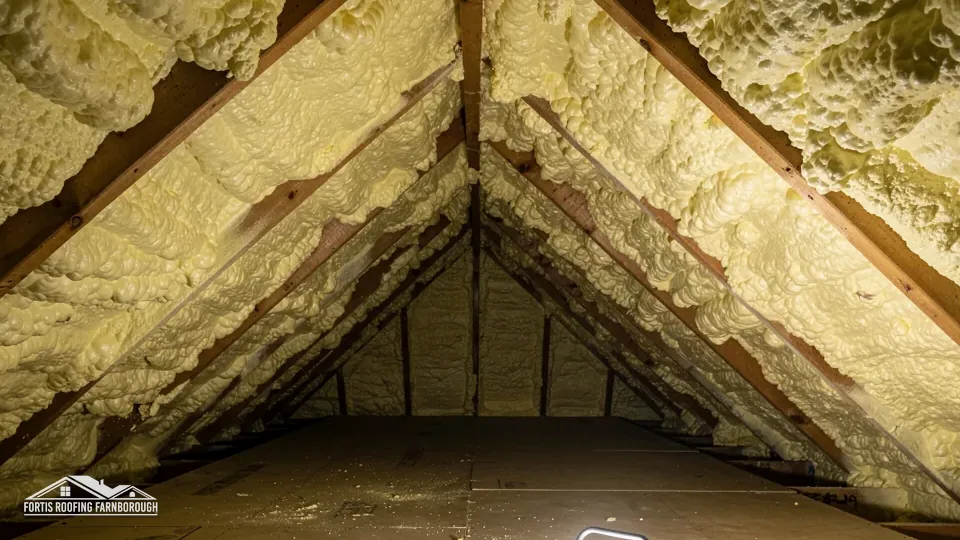
It is a two-part chemical mix sprayed as a liquid that expands into a solid foam. In roofs it goes onto the underside of the covering or between the rafters. It comes in open-cell and closed-cell types. It insulates and seals gaps, but it also bonds to timber and hides it, which has raised concerns among surveyors and lenders.
How it goes on
Installers mix two components at a spray gun. When they meet, they react and the mix expands rapidly, growing many times its liquid volume within seconds and setting into a cellular solid. The foam is built up in layers until it reaches the required thickness.
In a roof, the usual places are the underside of the covering, where it is sprayed straight onto the tiles, battens or underlay, and the spaces between rafters. Some installers coat the rafters too. The foam sticks to timber, masonry, felt and most other surfaces it touches, and it fills gaps and cracks in a way that rolls of fibre cannot.
The pitch of the sales message is that it insulates and seals air leaks in one operation and can be done quickly in an awkward roof space. Because it is applied where it is needed, it is also used in shapes that are hard to fit with boards or rolls.
The same adhesion that makes it effective makes it hard to remove. Once cured, it is bonded to timber and covering. Our answer on whether spray foam can be removed describes how that is done, by hand and in small sections.
Installers work in protective gear, and the roof space needs to be clear and ventilated while the foam cures.
Open-cell and closed-cell
Two main types are sold. Open-cell foam is built of microscopic pockets that stay partly open, which leaves it soft, light and spongy. It insulates and blocks draughts, but it can take up and pass on moisture, and it expands more, using less material for a given thickness.
In closed-cell foam the pockets are shut, making it denser, firmer and more resistant to water and vapour. It insulates well for its thickness, adds a measure of stiffness to what it is stuck to, and costs more. It is also harder to remove, because it grips harder.
The type matters for a roof because of moisture. A vapour-tight closed-cell layer can seal a roof's timbers from the house air, which helps if it is complete and hurts if damp is already inside or gets in through a gap. An open-cell layer lets some vapour through, which can be an advantage or a drawback depending on the roof.
Neither type is a fault in itself. Their performance depends on the thickness, the detailing at the eaves and ridge, the state of the roof under them and the standard of the installation. Our guide to open and closed cell spray foam compares them.
Why people have concerns
The main concern is what the foam hides. Once it covers the roof timbers, they cannot be seen or inspected, and the condition of a roof can only be judged by opening it up. A surveyor who cannot see the timbers cannot report on them.
The second is moisture. Insulation that blocks ventilation or traps damp can cause hidden rot. RICS says in its consumer guide that a badly done insulation job can harm ventilation and lead to damp. The Energy Saving Trust (updated May 2026) also advises against putting foam over a roof that is already leaking.
The third is the mortgage market. In March 2023 RICS described growing caution among lenders, equity release first, and it recommends owners ask their mortgage provider. Policies differ by lender, and no one can promise how a particular lender will respond.
None of this means that every foamed roof is damaged. Many are dry and sound. It means that foam makes checking harder, and that the questions are worth asking before a sale or remortgage. Our answer on what RICS says about spray foam sets out the documents.
Foam also raises building control questions when it is installed in a roof being renovated, since the work has energy and moisture rules.
What to do if you have it
Start by finding out what you have. Look at the installer's paperwork for the foam type, date and thickness, and check whether a guarantee exists. A loft inspection shows how it was applied and whether it covers the underlay, battens or the rafters.
Then look for signs of trouble: stains or mould on upstairs ceilings, a musty smell, damp at timber ends, and water marks on the foam. If there are none, the roof may be coping, but the timbers remain hidden.
Ask your mortgage provider early if you plan to sell, buy or remortgage. Keep the reply in writing. If a provider has concerns, an inspection opening, a removal or a report with photographs can answer them.
At the survey the foam and visible timbers are photographed and the findings reported simply. If removal is wanted, the method and likely repairs are explained. If it is not wanted, the foam stays, and nothing here suggests that every roof must be cleared.
See spray foam insulation removal for the service. Any work is quoted as a single written total, afterwards.