The short answer
Where foam has been sprayed straight onto the back of the tiles and battens, with no underlay between, it bonds to both. Tiles become hard to lift without breaking, leaks are hidden, and battens may rot unseen. Often the practical answer is to strip the roof, clear the foam from the battens and tiles, and re-cover it, so the decision is about the roof as a whole.
What happens with no underlay
A normal pitched roof has rafters, an underlay stretched across them, battens fixed over the underlay, and tiles hung from the battens. The underlay is the back-up that sheds stray rainwater toward the gutter. Some older roofs have no underlay at all, and the gaps between tiles let the roof breathe.
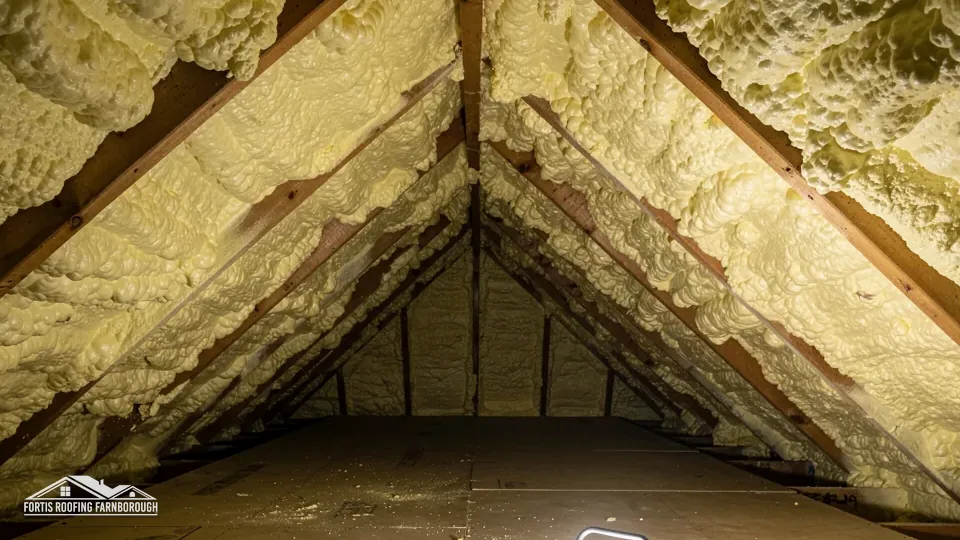
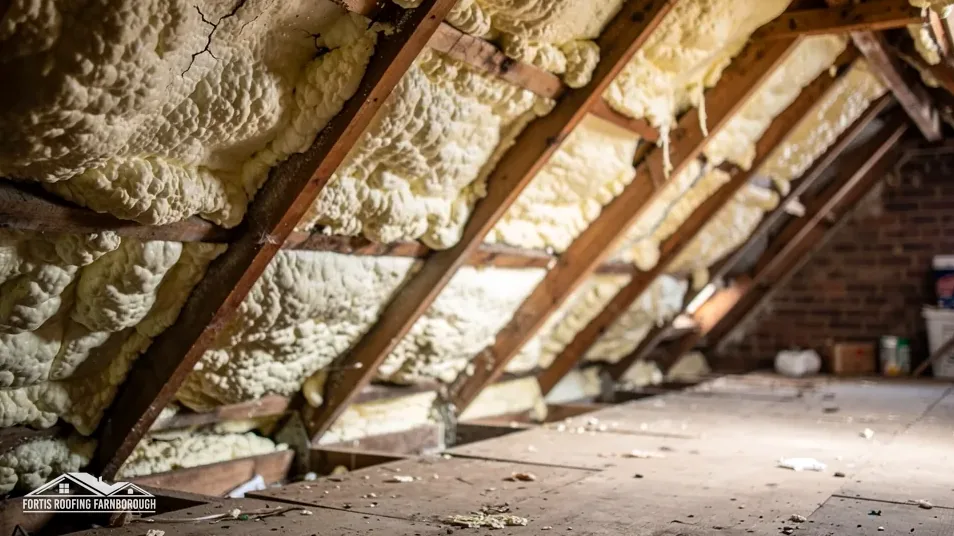
When foam is sprayed onto such a roof from inside, it reaches the back of the tiles, wraps around the battens and fills the gaps between them. It bonds to all of it. The tiles, the battens and the foam become one stuck-together layer. There is no membrane to separate them and no route for rain that gets through a cracked tile to run down and out. It lands in the foam.
That is the difficulty. A tile that cracks, a slipped tile or a failed ridge lets water in, and the foam holds it against the battens and the timber, without any visible sign inside the house. Rot can begin well before any ceiling stain appears.
The Energy Saving Trust (updated May 2026) takes a dim view of foam over a roof that already leaks, for just this reason. Our answer on spray foam and condensation explains how moisture builds up behind it.
Tiles and battens under the foam
Foam on the back of tiles makes the roof difficult to maintain. A loose or cracked tile cannot be lifted out cleanly, because the foam grips its underside and the battens either side. Pulling it free can break it, or tear the foam and leave a hole. The little lugs by which a tile hangs on its batten may be buried.
Battens are a worry. They are small timbers, often thin, and they are bonded into the foam on three faces. If damp reaches them, they can rot out of sight, and a batten that has lost its strength cannot hold the tiles it carries. RICS notes in its consumer guide that timber covered with foam cannot be fully inspected, and that applies here to the battens as well as the rafters.
The tiles themselves may suffer. Concrete and clay tiles tolerate a lot, but nails that hold them may corrode, and a tile held rigid by foam can crack when the roof moves with temperature. Slates are more brittle still, and our answer on cracked slates describes why.
For any repair, the roofer has to cut the foam around the tile, and then repair the foam, which is awkward and rarely perfect. A roof in this state becomes harder and dearer to look after than one without foam.
Removal and the re-roof decision
Removing foam from under tiles has two routes. One is from inside, scraping and cutting the foam off the battens and tile backs, which is slow because it has bonded to every surface and the tiles must not be dislodged. The other is from outside: strip the tiles in sections, free the foam from them and the battens, and re-lay.
Because the foam is stuck to the tiles, many are broken in the process. The sensible approach is usually a strip and re-cover. The roof is taken back to the rafters, the battens are renewed, an underlay is fitted so the roof has the layer it was missing, and the tiles that survive are re-used with new or reclaimed ones to make up the numbers. Our answer on re-roofing after spray foam removal covers it.
The decision depends on the evidence. If the survey shows dry battens, sound tiles and a lender who is content, you may choose to leave the foam. If damp is found, or removal is required, the re-roof route is often the one that gives a clean result.
A re-roof can involve building control. The Planning Portal test is under 25 per cent of the envelope and under 50 per cent of the roof, while extra weight of 15 per cent or more needs approval. Scaffold, and a highway licence if it stands over a road, may be needed.
How we assess it
We start in the loft. We photograph the foam and its edges, look for tile nibs and battens, test for damp with a moisture meter where we can reach timber, and check the covering from outside for cracked, slipped or missing tiles. We look for any sign of an underlay, because its absence changes the advice.
Then we explain what we found, with the photographs. The likely routes are to leave the foam and monitor, to remove it from inside where practical, or to strip and re-roof. We show you why each is or is not suitable for your roof.
If you have a mortgage or are selling, check the lender's position first. RICS reported in March 2023 that lender unease started in equity release. A roof with foam stuck to the tiles may worry a valuer more than neat insulation in a loft would, so ask your own provider.
Records are kept so that any later buyer or lender can see what was done, and each route gets one written total after the survey. See spray foam insulation removal for the service, and roof replacement for the re-roof side.