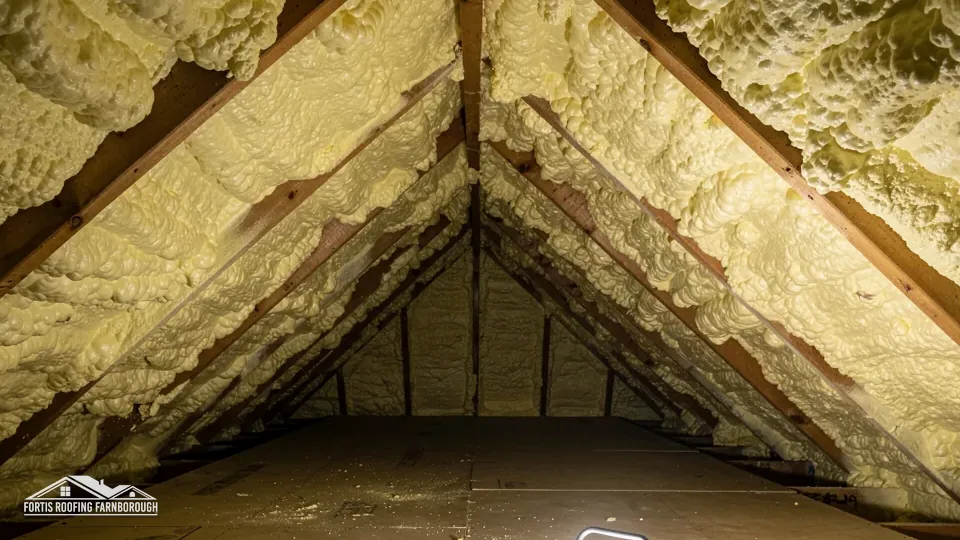
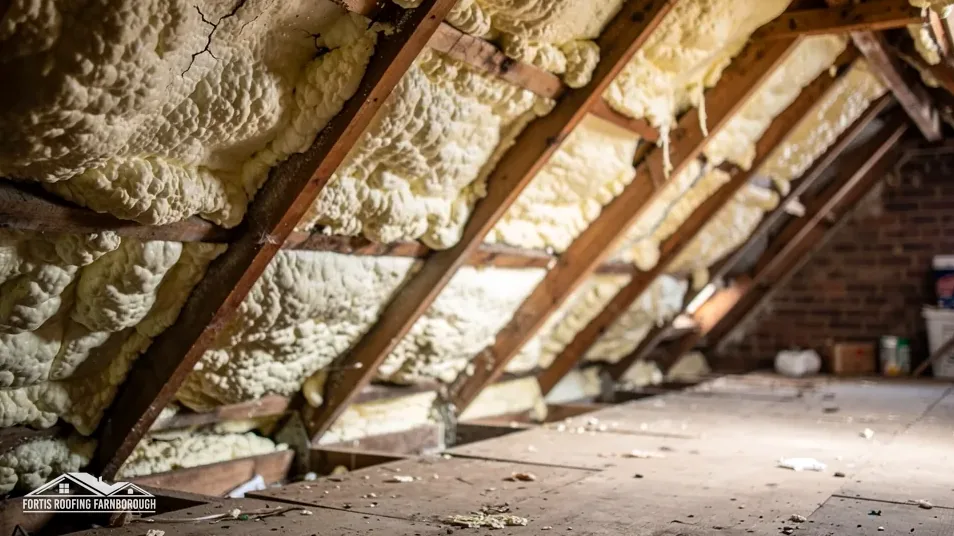
For years spray foam was marketed as a fast route to roof insulation from underneath, and plenty of homeowners in Hampshire and Surrey had it sprayed onto the underside of their tiles. In more recent years it has come up in conversations about mortgages and house sales, and many owners now want to know whether it can affect a loan, a remortgage or a buyer's survey.
The short answer is that it can, and that the picture varies from lender to lender. What we can offer is what is on the record: a statement from the Royal Institution of Chartered Surveyors, known as RICS, issued in March 2023, together with the consumer guide it published, and advice from the Energy Saving Trust on spraying foam onto a roof. We set out what those sources say, what they leave open, and the practical steps for a buyer, a seller or a homeowner thinking of remortgaging.
None of this is legal or financial advice. If spray foam is in your roof, your mortgage provider and your solicitor are the people who can say how it affects you, and a roof survey can establish what is actually under your tiles. We write this for owners around Farnborough and across the Hampshire and Surrey border towns.
What RICS said in March 2023
RICS is the professional body for chartered surveyors, and in March 2023 it launched a guide for consumers on spray foam insulation, alongside a press release dated 3 March 2023. The guide itself carries a published date of 31 March 2023.
The statement about lenders
The press release described unease in particular corners of the lending market, giving equity release mortgages as the example, and said the unease was by then reaching lenders more widely. Put plainly, RICS reported that spray foam in roofs had begun to worry some lenders, with equity release the first place it showed.
What that does and does not say
It is a statement about concern, from a particular date. It does not say that any named lender will decline a property, and it does not say that a mortgage cannot be had on a house with spray foam. Lending policies change, differ between lenders and depend on how the foam was applied and what the surveyor finds. The statement is a signal to check, not a rule.
The line from the guide
The guide's advice to owners includes a line about the lender: find out whether the mortgage provider's own rules allow such a product to go in. We give every owner the same advice: ask the lender, in writing if you can, before deciding anything.
Our answer on RICS guidance on spray foam gives the same material in short form.
Why the roof structure matters to lenders
Lenders rely on a valuation and often on a survey, and both ask whether the home is sound security for the loan. The roof is a large part of that, and the way foam is applied changes how much of it can be seen.
Timbers that stay out of sight
RICS points out that once foam covers the timber roof structure, the timber can no longer be fully viewed or checked. A surveyor cannot judge rafters, battens or the back of the roof covering through a layer of foam, and that uncertainty is one reason a valuer might flag the roof.
Ventilation and moisture
The guide adds that wrongly installed insulation may interfere with ventilation and lead to damp damage. A roof has to manage moisture, and a foam layer can change how it does so. Trapped moisture can harm timbers, though nothing in the guide suggests that every installation suffers.
A leaking roof
The Energy Saving Trust (advice updated 8 May 2026) does not recommend spraying foam over a roof that already leaks. A leak sealed under foam can hide a fault that goes on damaging timbers.
What it means for you
None of this makes spray foam automatically a problem. It explains why a lender or a surveyor may want to know more, and why records of what was done are valuable.
What to ask your mortgage provider
Whatever you plan, whether to buy, sell, remortgage or release equity, the first conversation is with the lender. A few questions make it productive.
Does your policy cover this?
Ask whether the lender's policy permits a property with spray foam applied to the roof, and whether it distinguishes between types or between a roof and a wall. Lending policies change, so get the answer in writing.
What evidence will you want?
Ask what the lender needs from an owner: a specialist survey, installer documents, product data, a building control certificate, or an independent report. Knowing this early shapes what you gather.
Does it affect the valuation or the loan?
Ask whether the lender may reduce the valuation, set a condition or decline, and what the conditions would be. Only the lender knows its decision in advance.
Is it different for equity release?
RICS gave equity release as the place concern first arose. If you are considering it, say so at the start. Our answer on spray foam and equity release covers it.
Who can advise?
A mortgage adviser can compare lenders' attitudes. Your solicitor handles the sale or purchase. A chartered surveyor can report on the roof. We survey the roof and report what is there, with photographs, and leave a lender's policy to the lender.
Keep a record
Note the date, the person you spoke to and what they said, and keep any email. If a lender's policy later changes, your record shows what you were told.
What a seller needs to show
If you are selling a house with spray foam in the roof, a buyer's solicitor and surveyor will ask about it, and the lender behind the buyer may do so too. Having answers ready avoids delay.
Who installed it, and when
Gather the installer's name, the date and the invoice or contract. A buyer and a lender want to know the work was done by a competent firm at a known time.
What was applied
Open-cell and closed-cell foams behave differently, and the product data sheet says which was used and how it should be installed. Keep any data sheet that came with the job.
Where it is
Record which parts of the roof carry foam: the whole underside, one slope or a section. A plan or photographs help.
Building control
If the work was notified to building control, find the certificate or letter. For Rushmoor and Hart addresses the service is the Hart and Rushmoor Building Control Partnership, on 01252 398715, and it can tell you what is on record for an address.
A survey of the roof
A survey that reports the condition of the roof and any foam, with photographs, answers many questions before they are asked. It also shows whether the roof structure is sound, which helps a buyer's confidence.
Be straightforward
Tell your solicitor about the foam early. A buyer who learns of it late may pull out, whereas one who is told at the start can plan. Our guide to selling a house with spray foam covers the steps.
Buying a house that has spray foam
A buyer who finds spray foam in a roof is in a different position from a seller, with their own questions and their own lender.
Look for it early
Spray foam on the underside of a roof is often visible from the loft hatch, as a layer of foam against the tiles and rafters. If the survey or the listing mentions it, treat it as a topic for your solicitor from the first week.
Ask your own lender
Your lender will have its own policy. Tell your mortgage adviser, and ask whether the lender will lend on the property as it is. Getting that answer before exchange saves a collapse later.
Commission a roof survey
A roof survey can report on what can be seen and what cannot. MyJobQuote's roof survey average is around £300, with rows of £100 to £200 and £200 to £350 (October 2026). A foamed roof may take longer to survey. The survey tells you what the roof is like and whether concerns are justified.
The conditions of the deal
If the foam is a concern, a buyer may ask the seller to cover the cost of dealing with it, or to reduce the price. These are negotiations for your solicitor.
What removal involves
Removing spray foam is a specialist job, and its cost depends on the roof, the type of foam and how it was applied, so it is priced after a survey. Our answer on spray foam removal cost explains what drives it.
Do not assume
Spray foam does not have to be removed in every case. Whether it should be depends on the facts of the roof, the lender and the buyer.
Options for a homeowner who already has foam
If you already have spray foam and want to remortgage or sell, or are simply uneasy, you have choices, and which one suits you depends on what is under the tiles.
Leave it and document it
If the foam is well installed, the roof is sound and the lender is content, the sensible course may be to leave it and keep the paperwork. A survey with photographs of the loft and the roof gives you a record.
Inspect and report
A survey can examine what is visible from the loft and the roof, and report on ventilation, any signs of damp and the state of the covering. Because foam hides timbers, a survey may recommend further investigation, which could include opening a small area to look.
Partial removal
Sometimes only part of the foam needs to come off, for instance where a lender's surveyor wants to see the structure at a particular place. Partial removal is possible, and the survey says whether it is sensible.
Full removal and re-insulation
Where the foam must come off, the roof is then reinsulated by another method. The VAT rate on energy-saving materials is zero for installations made up to 31 March 2027 and 5% from 1 April 2027, so the date of the work can matter. The standard rate is 20%.
Cancelling an installation contract
If you signed a contract at home for spray foam recently, the 14-day cancellation right for off-premises contracts may apply. Citizens Advice explains how it works.
Next step
A survey tells you what you have. Our spray foam removal page describes the removal and re-insulation work, and one written price comes after each survey.