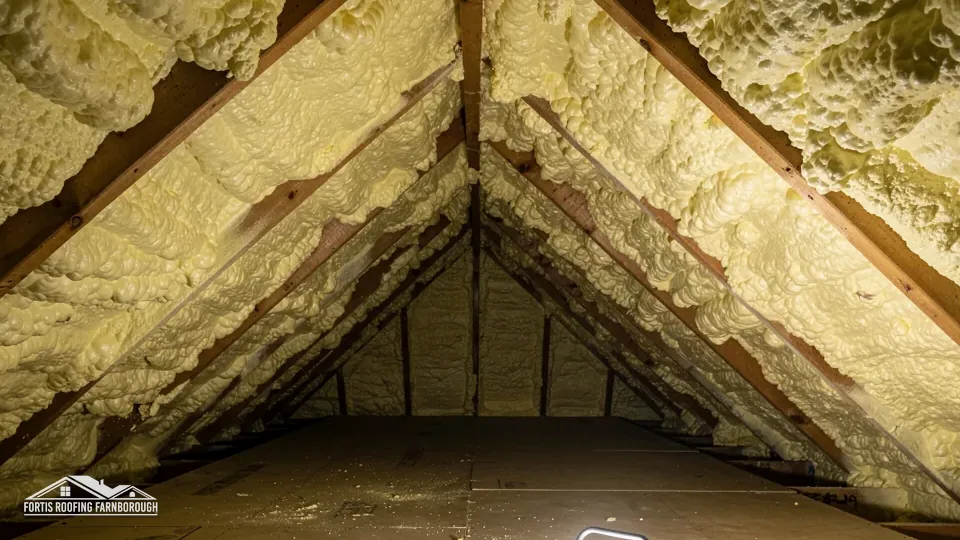
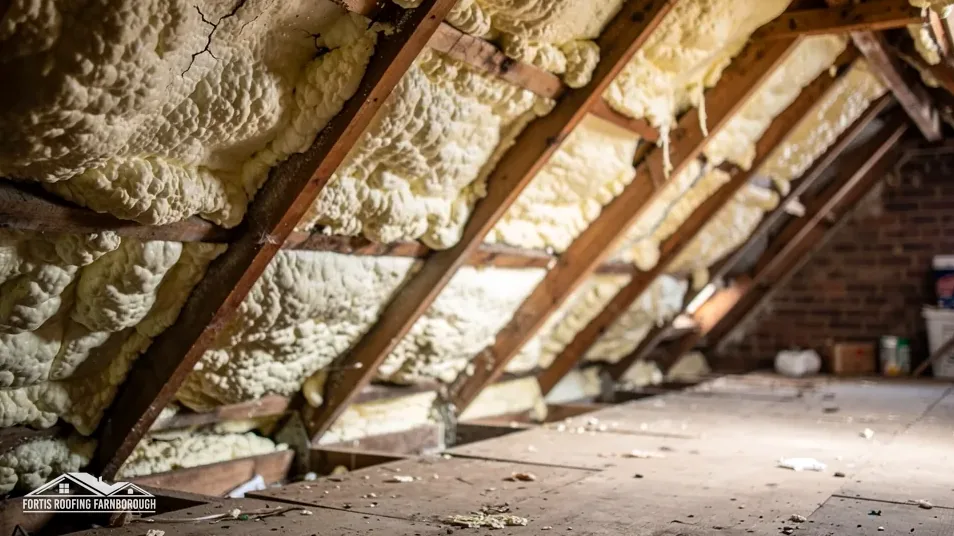
Spray foam is sprayed onto the underside of a roof and bonds to what it touches. That can include the back of the tiles, the underlay, the battens and the rafters. While it is there, nobody can see the condition of any of them. When it comes out, they are exposed together, and the owner is faced with a second question straight after the first: is the roof itself in good enough shape to stay, or has it been hiding trouble?
Answers vary. Some roofs come out of the process sound, with dry timbers and tiles that need only a clean. Others show perished underlay, damaged battens or tiles that cracked when the foam was freed. A few were already near the end of their life, and the foam was masking it.
Below: what removal exposes, how to compare repair with re-roofing, how the rules treat each, what the national guides publish, what a survey gives you and how to keep the order of work sensible.
What removal exposes
RICS, in its March 2023 consumer guide, makes the point that timbers under spray foam cannot be fully seen. Removal answers that, and the first job after it is to look.
The underlay
Where foam was bonded to the underlay, pulling it off can tear the membrane or leave patches stuck to it. A torn or perished underlay is common after removal. Without a sound underlay, wind-driven rain and snow that get past the tiles reach the timber.
The battens and rafters
These are checked for rot, beetle, staining, splits and rusted fixings. Foam applied over a leak can have kept the timbers wet for years, while foam over a sound roof may have left them in good order. Photographs are taken of each section.
The back of the tiles
Where foam reached the tiles, freeing it can chip or crack them, older concrete and clay above all. Cracked tiles show as daylight or broken edges when the roof is lit from below.
Flashings and details
Chimney trays, valleys and abutments are checked from the inside for staining that suggests a leak above.
Why it matters
This is the moment of truth for the roof. The evidence from the loft side, together with a look from outside, is what lets a roofer say whether repair or replacement fits. Our guide to what your surveyor needs after spray foam removal explains the record to keep.
Moisture readings
A moisture meter on the rafters and battens, at several points, puts numbers beside the visual check. High readings near a flashing or valley point to a leak above, and the cause is traced before any repair or insulation goes in.
When repair will do
Many roofs are in good enough condition after foam removal that a repair is the sensible course. The signs are fairly clear.
Signs that favour repair
- Dry, sound timbers with no rot, and battens that hold fixings.
- Underlay that is intact apart from local damage.
- Tiles in good order, with few cracked or slipped.
- Flashings and valleys sound.
- A roof within the long end of its published life.
What repair involves
Damaged underlay sections are replaced and lapped under sound areas. Rotten battens are cut out and renewed, tiles are replaced with matching ones, and the roof is cleaned and checked. The timbers are left clear of foam and ready to be re-insulated. Our guide to re-insulating after spray foam removal covers the next step.
Cost context
The average repair in MyJobQuote's guide is about £650 in 2026 (Oct 2026, typical UK range), and Which? lists £75 to £400 ex VAT for a handful of tiles (Nov 2025). Those suit small jobs, and a repair that takes in underlay sections and battens costs more.
Limits of repair
Repair works when the roof as a whole is healthy. Repairing one area of a failing roof only shifts the problem along. The survey, with photographs, says which case you have.
Planning the work
Repairs can be done at the same time as the removal or immediately after, so that the roof is closed up and re-insulated in one planned sequence.
When a re-roof makes more sense
Sometimes the evidence after removal points the other way. A re-roof deals with every layer in one go, and in some cases it is the better value.
Signs that favour re-roofing
- Underlay that has perished across large areas, or is missing.
- Battens that are soft, split or rotten over a wide area.
- Many tiles cracked, flaking or slipped, including damage from freeing the foam.
- Staining and rot that point to a long-running leak.
- A covering at or near the end of its life.
Age as a guide
HomeBuilding (Sep 2025) lists plain concrete tile at 40 to 50 years, clay at 60 to 80, Welsh slate at 100+ and fibre cement tile at 30 to 40, all as typical ranges rather than assurances. A roof past them with damage is a strong candidate for replacement.
Why combine
If the roof has to be stripped to deal with the foam anyway, the extra cost of a new underlay, battens and covering is smaller than a second visit with a second scaffold. A re-roof is also the time to fix ventilation and insulation together. Our guide to signs you need a new roof sets out the wider checklist.
What national guides publish
For a full re-roof, Which? shows £7,000 to £21,000 ex VAT across a three-bed house (Nov 2025), where HomeBuilding's £10,000 to £15,000 describes a 65 m² semi in plain concrete tile (Sep 2025). The two sit far apart, and the survey settles your own figure.
Building Regulations and planning tests
The route you choose decides which rules apply. A repair and a re-roof are treated differently.
The Planning Portal test
On the Planning Portal's test, a building control application is not normally needed if under 25 per cent of the building envelope and under 50 per cent of the roof is touched. A local repair sits well inside both, while a whole re-roof is likely to pass the second limit.
A heavier covering
If a new covering makes the roof 15 per cent or more heavier, Building Regulations approval applies, and a structural view is wise before the work is planned.
Council wording
Roof re-covering is named as work that may need approval by Bracknell Forest and by Basingstoke and Deane, and RBWM lists re-tiling or re-felting, with each speaking only for its own addresses. None of the councils around Farnborough publishes a percentage, and none says approval is always required.
Insulation and Part L
Re-insulating is likely to count as renovation of a thermal element, which brings Table 4.3 into play: 0.35 as the threshold and 0.16 as the improved figure. Our guide to insulation when re-roofing sets out the rules.
Planning
Class C permitted development normally covers a re-roof on a house, but not a flat. Listed buildings need consent, and conservation areas may have Article 4 directions. For Rushmoor addresses, the Hart and Rushmoor Building Control Partnership is on 01252 398715.
Getting the order of work right
Foam removal, repair or re-roofing, and re-insulation all affect each other. Doing them in the wrong order wastes money.
A sensible sequence
- Survey the roof and loft before removal, with photographs.
- Remove the foam, collecting waste as it comes off.
- Inspect and photograph the exposed timbers, underlay and tiles.
- Decide between repair and re-roof on the evidence.
- Carry out the repair or re-roof, with scaffold if needed.
- Re-insulate and ventilate to the chosen build-up.
- Close up, with building control checks where required.
Scaffold
Small repairs may get by with a tower or ladder, whereas a re-roof calls for full scaffold, and highway scaffold needs the authority's licence (Highways Act 1980), which we arrange with the scaffolder.
Matching new work to old
Where only part of the covering is replaced, the new tiles or slates must match the old in size and pattern, and the pitch must suit the product. A mismatch shows from the road and can leak at the join. The survey records the make and profile of what is there, so a match can be sourced before the roof is opened.
Weather
An open roof needs dry weather. Work on the covering is planned around the forecast, with temporary protection at the end of each day.
Coordination
Where the foam is removed by one contractor and the roof repaired by another, the handover is where mistakes creep in. Using one plan, with one written total, keeps responsibility clear.
Your records
Photographs at each stage, the data sheets for new materials and any completion certificate go into the file for a future buyer or lender.
Weighing disruption
A repair is quicker and less disruptive than a re-roof, but a re-roof leaves a roof that is known from top to bottom. If the household cannot face two sets of works, that can tip the decision toward doing everything at once while the roof is open.
Questions to ask and next steps
A short list of questions helps you judge a proposal for either route.
About the evidence
- What did the removal show about the underlay, battens and rafters?
- Can I see photographs of each area?
- Were any tiles damaged by freeing the foam?
About the options
- What would a repair involve, and what would it leave untreated?
- What would a re-roof involve, and what would it cost beside a repair?
- How old is the covering, and where does it sit in its published life?
About the rules
- Does the work need Building Regulations approval?
- How will Part L apply to the new insulation?
- Is the house listed, in a conservation area or a flat?
About price
After the survey you get a written price, one total, with VAT stated and scaffold access built in for whichever route you choose. If removal reveals more than the survey could see, you are told with photographs before extra work is added.
Lenders and buyers
On lending, RICS tells owners to ask their mortgage provider about its policy. Once the foam is gone and the roof is sound, the paperwork you hold, photographs, data sheets and certificates, gives a buyer or lender something to rely on.
Our spray foam removal service ties inspection, repair or re-roofing and re-insulation into one plan.
If you are selling
A buyer's surveyor will ask what was under the roof and what was done about it. Photographs of the bare timbers, receipts and certificates answer that, and they are worth more than a verbal account.