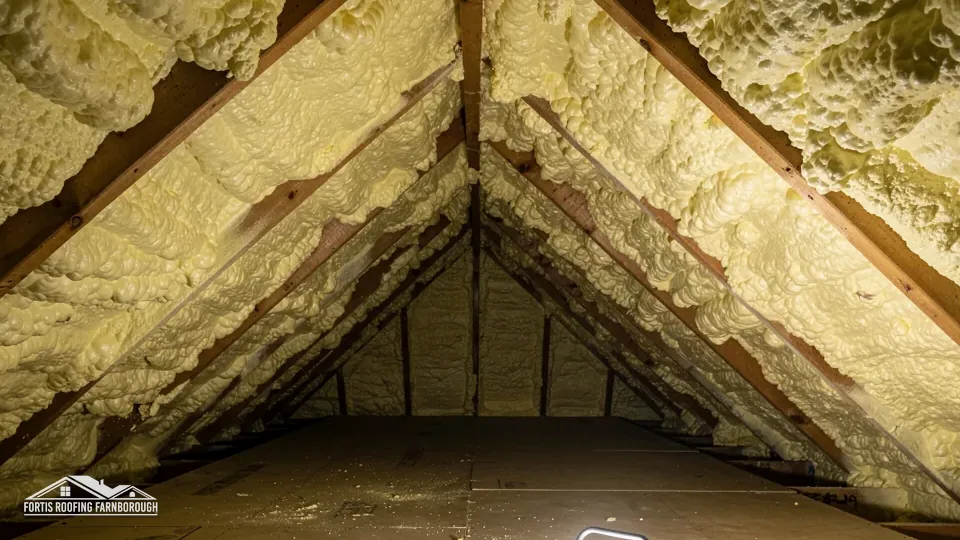
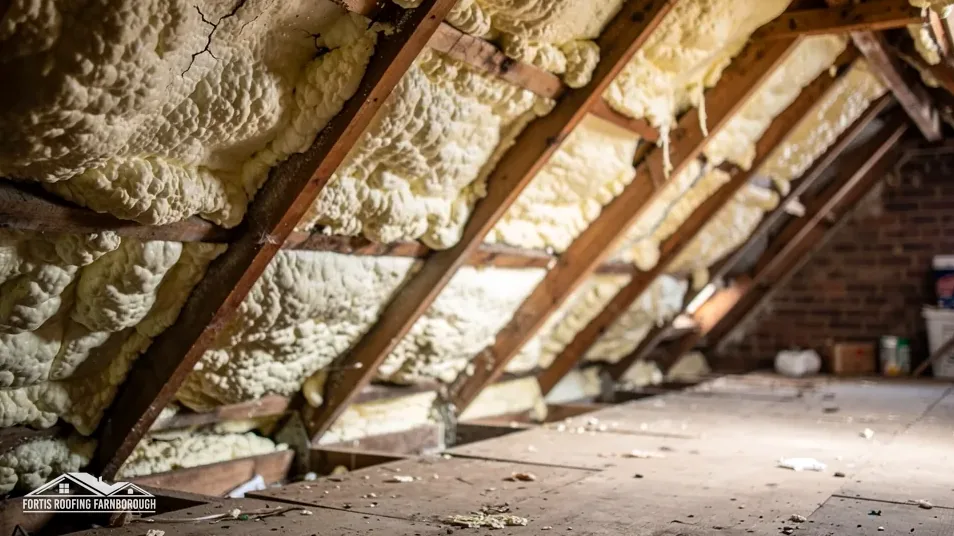
Spray foam in a roof tends to surface at the worst moment: after an offer, when the buyer's surveyor goes into the loft and finds the underside of the roof covered. The surveyor will note it, the buyer will ask what it means and the buyer's lender, if there is one, may want to know more. A sale that was straightforward can then slow down or fall through.
This is a separate question from the one a homeowner faces when remortgaging. Here the person asking is a buyer, the issue is what they will accept and at what price, and the seller controls how prepared they are. Some sellers choose to remove the foam first, others sell as it is with documents, and a few adjust the price.
This guide explains what a buyer's survey is likely to say, what RICS has said about spray foam and lenders, the options open to a seller, the documents worth collecting, how removal fits before a sale and how to approach timing and conversations with the buyer, for sellers in Farnborough and neighbouring areas.
What a buyer's survey is likely to say
A surveyor looking at a roof with spray foam on the underside has a problem that is easy to state: part of what they are paid to inspect is hidden.
The timbers cannot be seen
The RICS consumer guide on spray foam observes that foam over the roof timbers rules out a full look at them. A surveyor is therefore unable to comment on the rafters and battens beneath, and the report will usually say so.
What the report may recommend
The report may recommend further investigation, an inspection by a specialist, or removal of the foam to allow the timbers to be checked. It may flag that the buyer should speak to their lender. Wording varies by surveyor, and some reports are more cautious than others.
Effect on the buyer
A cautious report makes buyers nervous. They may ask for a reduction, ask you to remove the foam, ask for a specialist report at your cost or withdraw. Others, with the foam documented and no sign of trouble, go ahead.
Other findings
The surveyor may also note ventilation, staining or the condition of the roof covering as seen from outside. Those observations are separate from the foam.
What you can do beforehand
Know what is in your roof, have its paperwork to hand and, if you wish, have your own survey done so the facts are known before the buyer's surveyor arrives. Our guide to spray foam surveys explains what is checked.
Speed
Surveys happen fast once an offer is accepted. A buyer who finds foam in the second week of a six-week timetable has little room. Raising it yourself at the start keeps the sale on course.
What RICS has said about lenders
The worry for many sellers is the buyer's mortgage. The facts are narrower than the rumours.
The press release
RICS issued a press release dated 3 March 2023 introducing its spray foam consumer guide, and the guide shows a published date of 31 March 2023. The release reported unease in particular lending sectors, equity release among them, which by then was reaching lenders more widely.
The advice to owners
The guide tells owners to ask their own mortgage provider about its policy on such products. That is a question about each lender's own rules, and the rules differ.
What this does not mean
Nothing in it says lenders turn such houses down, and nothing in it orders the foam out. Some lenders will lend, some ask for further information and some have policies that make it harder. Nothing in the RICS material removes the need to ask the actual lender.
For a seller
You cannot know the buyer's lender in advance, so the best preparation is information. If the buyer's lender asks for a specialist report or a timber inspection, having done the work or collected the documents makes the answer quick. Our guide to why people are removing spray foam sets out the wider picture.
No one can promise that a particular lender will accept a particular house, and we do not.
Your options as a seller
Four broad routes are open, and which suits depends on the foam, the roof, the buyer and your timetable.
1. Sell as it is, with documents
If the foam is documented, the installer is known and there are no signs of trouble, selling as it is can work, particularly with an informed buyer. You disclose what you know, supply the paperwork and let the buyer decide.
2. Commission a survey first
A specialist survey tells you the type, the extent, whether timbers are accessible and what is visible. It gives you a report to hand to the buyer, and it may reassure or may show a problem you can then deal with on your terms.
3. Remove the foam before the sale
Taking the foam out lets the timbers be inspected, repairs to be made and the roof to be re-insulated in a conventional way. It costs money and time, but it takes the foam out of the conversation. Our guide to how spray foam removal works explains the steps.
4. Adjust the price
Where the foam is a known issue and you want a quick sale, an allowance in the price may be the pragmatic route, leaving the buyer to deal with the foam.
How to choose
Ask your estate agent how buyers in your area react, your solicitor what to disclose and a roofer what the roof needs. The cost of removal sits against the effect on price and the chance of a fall-through, and the decision is yours.
Cost of waiting
Delay has a price. A sale that stalls over a roof question can lose its chain, and a buyer who walks away leaves you starting again with the same foam. Settling the question early, by whichever route, is usually cheaper than settling it late.
Documents worth collecting
Paperwork changes the conversation. A buyer who can see what was installed, by whom and when is far more comfortable than one told only that there is foam.
From the original installation
- The installer's invoice and any contract.
- The product name and data sheet, showing the type of foam.
- Any warranty or guarantee paperwork from the installer.
- Building control records or certificates, if the work was notified.
- Photographs taken before, during and after the installation.
From inspections
- Any survey or report on the roof and the foam.
- Moisture readings or timber inspection notes, if taken.
- Photographs of the roof from the outside showing the covering.
If the foam has been removed
- The contractor's report and photographs of the bare timbers.
- Records of repairs and any replaced timber.
- Data sheets and certificates for new insulation and underlay.
Missing paperwork
If you bought the house with the foam in place, the previous owner or their solicitor may hold the papers. If none exists, say so, and a survey can establish what it can. Our guide to what your surveyor needs after spray foam removal sets out the record to keep.
Give the pack to your solicitor early, so questions from the buyer's side are answered quickly.
Choosing a contractor for the report
A buyer will give more weight to a report that comes from an independent source than to a seller's own summary. If you remove the foam, ask the contractor for a written record that names the work, the findings and the date, and keep the photographs in order. A clear, dated sequence is easy for a surveyor to read.
If you decide to remove the foam first
Removing foam before a sale is a significant decision, so it helps to see what it involves and what it leads to.
The sequence
A survey comes first, then removal, then inspection of the exposed timbers and underlay, then any repairs, then re-insulation and ventilation, with photographs at each stage. The result is a roof that can be inspected and described in the usual way.
What it may reveal
Some roofs are sound, and the removal gives you proof. Others reveal damp timber, perished underlay or tiles damaged in the process, and those need repair. It is better to find out before a buyer's surveyor does.
Re-insulation and the rules
Putting back insulation counts as building work and Part L applies to the roof layer, with Table 4.3 setting a renovation threshold and an improved target and a payback relaxation behind them. Our guide to re-insulating after spray foam removal covers it.
VAT
The standard rate is 20%. Energy-saving materials installed between 1 May 2023 and 31 March 2027 are zero-rated, and from 1 April 2027 the reduced rate of 5% applies.
Cost and time
Removal costs depend on the type, area, access and what is found underneath, and the survey with one written total fixes the figure. Allow time for the work, any repairs and building control. A sale with a firm date should plan backwards from it.
Sale paperwork
The finished job should leave you with a report, photographs and certificates. Our spray foam removal service provides the record a buyer will want.
Timing, disclosure and talking to buyers
How and when you deal with spray foam can matter as much as what you decide.
Disclosure
Tell your solicitor what you know about the foam, when it was installed and by whom, and ask what has to go on the property information forms. Honesty early prevents trouble later. We do not give legal advice, and the solicitor decides what to say.
Early or late
It is usually better to raise the foam before the buyer finds it than to let them discover it at survey. A buyer who is told, with a document pack, is better placed to make a calm decision.
Talking to buyers
Stick to facts: the type of foam, the date, the installer, what has been inspected and what the paperwork shows. Avoid speculating about lenders. If a buyer asks about their mortgage, suggest they ask their own provider, as the RICS guide advises.
If the survey causes a problem
If the buyer's surveyor recommends further investigation, agree who commissions it and who pays. A specialist inspection can be arranged quickly, and the report may settle the matter.
Walking through the roof
Photographs of the roof and loft, taken before viewings, help buyers understand what they are looking at.
Realistic expectations
Not every buyer will go ahead, and not every lender will lend. Preparation improves the odds without guaranteeing an outcome.